Third time’s the charm
Saudi Arabia | Anno 2026
Tuesday 10 February | Old Riyadh – Al Diriyah
Wednesday 11 February | Riyadh – KAFD
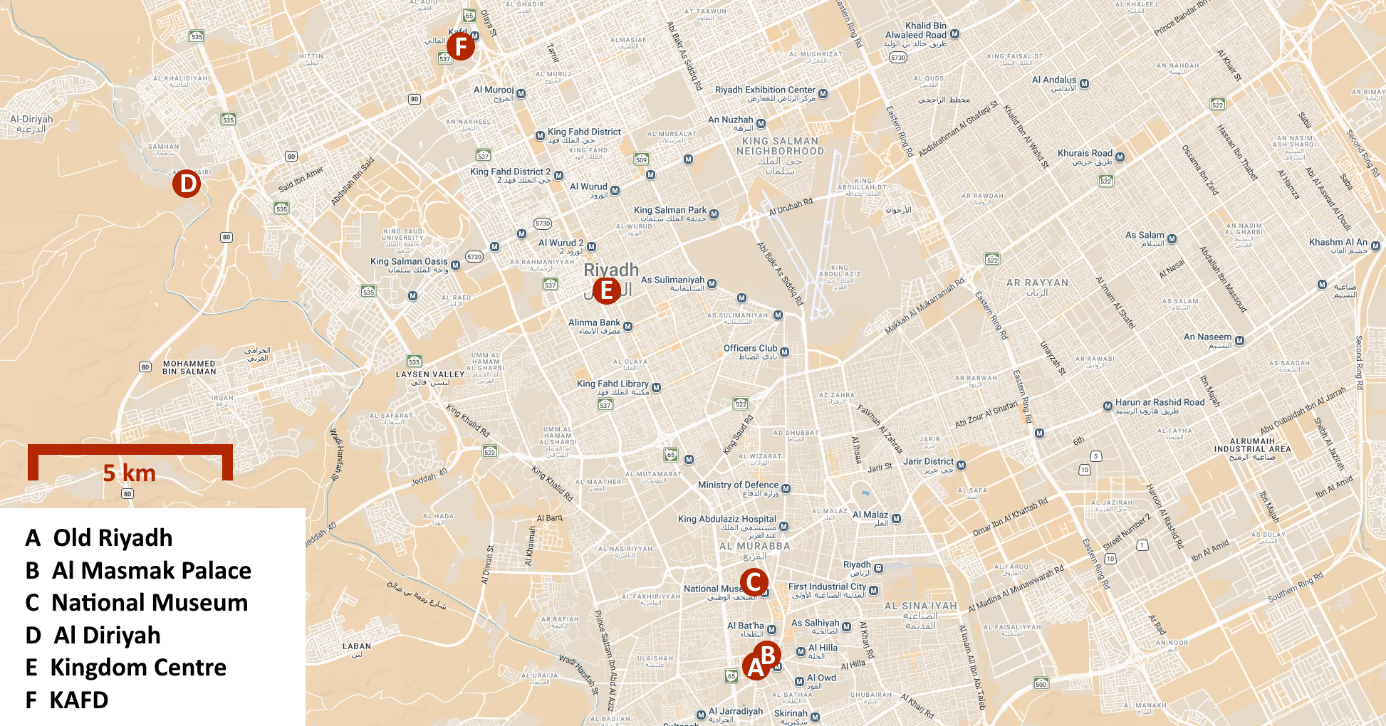
Tuesday 10 February | Old Riyadh – Al Diriyah
Were devout pilgrims in traditional white ihram garments the main people sharing the breakfast room with us in Medina, here it is mostly arms dealers in suits and ties who turn up for breakfast. After all, from 8 to 12 February, Riyadh is hosting the World Defense Show, a major biennial event for the arms industry. Downstairs, in the hotel lobby, they have even set up an Information Desk for the many accredited Exhibitors and Visitors staying here.
When it comes to military equipment, they are not ones to worry about spending an extra oil dollar or two
The Saudis are, after all, major players in the global arms market. When it comes to military equipment, they are not ones to worry about spending an extra oil dollar or two. You can see this on the streets, too. Here and there, digital billboards extol the virtues of SCOPA, a private Saudi defence and security company. Drones, fighter jets, submarines, tanks, artillery – you name it, they make it.
Once again, a brilliant blue sky promises us a pleasant day. Temperatures are not expected to rise above 32 °C (90 °F). An enthusiastic Noura is already waiting for us. Today, she will be our guide. She comes from the south of Saudi Arabia, near the border with Yemen, and is wearing a black abaya with a matching headscarf. As she speaks enthusiastically, the scarf keeps slipping back, revealing strands of her hair, something she seems barely concerned about.
Our first destination today is the old city of Riyadh, once the seat of the Second Saudi State. Later in the day, we will visit Al Diriyah, the birthplace of the First Saudi State, Noura adds. And, just to be clear, the Saudi Arabia we know today is in fact the Third Saudi State, she emphasises.
Three Saudi states – that calls for a little explanation
Three Saudi states – that calls for a little explanation. For centuries, the Arabian Peninsula was a patchwork of tribes, each with its own territory. This fragmentation led to considerable unrest. They were frequently at loggerheads with one another, and there was no question of political unity.
That began to change in the early eighteenth century. Mohammed bin Saud, the leader of one of the most influential Arab tribes, was steadily extending his influence from Al Diriyah and conquering ever more territory. Moreover, in 1744, he formed an alliance with Mohammed bin Abdul Wahhab, an ultra-conservative religious leader who advocated a return to the original, pure form of Islam. It was a win-win situation for both men: Mohammed bin Saud could count on his policies being defended in the mosques, while Mohammed bin Abdul Wahhab saw his teachings spread throughout the peninsula. The effects of this alliance are still felt in Saudi society to this day. The fact that only the strict interpretation of Wahhabism is practised in Saudi Arabia can be traced back to these events.
The fact that only the strict interpretation of Wahhabism is practised in Saudi Arabia can be traced back to these events
Gradually, the Saudis brought most of the Arabian Peninsula under their control. But eventually they overreached by seizing the holy cities of Medina and Mecca from the Ottomans. Worse still, they even dared to have the Ottoman Sultan’s name removed from the Friday prayers. This was something the Sultan could not let pass. He sent his Egyptian viceroy to deal with the Saudis. The siege of Al Diriyah lasted seven months, but eventually the Saudis were forced to surrender. Their capital was razed to the ground. Thus, in 1818, the First Saudi State came to an end.
But the House of Saud was not prepared to give up. Although their capital had been destroyed, they managed to survive in exile. Just six years later, Turki bin Abdullah, grandson of the founding patriarch Mohammed bin Saud, succeeded in driving the Ottomans out of Riyadh. This now became their new capital.
What is more, the Saudis had learnt their lesson. They put their expansionist ambitions on the back burner, but this did not exactly usher in an era of peace and harmony. Instead, they began squabbling among themselves. Internal divisions, succession disputes and regional rivalries allowed their main rivals, the Rashidis, to grow increasingly powerful and eventually drive the Saudis out of Riyadh. Thus, in 1893, the Second Saudi State came to an end.
But the Saudis still refused to give up. Third time’s the charm, as the saying goes. A man by the name of Abdulaziz was destined to succeed where the others had failed. His full name was Abdulaziz ibn Abdul Rahman ibn Faisal ibn Turki ibn Abdullah ibn Mohammed Al Saud. The astute reader will readily deduce that Abdulaziz was the great-great-great-grandson of the founding patriarch, Mohammed Al Saud.
Abdulaziz had an estimated 22 wives in total – though never more than four at a time, Noura reassuringly adds, as Islam does not permit more than that
Abdulaziz must have been quite a remarkable man, because the ease with which he eventually conquered the Arabian Peninsula was due in part to his popularity among the local population. But it was also a question of courage and sheer audacity. With just 72 loyal followers, he managed to recapture Riyadh in 1902, Noura explains proudly. What is more, she adds, there were eventually just six of them waiting at the gate of the Masmak Palace to ambush and kill the leader of the Rashidis as he emerged from his stronghold on his way to the mosque. This laid the foundations for the Third Saudi State.
Over time, Abdulaziz managed to extend and consolidate his authority across the Arabian Peninsula. To achieve this, he relied not only on a strong, well-trained army, but also on religious and political networks and tribal alliances. Marriage, too, played an important role. Abdulaziz had an estimated 22 wives in total – though never more than four at a time, Noura reassuringly adds, as Islam does not permit more than that. By marrying women from other tribes, Abdulaziz was able to strengthen ties and promote unity throughout the country.
But this also exposes a structural flaw in the way dynastic succession is traditionally organised among Arab tribes. When a ruler dies, it is not his eldest son who succeeds him, but his eldest surviving brother. Only once that line has been exhausted does the next generation come into the picture.
The man currently in power is therefore still the son of a man born in 1876
And that line of succession can be a long one. Abdulaziz was certainly thorough in this respect. He had a total of 45 sons, 36 of whom survived into adulthood. Even at the age of 77, Abdulaziz still managed to delight the nation with the birth of another prince. There can be no denying that the good man gave his all for his country throughout his life.
As a result, ever since Abdulaziz’s death in 1953, every ruler of Saudi Arabia has been one of his sons – Saud, Faisal, Khalid, Fahd, Abdullah and Salman. The man currently (2026) in power is therefore still the son of a man born in 1876. A veritable gerontocracy, in other words.
Occasionally, someone tries to put a stop to this and claim a place for himself, as happened in 1975, for example, when King Faisal was murdered by one of his nephews. But the system closed ranks, the nephew was executed, and Khalid succeeded his half-brother Faisal.
Nevertheless, a turning point seems to have arrived. In June 2017, the then 82-year-old King Salman appointed his own son, Mohammed bin Salman – better known as MBS – as Crown Prince, leaving his contemporaries behind. In practice, MBS now holds all the strings.
When Abdulaziz declared the country’s independence in 1932, he did not hesitate to tie its official name irrevocably to his family name. For this is not the land of the Rashidis or any other tribe. No, this is the land of the House of Saud – Saudi Arabia. In the same way, Belgium could be called Saxe-Coburgia and the USA the United States of Trump.
In practice, MBS now holds all the strings
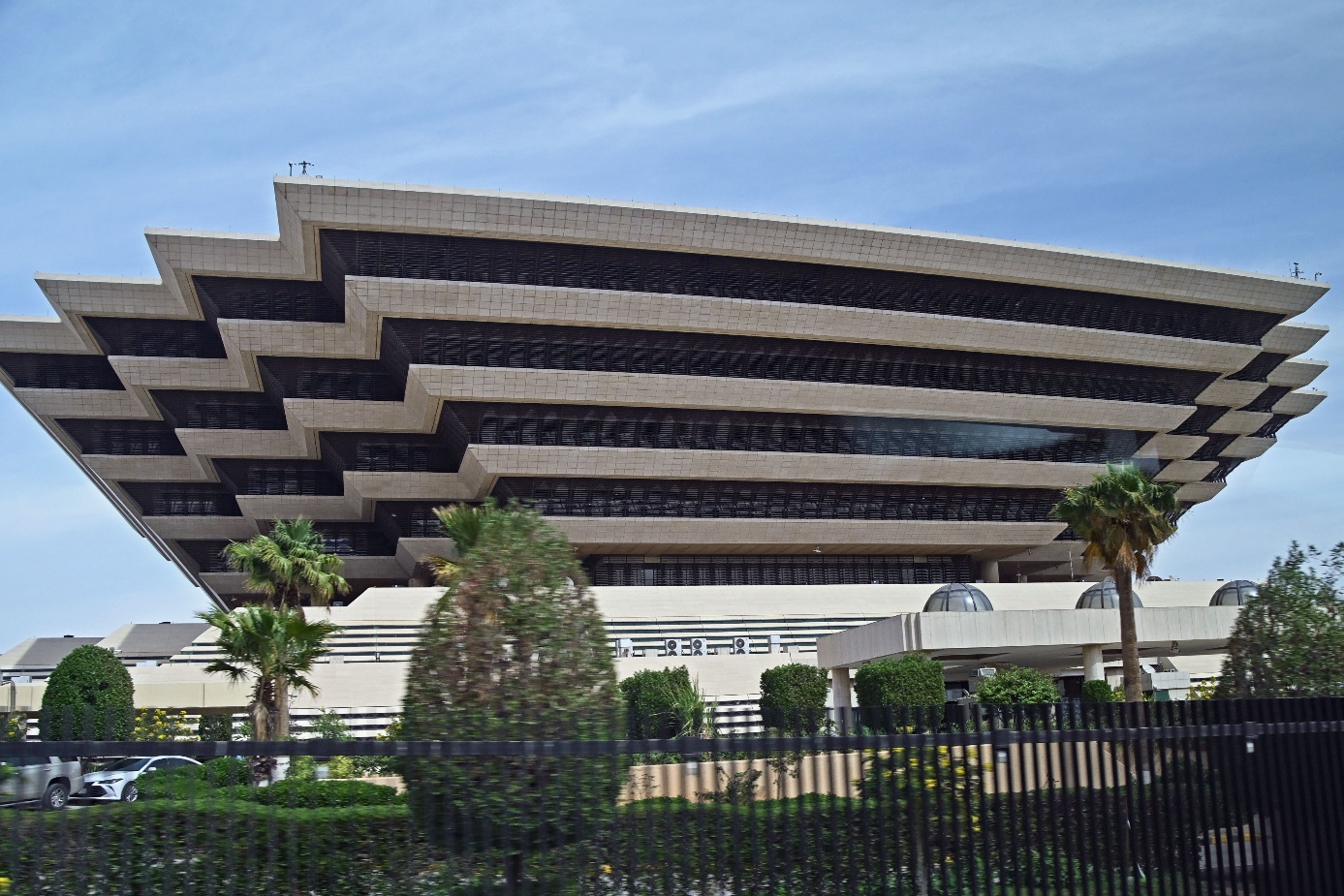
Ministry of the Interior
Everything seemed to suggest that Saudi Arabia would remain a poor and insignificant country, playing hardly any role on the world stage. Barely six years later, however, everything changed. And how! After almost five years of exploration, oil was finally discovered in the east of the country, near Bahrain, on 3 March 1938. The well near Dammam where the discovery was made has been known ever since as Well No. 7, or Prosperity Well. Saudi Arabia grew into the world's largest oil exporter and is second only to Venezuela in terms of the size of its proven oil reserves.
Meanwhile, we are heading towards the old part of the city, where the centre of power of the Second Saudi State took shape during the nineteenth century. It was no coincidence that Riyadh played such a prominent role from the outset in the country's journey towards independence. Like so many cities on the peninsula, it owed its influence to its strategic position along the caravan routes. All the major trade routes – carrying spices, incense and silk – passed through Riyadh.
Shortly after independence, in 1935, the city had a population of around 31,500. By 1972, that figure had already reached half a million. Today, it stands at approximately eight million. And still they are not satisfied, because according to Noura, MBS is aiming for a population of ten million by 2030. Whether that target is still achievable seems highly doubtful to us.
It almost seems as though Riyadh's skyline has developed around this busy thoroughfare
Olaya Towers |
|
King Abdoullah Financial District (KAFD) |
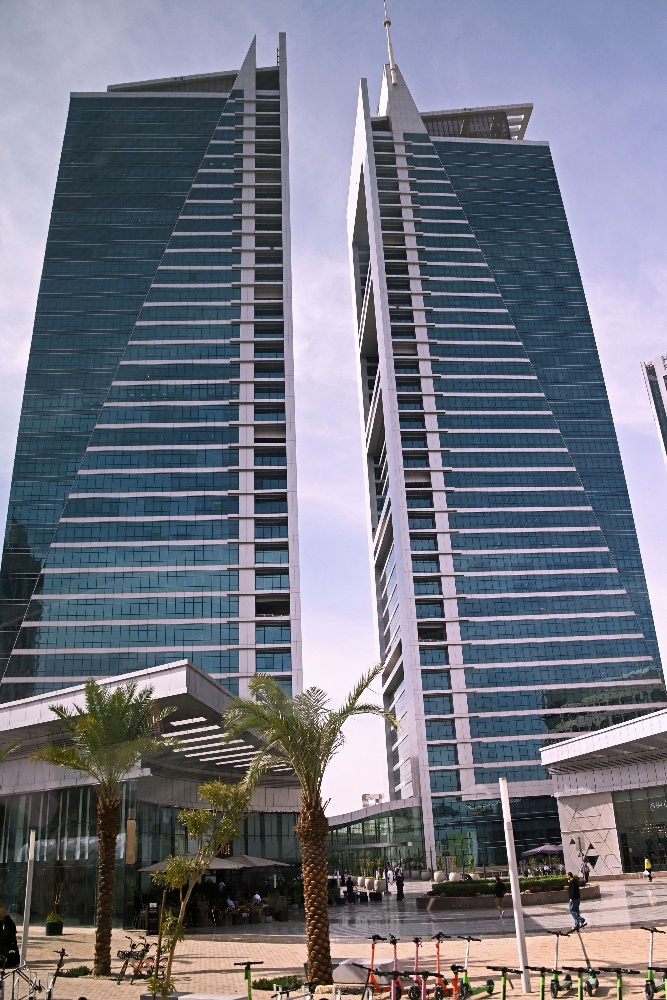
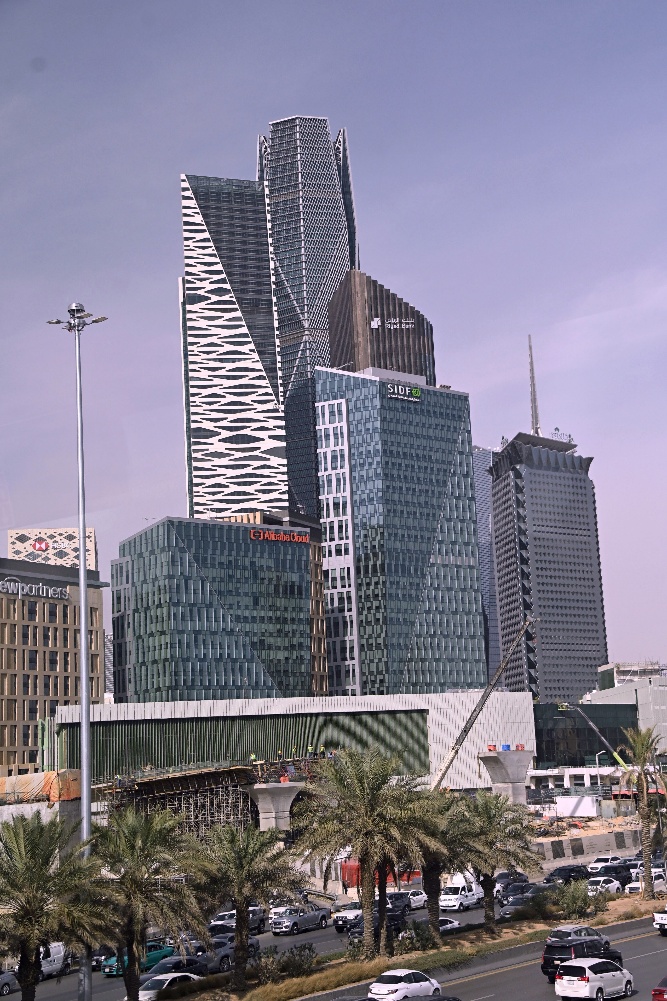
There is certainly no shortage of space in Riyadh to accommodate all these people. After all, in the desert, a few extra kilometres here or there hardly matter. The city is estimated to stretch some 70 to 80 kilometres from north to south. For us, it is a drive of more than twenty kilometres, right through the city centre, to reach Old Riyadh.
Yet the journey is remarkably smooth, thanks to the broad King Fahd Road. What is more, it almost seems as though Riyadh's skyline has developed around this busy thoroughfare. One by one, some of the city's most impressive skyscrapers slide past our window.
Al Faisaliah Tower |
|
Boudl Tower |
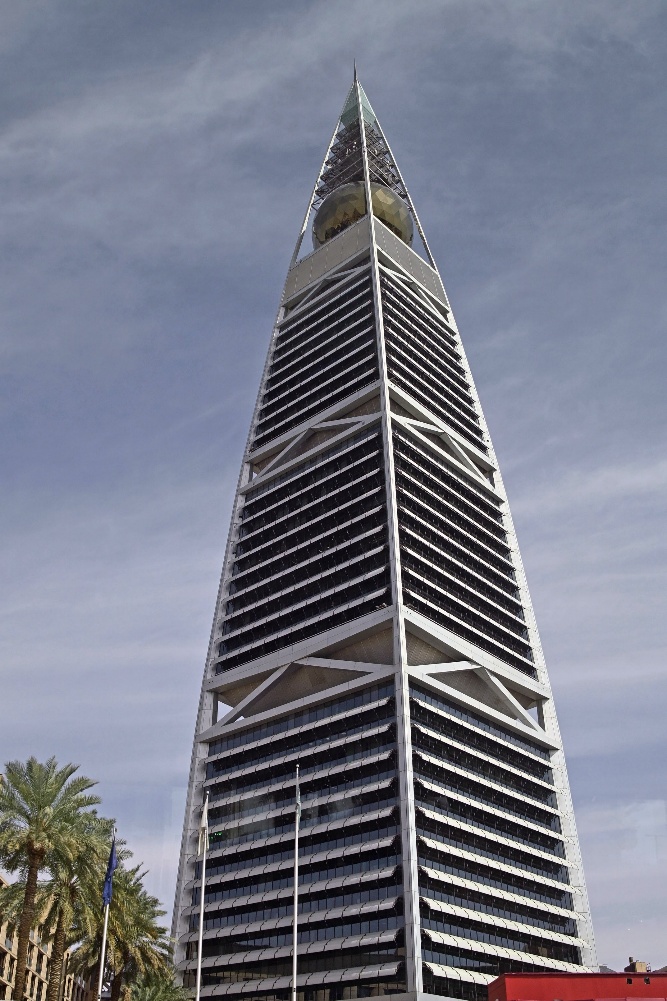
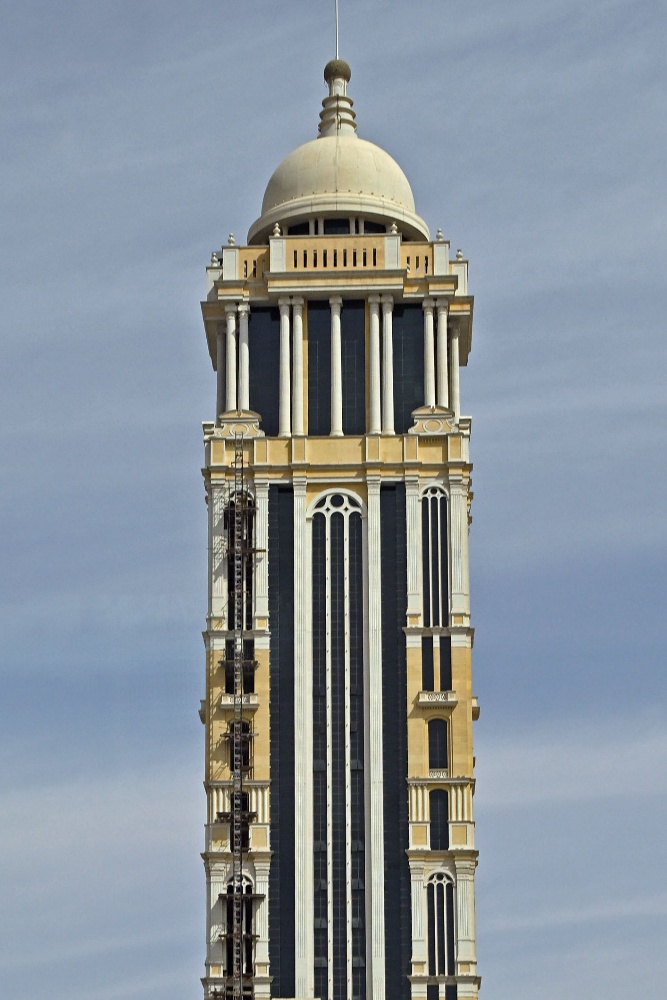
One such landmark is the Ministry of the Interior building – an inverted truncated square pyramid. Or take the Al Faisaliah Tower, completed as recently as 2000 and yet already the oldest skyscraper in Riyadh. Its design was inspired by the minaret of the Umar ibn al-Khattab Mosque in Dumat al-Jandal. What catches our eye most, however, is the copper-coloured sphere right at the top. And, unsurprisingly, it houses a restaurant offering panoramic views across the city. A rather unusual sight amid all this ultra-modern architecture is the Boudl Tower, with its blend of Beaux-Arts and neoclassical architectural features.
Whichever way you look, the silhouettes of gigantic tower cranes stand out sharply against the blue sky
Construction cranes in Riyadh |
|
Steel tree canopies |
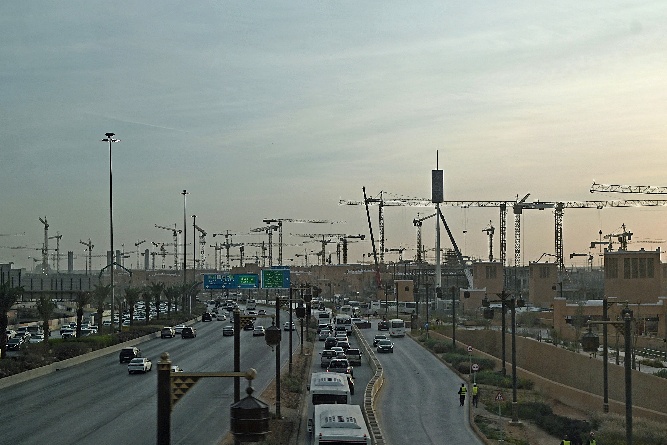
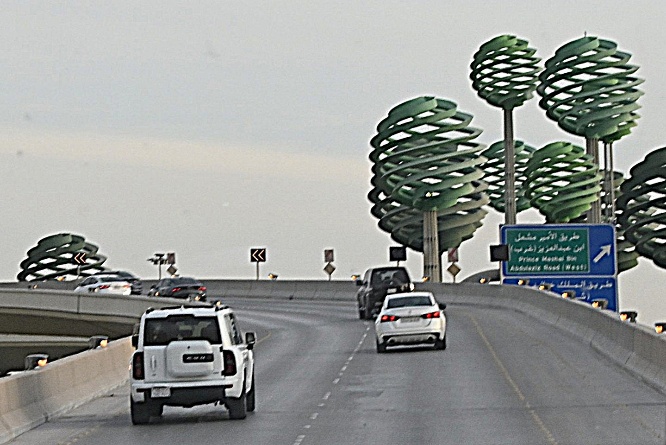
Whichever way you look, the silhouettes of gigantic tower cranes stand out sharply against the blue sky. Riyadh's construction boom seems to know no end. But it is not just skyscrapers that are springing up like mushrooms here. Right in the heart of the city, work is under way on King Salman Park – four times the size of Central Park in New York. A million trees are to be planted there, not only to increase the amount of green space but also to combat the urban heat-island effect. Further outside the city, on the slopes of Jabal Tuwaiq, Qiddiya City is taking shape. This is a vast tourism development dedicated entirely to entertainment, culture and sport. Its organisers hope to welcome no fewer than… 17 million visitors a year. And then there are the six brand-new football stadiums that are due to be ready for the 2034 FIFA World Cup.
The surroundings look very different when we are dropped off in Old Riyadh, the district that more or less coincides with the original walled city. No ultra-modern high-rises here, but rather sand-coloured buildings, most of them inspired by traditional Najdi architecture.
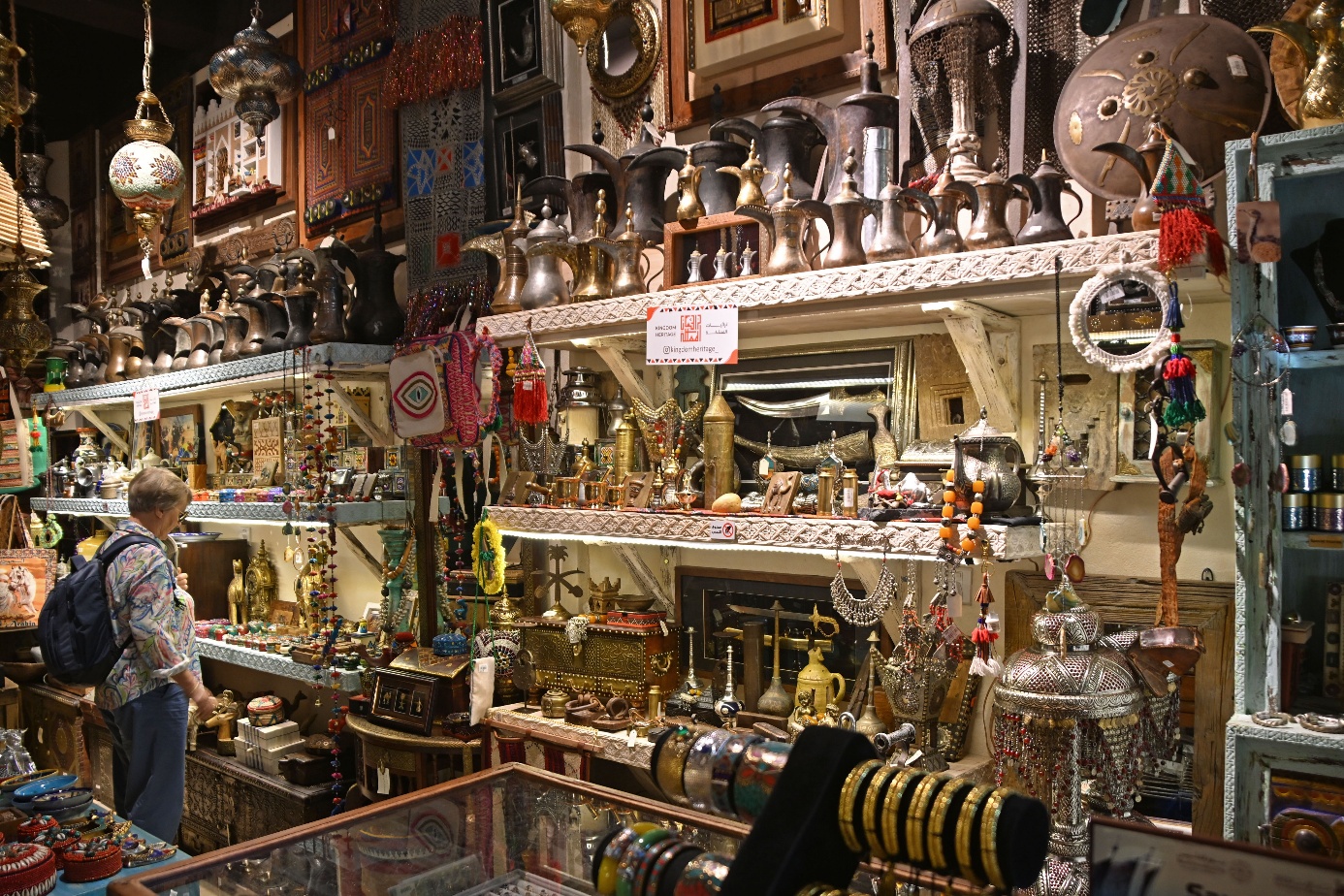
Noura promptly leads us to the Swaigah Trade Center, which specialises in abayas, cosmetics and traditional perfumes made with oil rather than alcohol. We cannot help noticing two ragged-looking children wandering barefoot around the open gallery, with litter scattered here and there. This is something we have not encountered before in the otherwise spotless city of Riyadh.
Just as in the West you are expected to wear a suit and tie for certain formal occasions, here the equivalent is the thobe
But it is a menswear shop that Noura particularly wants to draw our attention to. Most Arab men wear a thobe, a long-sleeved robe that reaches down to the ankles. It reminds us that we need to be careful when looking for the toilets, as the distinction is sometimes indicated by pictograms showing a man wearing a thobe and a woman wearing an abaya. The difference is rather subtle.
In summer, the thobe is generally made of white polyester fabric, while in winter it is usually made of coloured wool. In any case, it is more than just an item of clothing: it is a symbol of national and cultural identity. Just as in the West you are expected to wear a suit and tie for certain formal occasions, here the equivalent is wearing a thobe. On very special occasions, some men also wear a bisht over it, a traditional dark outer cloak made of camel hair or sheep's wool.
In ancient Mesopotamia, men used to wear their fishing nets on their heads. This eventually gave rise to a headscarf featuring a fishing-net pattern
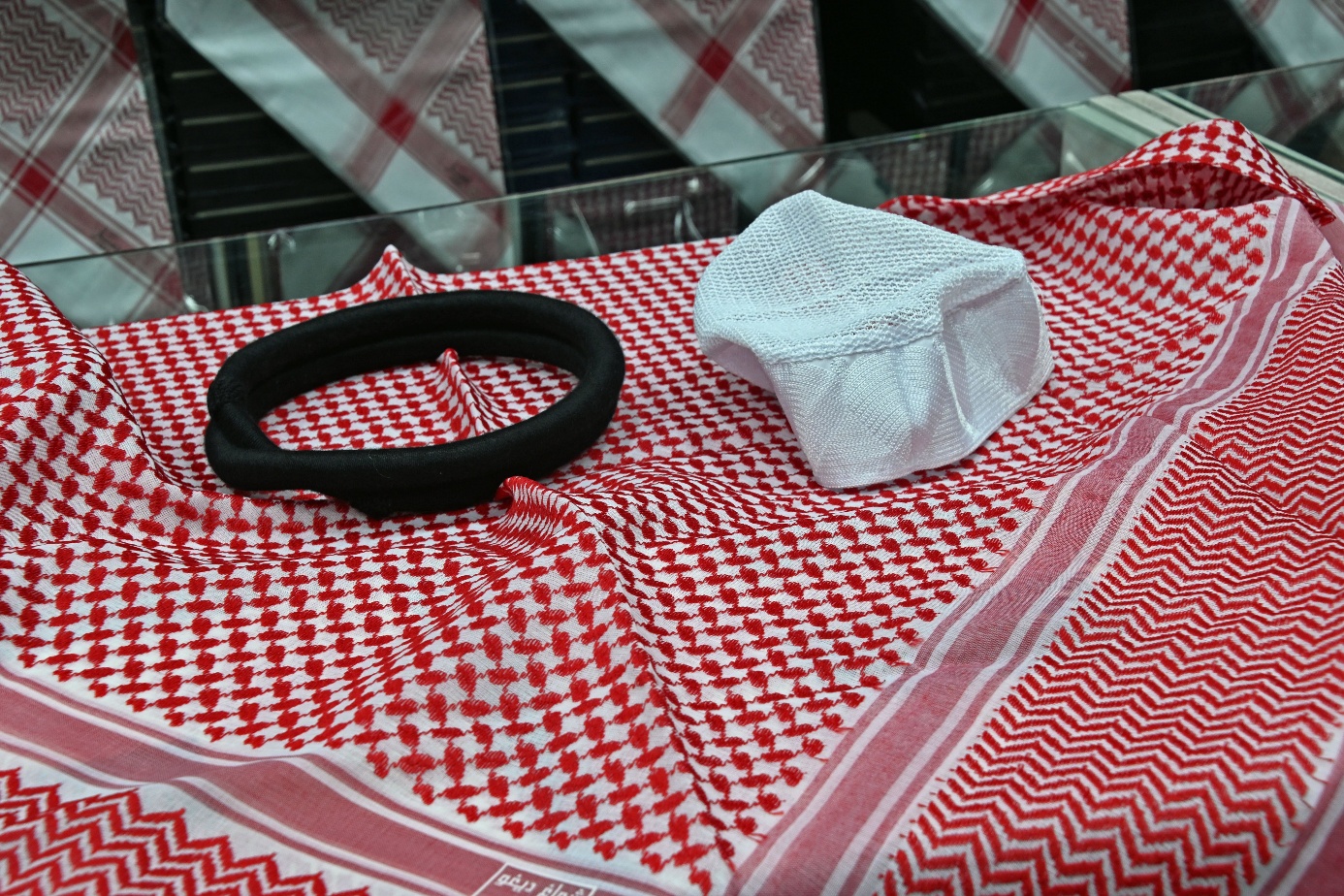
Shemagh, agal and taqiyah
Naturally, this outfit is always accompanied by a headscarf, known as the shemagh, better known to us as the keffiyeh. The name derives from the city of Kufa in what is now Iraq. The keffiyeh was already in use among the Sumerians in ancient Mesopotamia, the land between the Tigris and Euphrates rivers. Men used to wear their fishing nets on their heads. This eventually gave rise to a headscarf featuring a fishing-net pattern. The design often included two broad lines as well, representing the Tigris and Euphrates, with waves of water in between. Sometimes these lines were also associated with the trade routes.
From 1936 onwards, the black-and-white version of the keffiyeh became a symbol of the Palestinian uprising. Hence the name 'Arafat scarf'
Originally, the shemagh served purely a practical purpose: protecting the wearer from the scorching sun, blowing sand, dust and cold desert nights. Gradually, however, it acquired a symbolic significance too. In Saudi Arabia, the black pattern was replaced by a red one. Noura describes red as the colour of blood, symbolising courage and bravery. From 1936 onwards, the black-and-white version of the keffiyeh even became a symbol of the Palestinian uprising. Hence the name Arafat scarf.
If you want to keep the shemagh firmly in place, you first put a small white cap on your head, known as a taqiyah. You then secure it with an agal, a traditional double black cord made from goat hair. In less formal settings, men often wear just a white taqiyah, sometimes crocheted. This is more an expression of devotion to the Islamic faith, comparable to the Jewish skullcap or kippah.
Impressive caravans laden with spices, incense and silk would emerge from the desert and gather outside the city gates
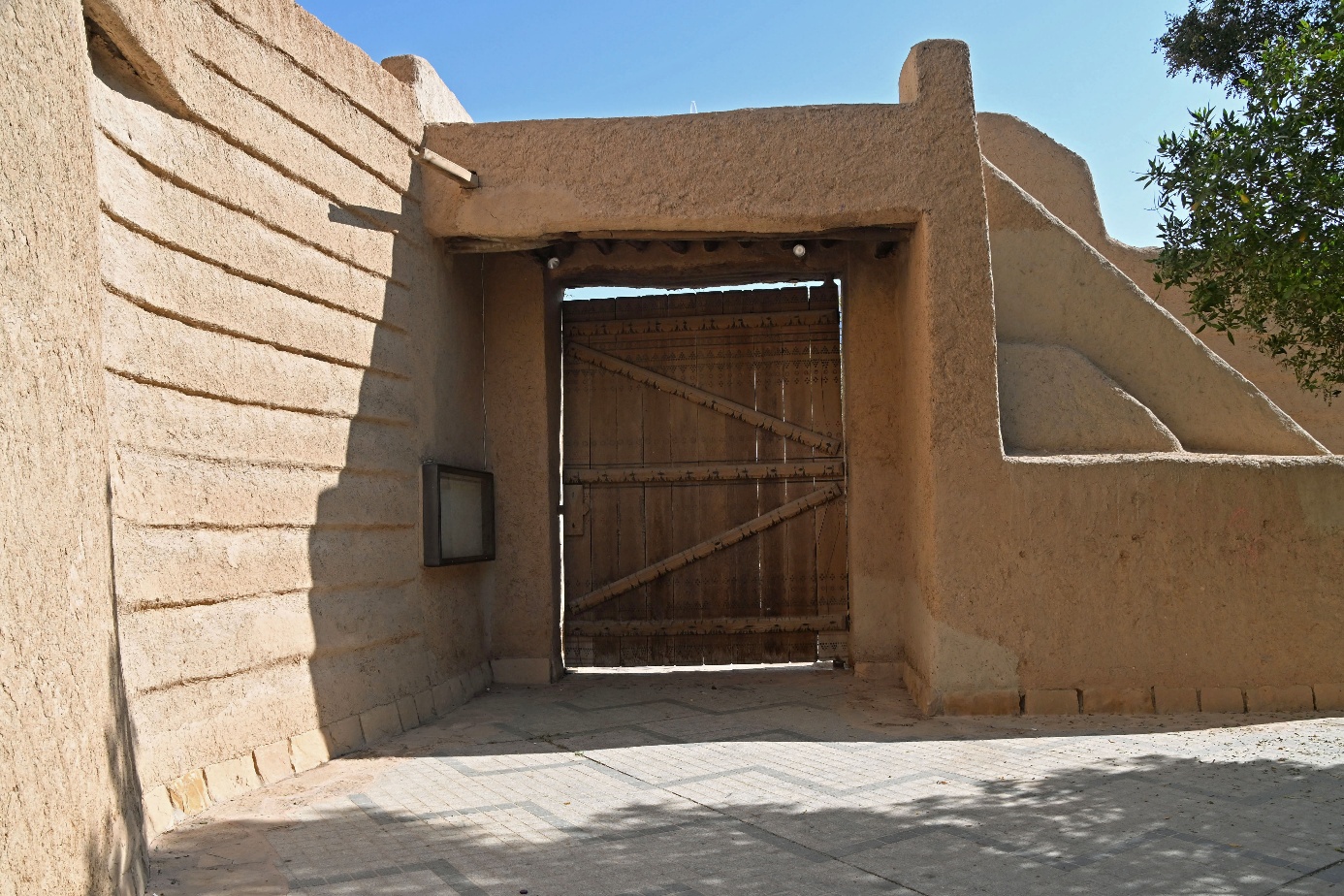
Al Thumairi Gate
We are actually now in Al Thumairi Souq, the oldest souq in Riyadh. Historically, however, not much of it remains. Only the rather modest wooden Al Thumairi Gate still recalls an era when impressive caravans laden with spices, incense and silk would emerge from the desert and gather outside the city gates.
Al Masmak literally means the thick one or the sturdy one. With its gigantic mud-brick walls, stone foundations and four massive corner towers, this palace was considered virtually indestructible
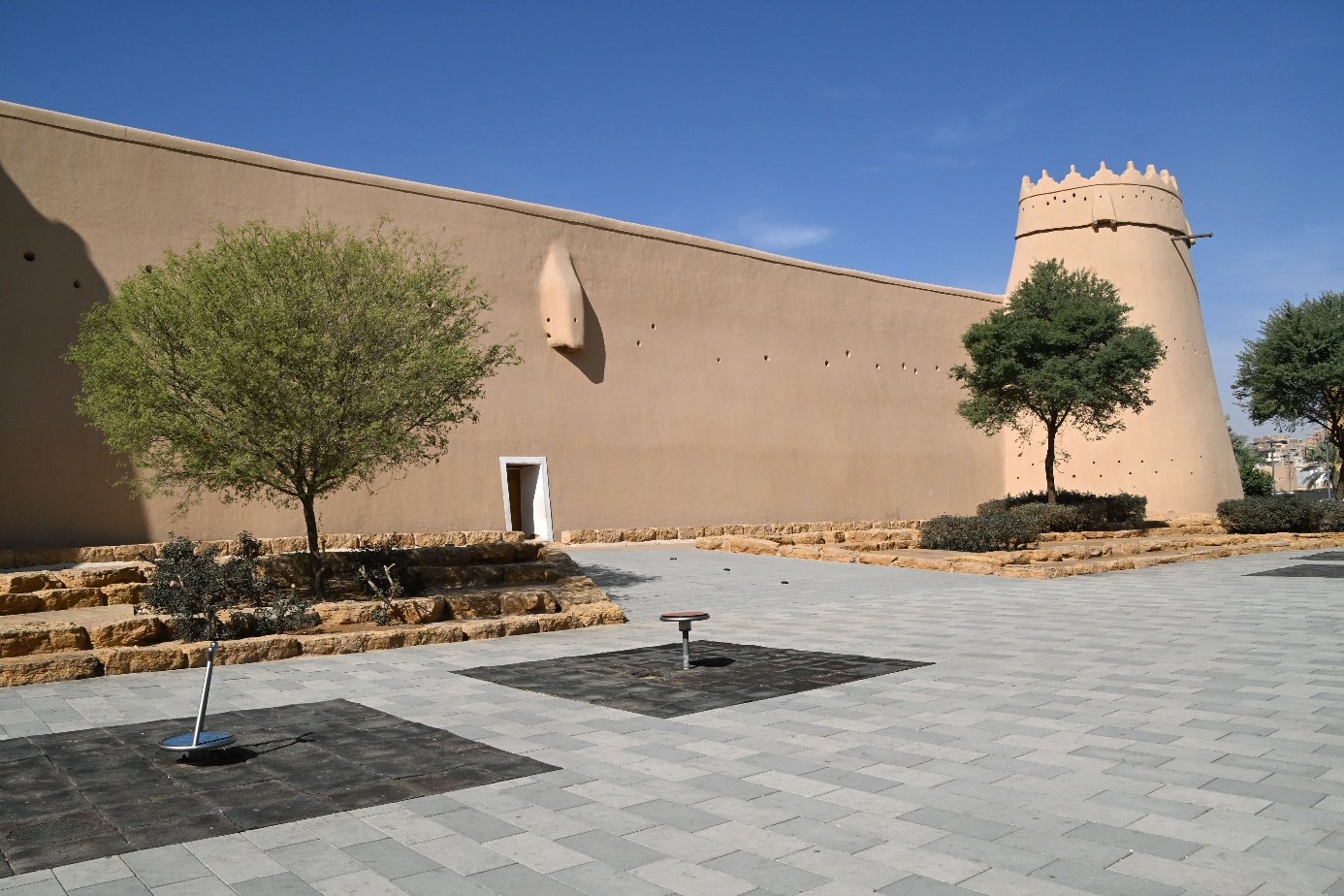
Al Masmak Palace
The nearby Al Masmak Palace, on the other hand, has remained virtually intact throughout all these years. It dates back to around 1865, during the Second Saudi State. Unfortunately, it is currently closed for renovation. That does not prevent us from admiring the building from the outside. After all, Al Masmak literally means the thick one or the sturdy one. With its gigantic mud-brick walls, stone foundations and four massive corner towers, this palace was considered virtually indestructible.
Noura takes us to the western entrance of the palace. This is where the incident took place in 1902 that would herald the beginning of the Third Saudi State.
|
|
|
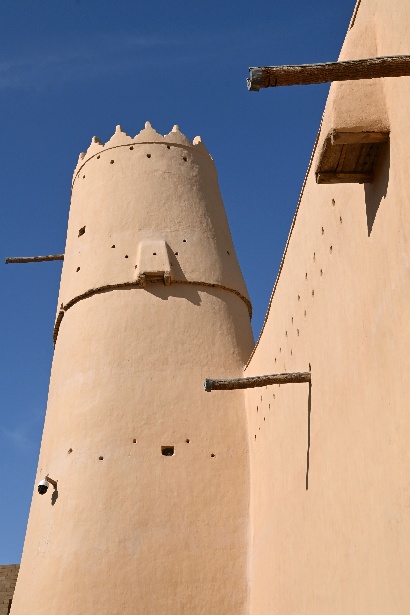
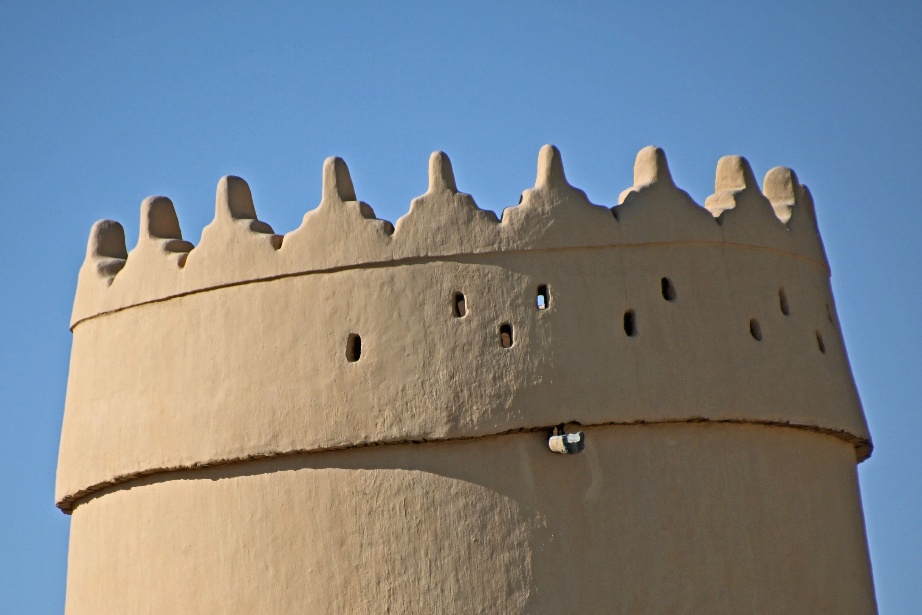
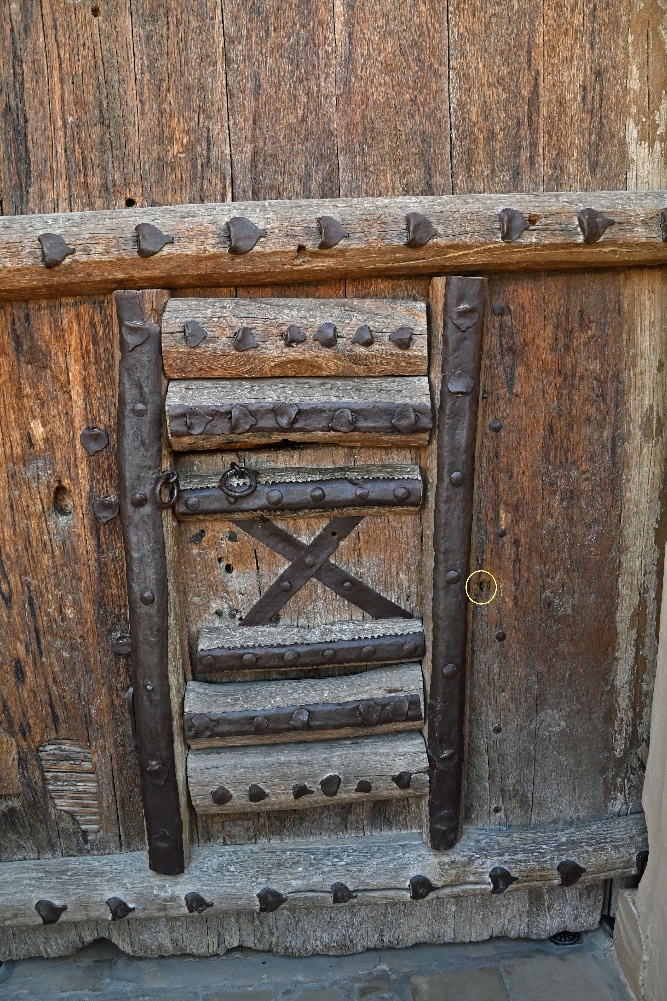
In 1893, the Rashidis had driven the Saudis out of the city, bringing the Second Saudi State to an end. But this situation was not to last long. As early as 1902, Abdulaziz appeared at the city gates with his army of 72 loyal followers. The city's governor was killed outside the gates of his own fortress. Noura points to the simple wooden gate and shows us the spot where the tip of a spear, which narrowly missed the governor, can still be seen. It proved to be a turning point in the country's history. Thirty years later, on 23 September 1932, Abdulaziz would declare the independence of his Saudi Arabia.
The black bisht with gold trim and the gold-coloured agal make it clear that we are looking at a sharif
Gate with tip of a spear (yellow circle) |
|
Sharif |
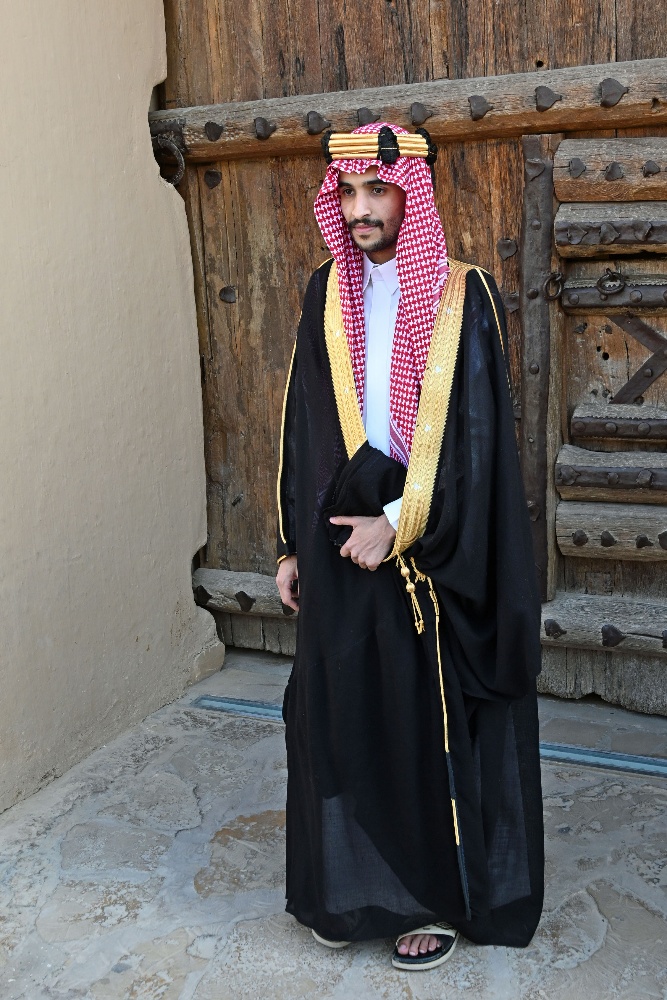
While we are listening to Noura's story, a man appears in full ceremonial attire: a black bisht with gold trim worn over his white thobe, and a gold-coloured agal on his head. These distinctive garments make it clear that we are looking at a sharif, a man (or woman) who claims descent from the Prophet Mohammed. Although this is not always easy to verify, as in practice the term is sometimes interpreted rather loosely.
A large Saudi flag flies over the square. It has a green background – the colour of Islam – and bears the Islamic declaration of faith in white lettering: There is no god but Allah; Mohammed is the Messenger of Allah. Beneath it is a sword, symbolising justice.
Public beheadings took place at the notorious Deera Square until 2022
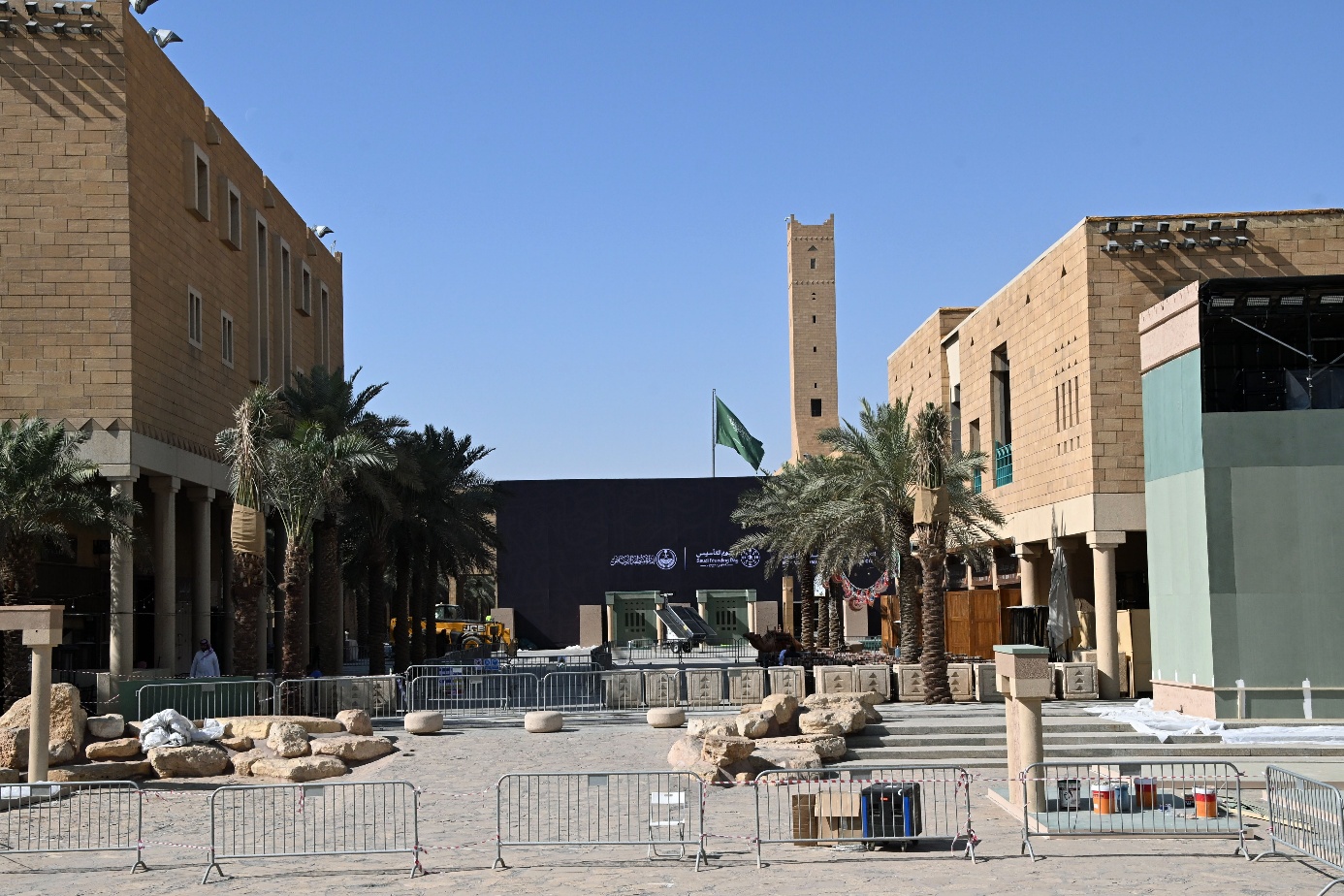
Deera Square (in the background)
And that last point is meant quite literally. For when we turn our backs on the palace, we find ourselves looking out over the notorious Deera Square. This is where public beheadings took place until 2022. In the West, it has acquired the grim nickname Chop Chop Square. It is the only square in Riyadh with a drainage system – designed to wash away the blood.
After the beheading, the deceased's head was sewn back onto the body
Beheading is used as a punishment for offences such as murder, adultery, sodomy, drug offences, witchcraft and sorcery. Evidence often included confessions obtained under torture. The executions were not announced in advance. They frequently took place on Fridays, when large numbers of unsuspecting people happened to be present in the square. Since 2015, photography and filming have been strictly prohibited. After the beheading, the deceased's head was sewn back onto the body. The body was then wrapped in a shroud so that the appropriate burial rites could be performed.
The fact that no executions have taken place in the square since 2022 does not mean that executions by the sword have ceased altogether. On 12 March 2022, 81 people were executed in a single day. Over the course of last year (2025), at least 356 beheadings took place – a new record. These days, the authorities simply make less of a public announcement about them. Apparently, MBS considers discretion on this matter better for the country's image.
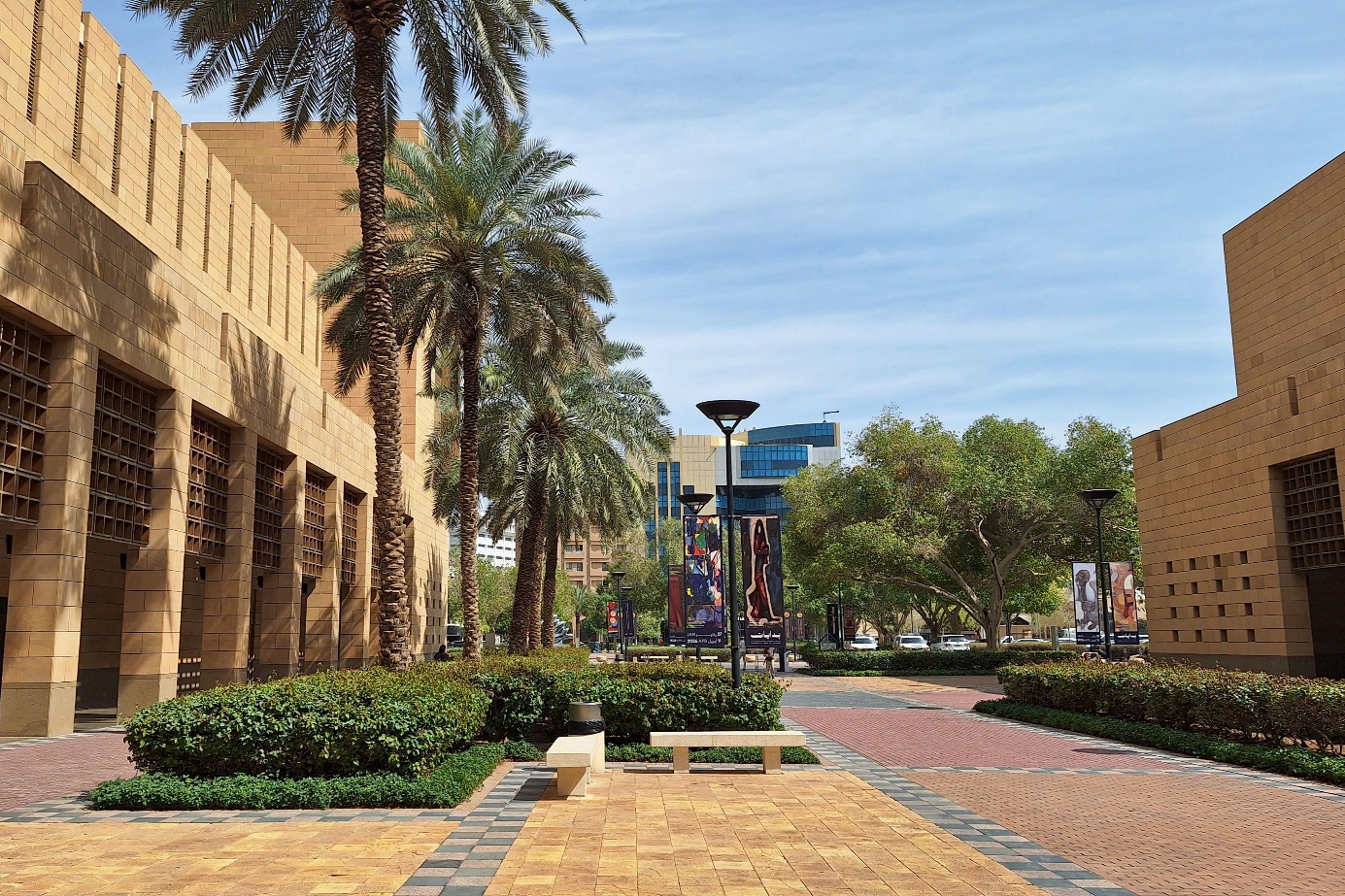
National Museum of Saudi Arabia
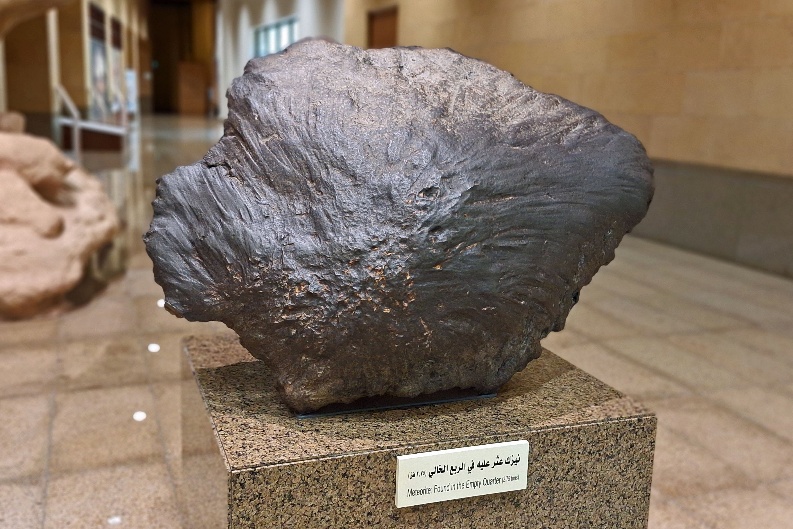
Our next destination is the National Museum of Saudi Arabia. Among other things, we come across an enormous meteorite that fell in the Rub' al Khali, the vast desert in the south of the country, some four hundred years ago. The thing weighs almost three tonnes (6,600 lb). The impact must have been tremendous, as evidenced by the Wabar Crater, measuring 61 metres in diameter, which it left behind.
The desert rose is not a flower in the literal sense, but a crystalline formation consisting of a mixture of gypsum and sand grains
Wabar Crater meteorite |
|
Desert rose |
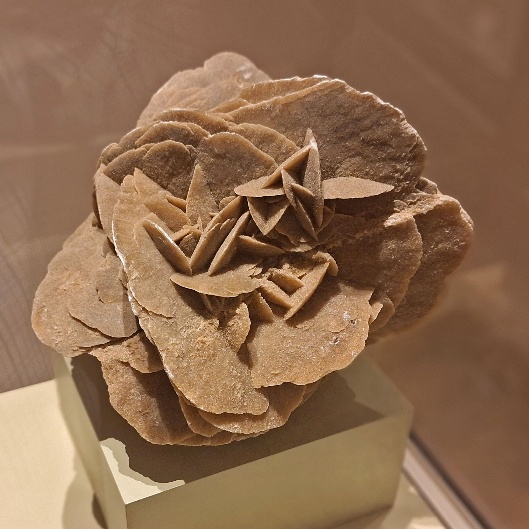
Another remarkable phenomenon from the desert is the desert rose. Despite its name, it is not a flower in the literal sense, but a crystalline formation consisting of a mixture of gypsum and sand grains. Such formations can develop when gypsum-rich water evaporates in a dry, sandy environment. As the gypsum crystallises, sand grains gradually become embedded in the structure.
Beneath its trunk, Platybelodon had tusks that had evolved into blade-like structures, allowing it to cut through branches and tree bark
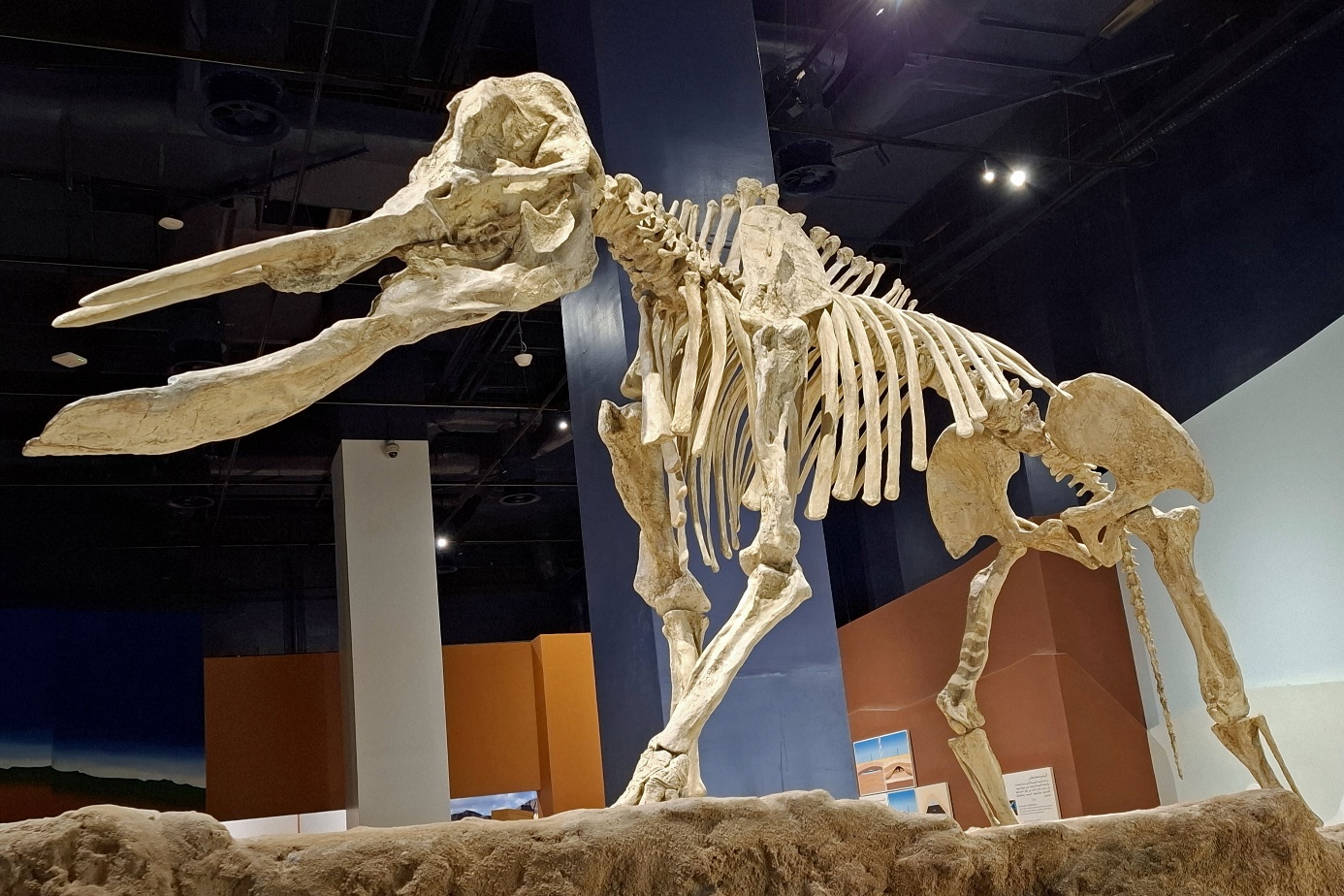
Platybelodon
Particularly impressive is the complete skeleton of a Platybelodon. This imposing creature must have lived some 15 to 17 million years ago. It looks like an elephant, but that is only half the story. Beneath its trunk, it had tusks that had evolved into blade-like structures, allowing it to cut through branches and tree bark.
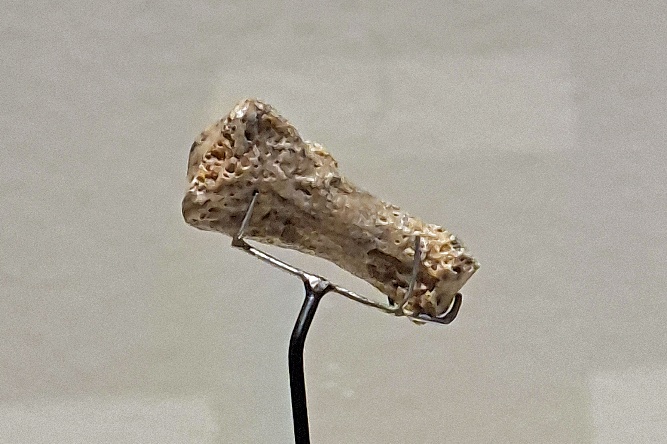
This is also where we can admire the famous finger bone from Tayma. It is nothing more than the middle bone of a middle finger, barely 3.2 cm (1.26 inch) long. Yet in 2016, it turned the world of palaeontology upside down. The bone turned out to be approximately 88,000 years old and, remarkably, belonged to a Homo sapiens. This meant that the prevailing theory about the migration of Homo sapiens out of Africa had to be revised.
Did we imagine that the Arabian Peninsula was a desert region where civilisations could never have flourished? Well, we could hardly have been more mistaken
Homo sapiens finger bone (88,000 years old) |
|
Inscribed stone slabs (Tabuk) |
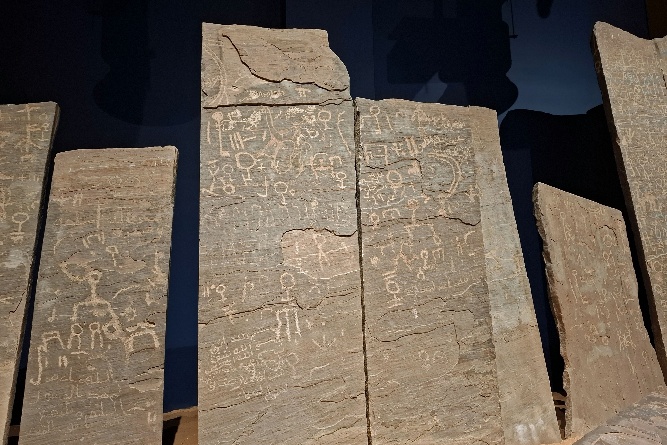
But perhaps the biggest surprise is the sheer variety of cultures we encounter in the gallery devoted to the Arabian kingdoms. Did we imagine that the Arabian Peninsula was simply a desert region covering 2.1 million square kilometres, where civilisations could never have flourished? Well, we could hardly have been more mistaken.
Take, for example, the mysterious stone slabs, standing four metres tall, from the area around Tabuk in the north-west of the country. They were erected there 6,000 years ago. Who put them there, and why, remains a matter of debate among archaeologists. Yet they must have had some special significance, given the enormous number of artistic depictions of animals and people, as well as the many ancient forms of writing carved into the slabs.
Rock with the Seven Hands |
|
Bearded man (Sarat Abidah) |
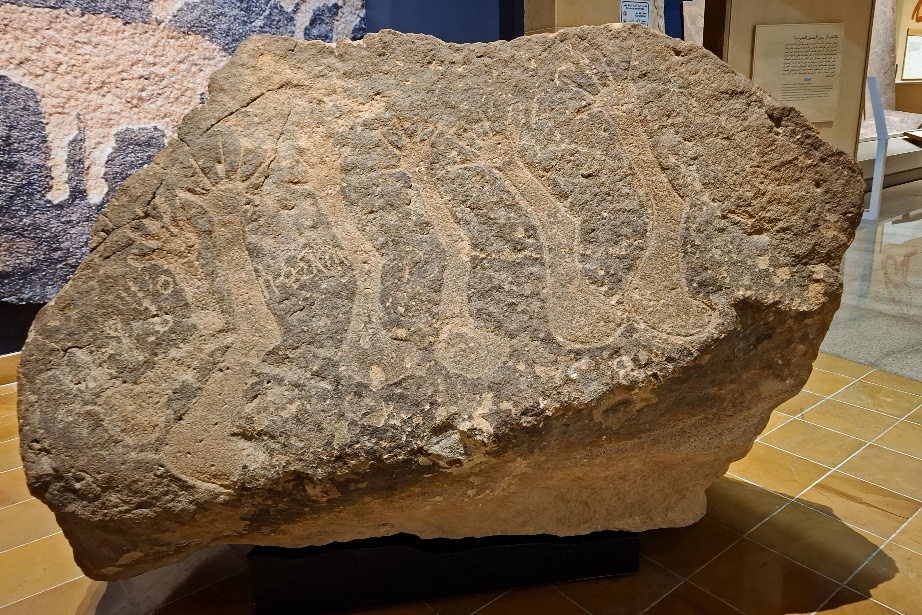
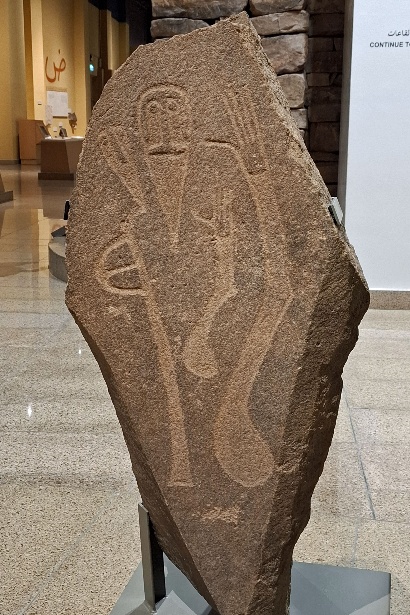
The Rock with the Seven Hands dates from a somewhat later period – around 2000 BCE. It was discovered at Bir Hima, a rich archaeological site close to the border with Yemen. This rather bizarre depiction shows six detached arms, complete with shoulder joints. A seventh example can be seen on the reverse. A few letters in the Thamudic script have also been added.
More or less contemporary is the surprisingly modern-looking depiction of a bearded man on a basalt stone. This was discovered at Sarat Abidah, some 200 kilometres (124 miles) from Bir Hima. The connection with the rock at Bir Hima is obvious, as the detached arms feature here too.
For the Arabs, the Battle of Qarqar was a turning point – for it was then that they suddenly made their appearance on the world stage
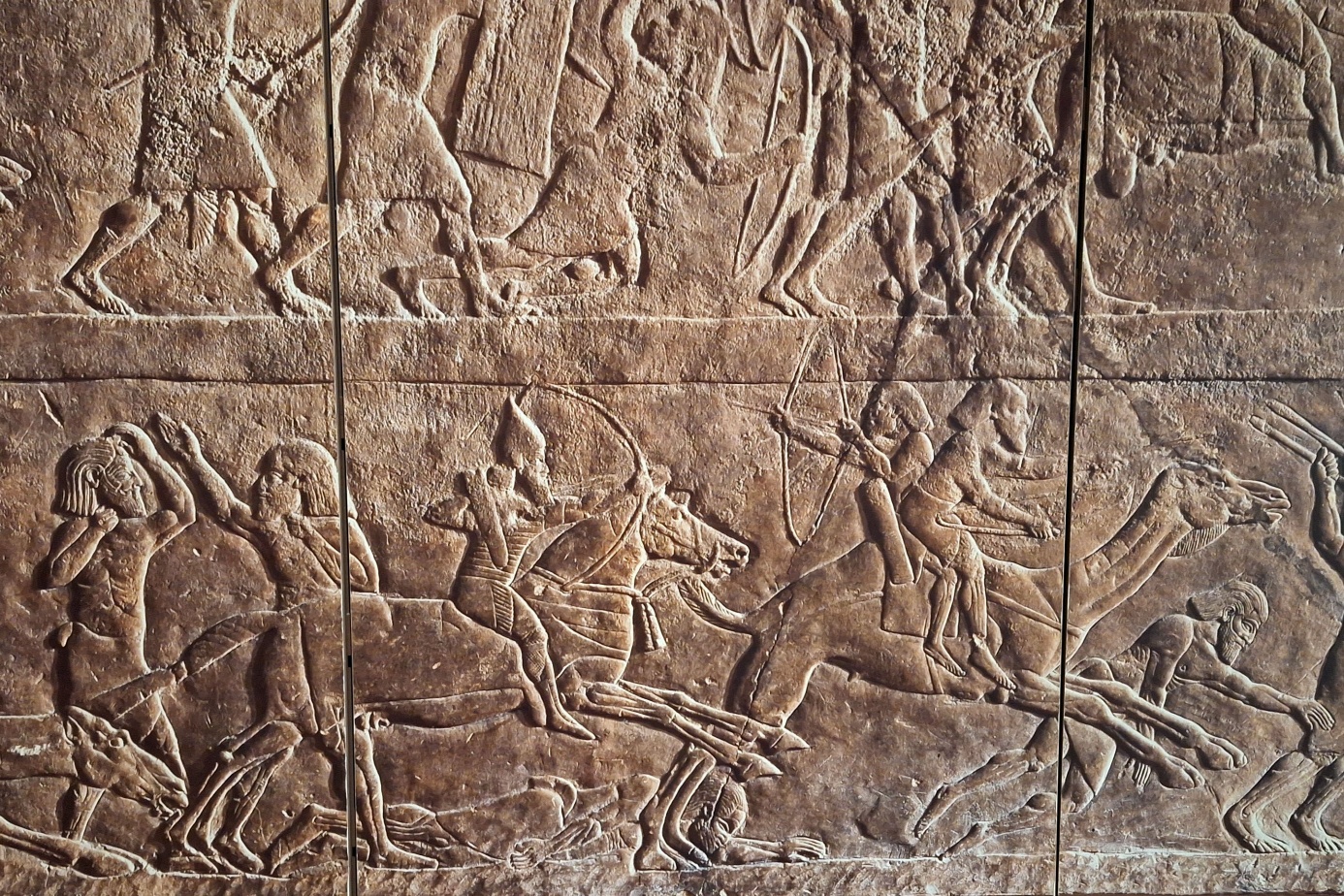
Assyrian horsemen pursuing Arab camel riders
An Assyrian relief shows Arab warriors on camels being pursued by Assyrian horsemen. The Assyrians appear to have the upper hand. But this is pure propaganda, because it was the Assyrians who came off second best at the Battle of Qarqar in 853 BCE. Even so, this battle marked a turning point for the Arabs. Until then, the historical sources had been dominated by Egyptians, Hittites, Assyrians, Babylonians, Medes and Persians. Now, those mysterious Arabs from the desert were suddenly making their presence felt on the world stage too.
Some even see a resemblance between this minimalist style and the early Cubist art of Pablo Picasso
The goddess Al-Uzza (Nabataeans) |
|
Thaj gold treasure |
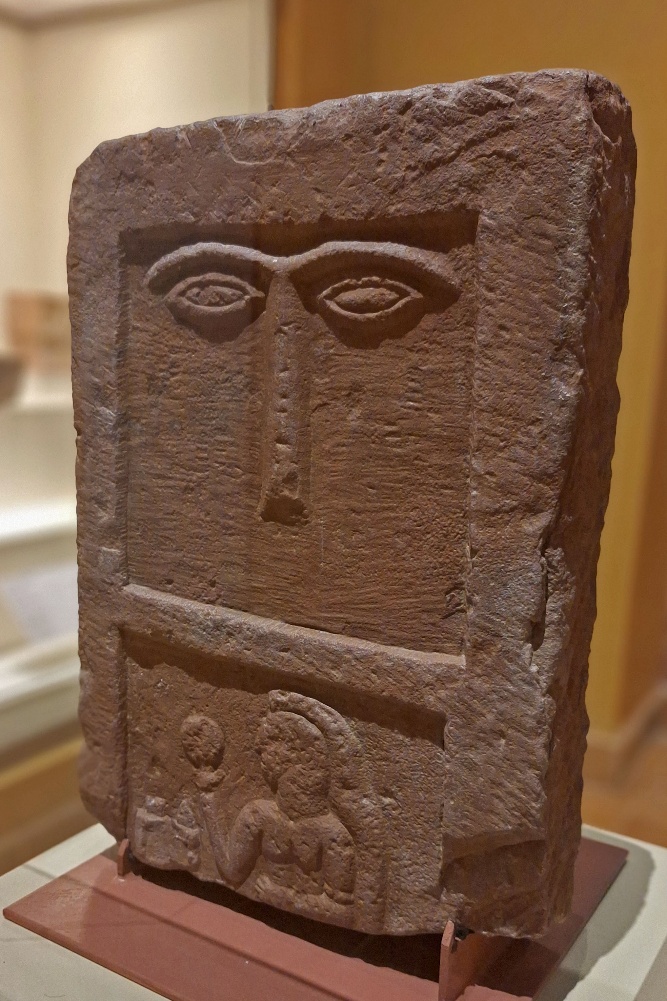
The Nabataeans, of course, could not be left out. Initially, they did not depict their gods in human form. That began to change from the first century BCE onwards. Even then, however, they restricted themselves to the bare essentials. A depiction of Al-Uzza, for example, one of the most important deities in the Nabataean pantheon, is reduced to two almond-shaped eyes and a long, narrow nose. Some even see a resemblance between this minimalist style and the early Cubist art of Pablo Picasso.
The fact that Hellenism also exerted its influence on the Arabian Peninsula is yet another surprise
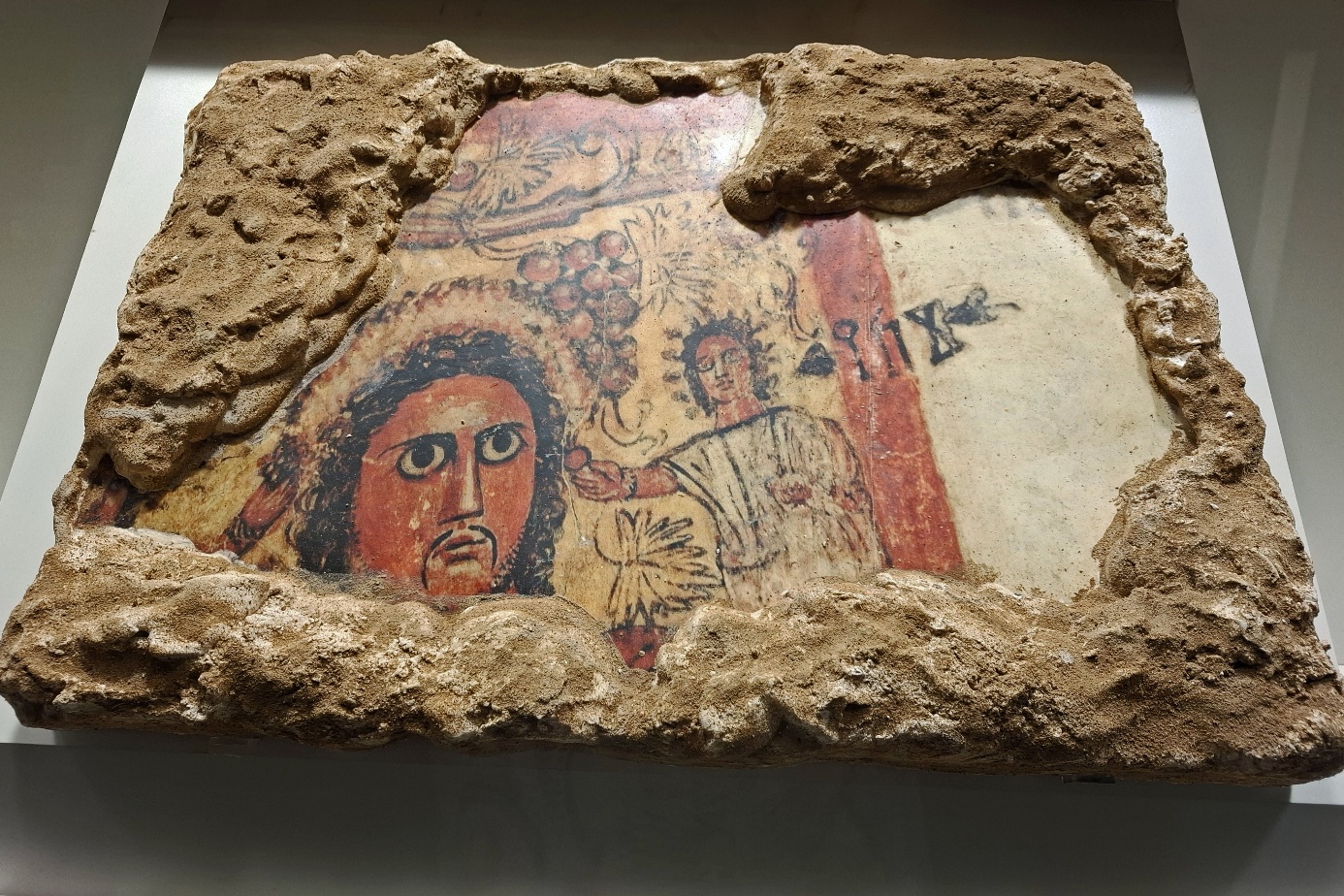
Hellenistic influence in Qaryat al-Faw
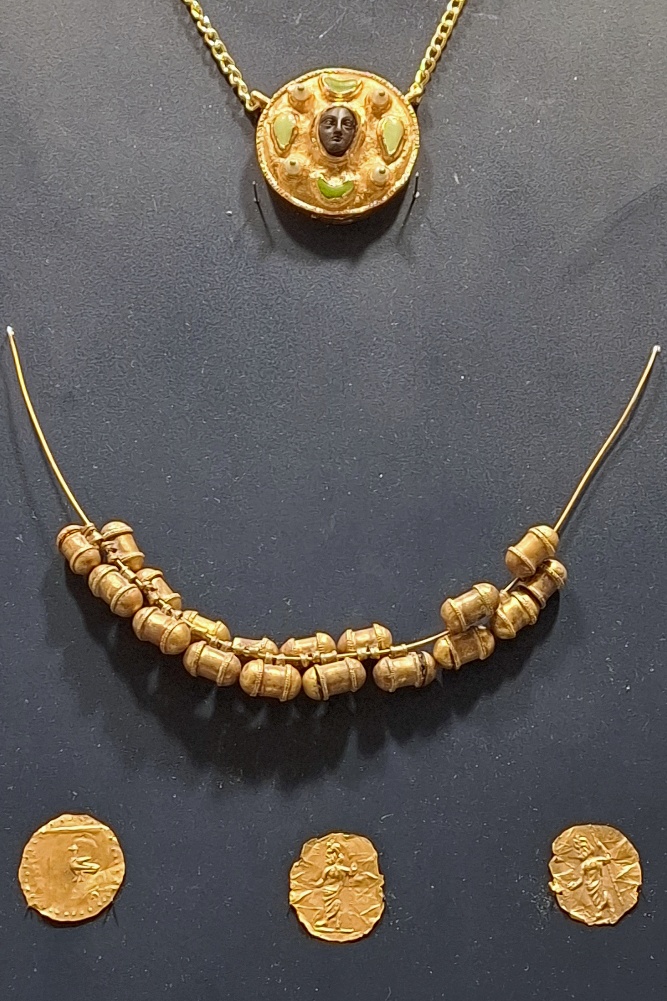
Another surprise is the extent to which Hellenism made its influence felt on the Arabian Peninsula. One example is Thaj, an archaeological site close to the Persian Gulf. In 2009, archaeologists were able to uncover the burial chamber of a young girl there. Probably a princess, judging by the treasure trove of gold buried with her. Even Qaryat al-Faw, deep in the south of the country, fell within the Hellenistic sphere of influence. This is strikingly illustrated by a mural depicting a man with curly hair.
Then an escalator takes us from darkness into light – both literally and figuratively. From the pre-Islamic period on the ground floor, we move up to the Islamic period on the first floor. The events that befell Mohammed in those days are part of the collective memory of Muslims throughout the world. How he was continually supported by his uncle. How, after his uncle's death, a bounty of a hundred camels was placed on his head. And how he was eventually forced to flee from Mecca to Medina.
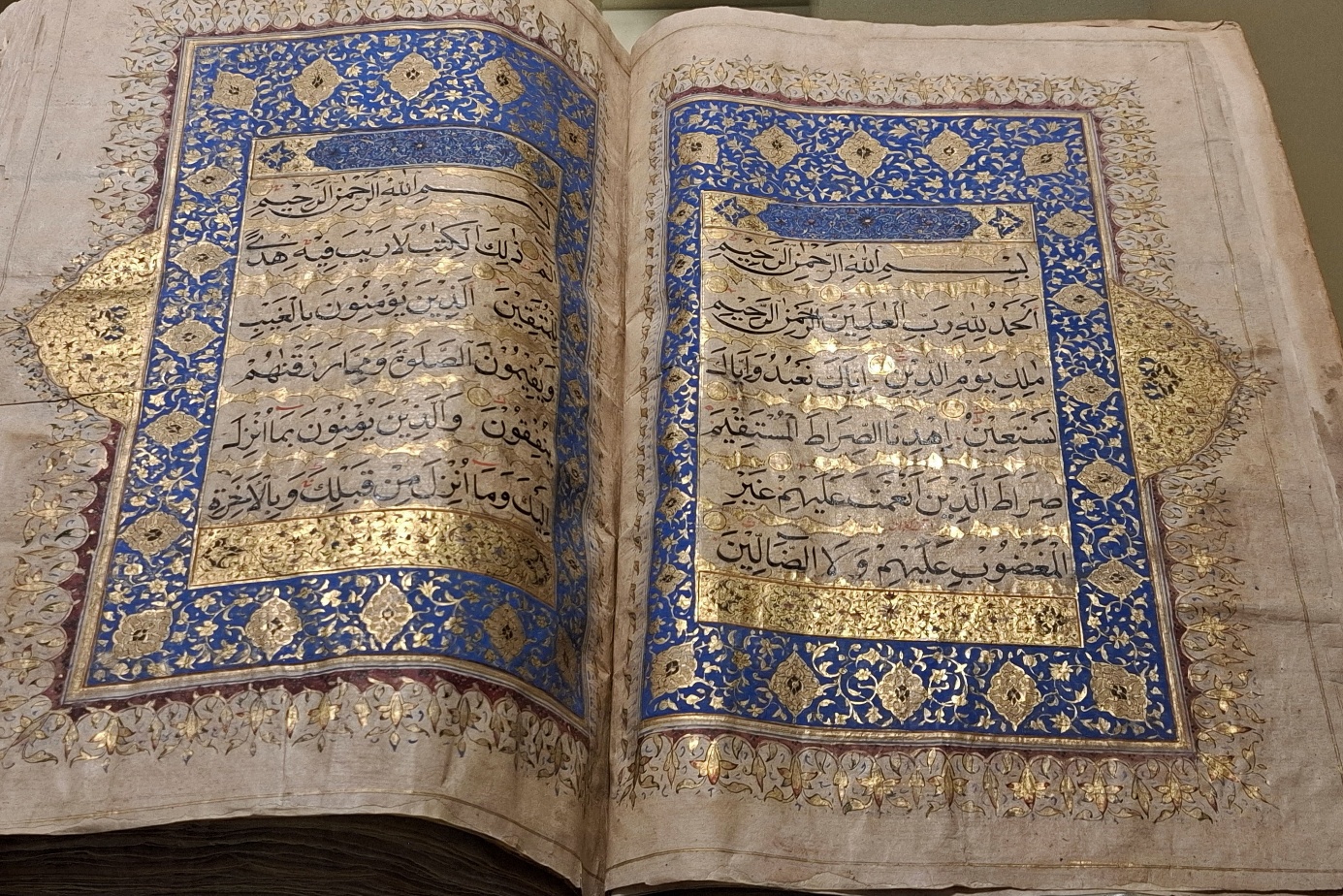
Qur’an in gold script
The latter sometimes involved miraculous events. Mohammed was once able to hide in a cave for three days because spider webs covered its entrance and there were pigeon eggs on the ground. His pursuers concluded that nobody could possibly be inside. On another occasion, during a chase, the horses of those pursuing him miraculously sank into the sand, preventing them from catching up with Him. A goat that had stopped giving milk began producing milk again when Mohammed laid his hands on it.
It took the Muslims a little over a century, between 630 and 750, to expand the Islamic Caliphate from the Indus in the east to the Iberian Peninsula in the west
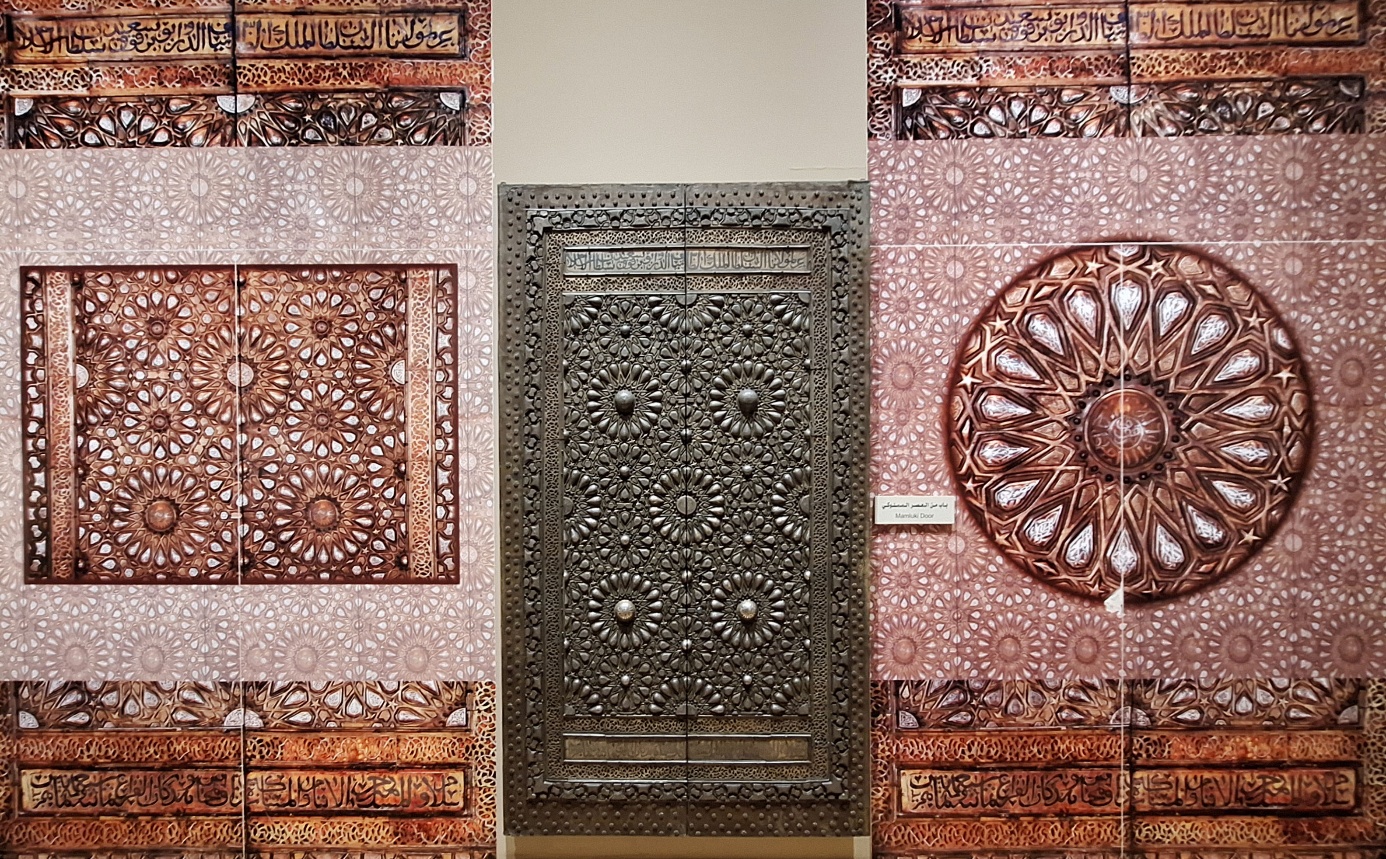
Mameluke door
The astonishingly rapid spread of Islam is also covered. One can only call it spectacular – this wave of conquest that originated from this sparsely populated peninsula. It took them just over a century, between 630 and 750, to expand the Islamic caliphate from the Indus in the east to the Iberian Peninsula in the west. They even crossed the Pyrenees. There, in 732, Charles Martel finally and decisively halted their advance at Poitiers. What Western Europe might have looked like had he failed remains an open question.
On our way to Al Diriyah, we see the gleaming towers of KAFD rising in the distance, Riyadh’s ultra-modern financial district. But that is for tomorrow. This afternoon, we are once again turning our attention to the past. And we are in good company, too: only yesterday, the British heir to the throne, Prince William, visited this site.
Despite the destruction, enough of Al Diriyah has survived for it to be described as one of the largest mud-brick cities in the world
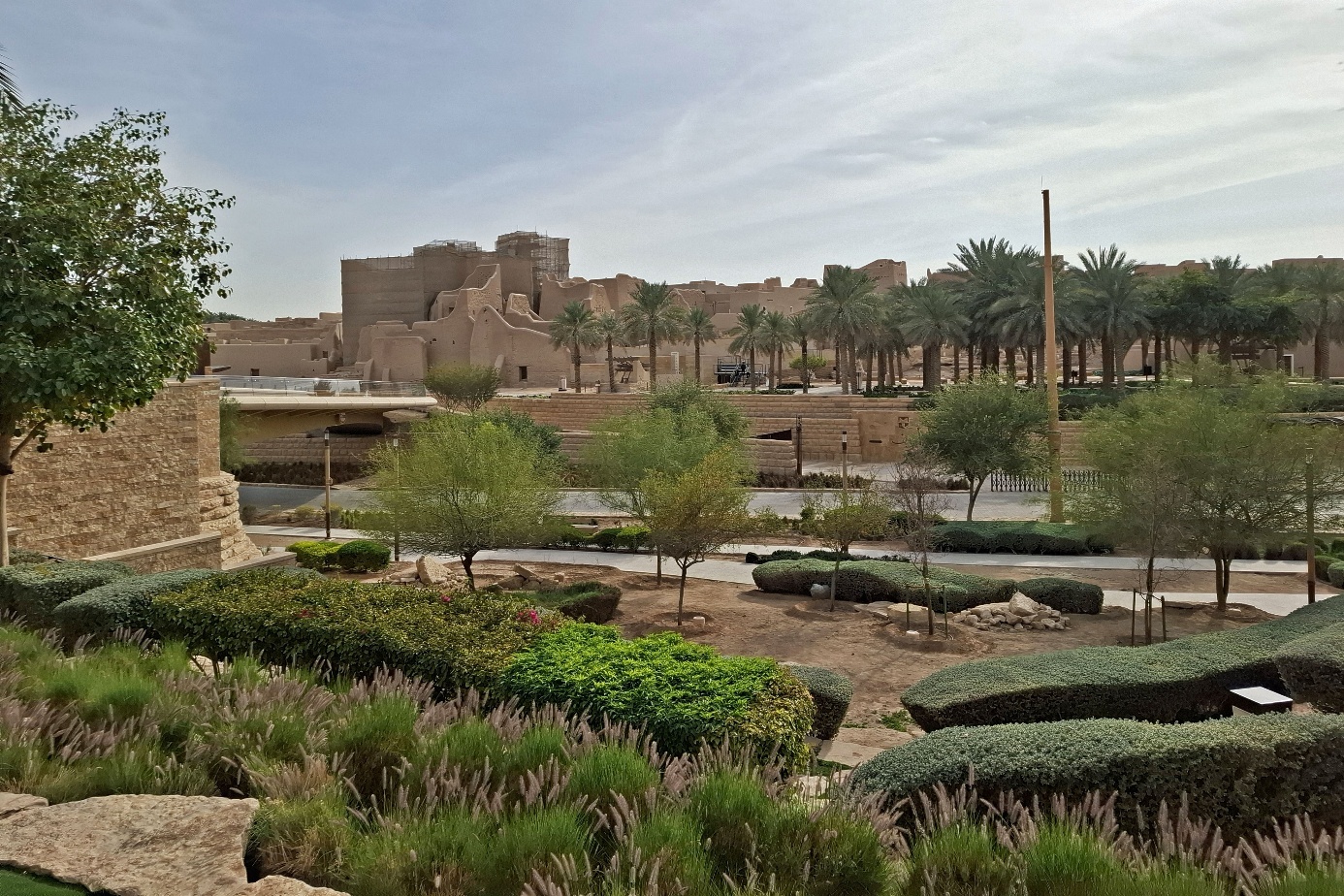
Al Diriyah – Wadi Hanifah
By now, we know that Al Diriyah was the birthplace of the First Saudi State. Al Turaif was the district where all the power was concentrated. It was home to the palaces of members of the royal family, the principal mosques, government buildings and other facilities.
But that all came to an end in 1818. The Ottomans wanted to cut this new state down to size before it grew too powerful. Things had started well enough for the Arabs. In 1811, with an army of 18,000 infantrymen and 800 cavalrymen, they managed to halt the Ottomans at Wadi al Safra, near Medina. Ever since, this battle has been extravagantly celebrated in local history books.
The inhabitants were killed or driven out, the water sources were poisoned and every palm tree was uprooted
But it was only a stay of execution. Seven years later, the Ottomans returned, this time with an even greater force. Imam Abdullah bin Saud had the walls reinforced and new towers built, but after a six-month siege he was forced to surrender. The Ottomans had been ordered to destroy Al Diriyah, and they did so thoroughly. The inhabitants were killed or driven out, the water sources were poisoned and every palm tree was uprooted.
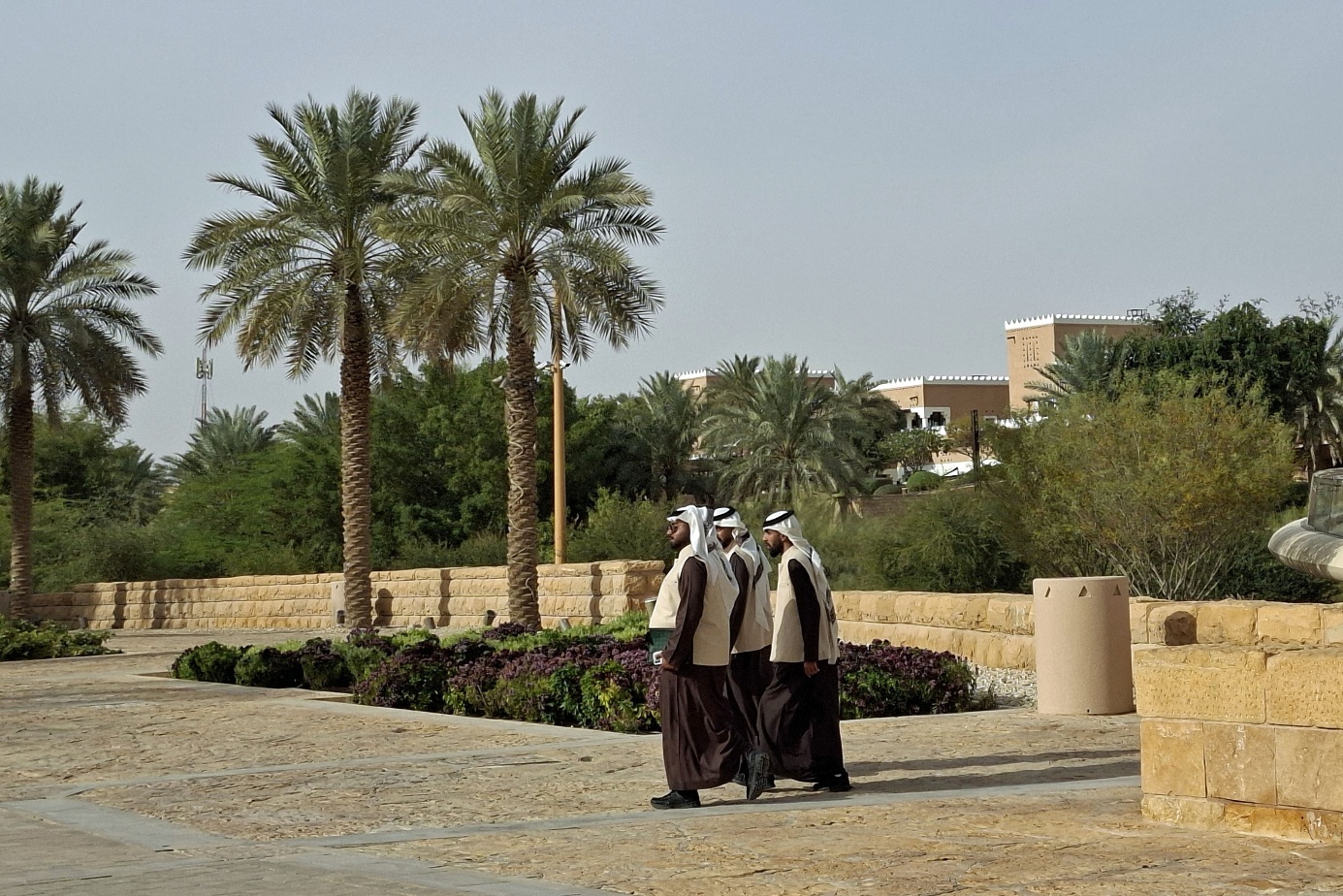
Abdullah bin Saud himself was first taken to Cairo, and then on to Istanbul, where he was publicly beheaded in May 1819 in the square in front of Hagia Sophia. Just to taunt him a little more, the sultan had him listen to a lute player beforehand – back home, Abdullah bin Saud had banned the playing of music.
Despite the destruction, enough of Al Diriyah has survived for it to be described as one of the largest mud-brick cities in the world. In 1999, King Salman ordered the site to be renovated. With considerable success: in 2010, Al Turaif was recognised by UNESCO as a World Heritage Site. But the first thing that strikes us as we enter the site via Bujairi Terrace is just how thoroughly commercialised it has become. Some of the restored buildings have been converted into shops or event venues.
The harvest takes years to come around. No wonder oud commands such high prices
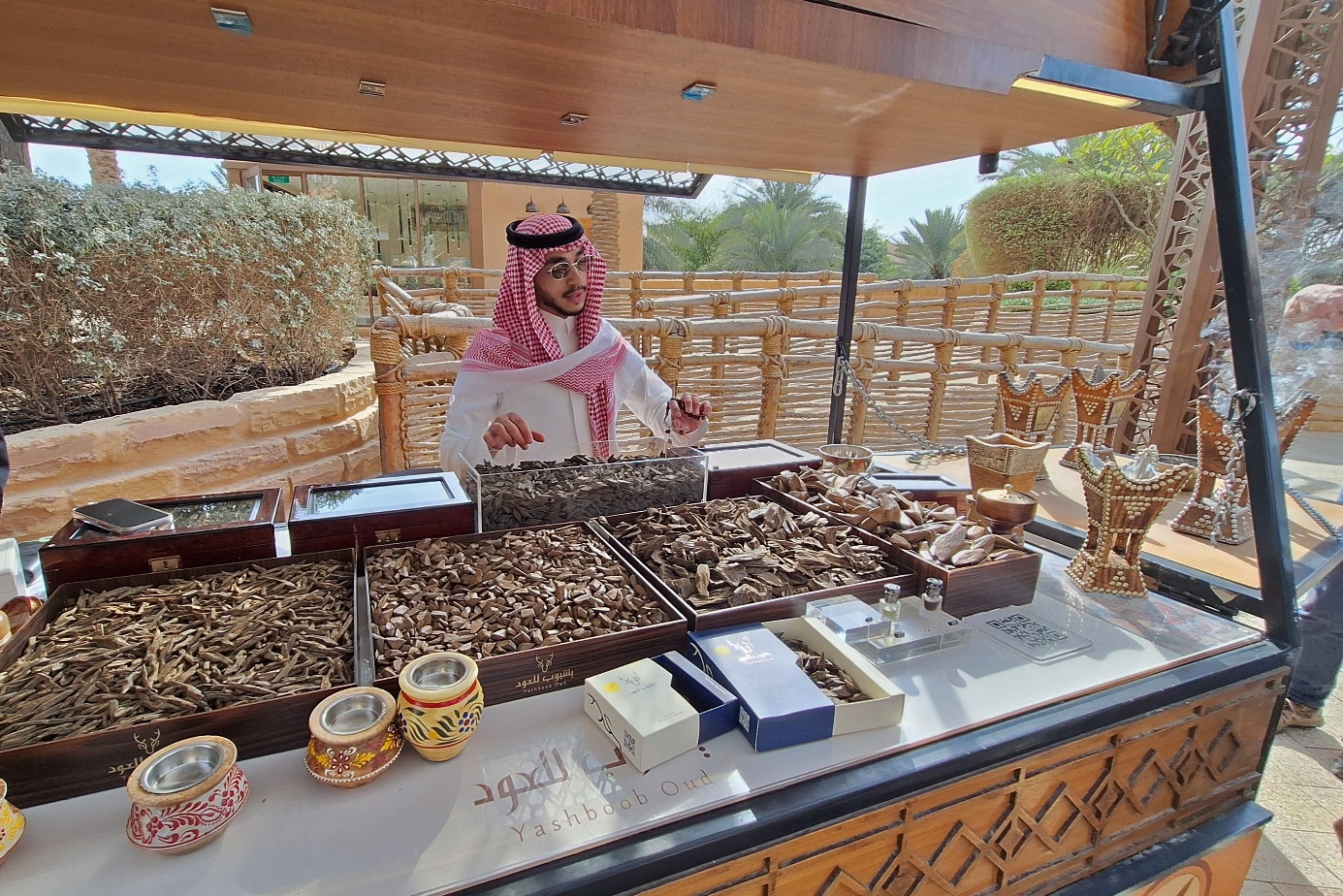
Sale of agarwood (oud)
What they have for sale at the Yashboob Oud stall looks like wood shavings. And that is, in fact, what it is. This is agarwood, a type of incense known here as oud. Thanks to its complex and highly appealing fragrance, oud is much sought after throughout the Middle East. Half a dozen varieties are available here, while several burners release their fragrant aromas in what amounts to a kind of tasting session.
The way oud is formed is a fascinating process. It requires a particular type of tree, Aquilaria, which grows only in South-East Asia. When such a tree is attacked by a certain fungus, it defends itself by producing a dark resin in its heartwood. This makes the wood very dense and resin-saturated, preventing the fungus from spreading any further. The wood also changes colour: its pale interior darkens, making it ready to be sold as oud. This process occurs only under the climatic conditions found in a rainforest. Oud therefore always has to be imported.
Local people give the trees a helping hand by deliberately infecting them with the fungus
Naturally infected trees are also rather rare. Local people therefore give the trees a helping hand by deliberately infecting them with the fungus, thus triggering the production of oud. Even then, the harvest takes years to come around. No wonder oud commands such high prices. Cultivated oud costs between € 70 and € 400 ($ 83 and $ 475) per kilogram; naturally produced oud can fetch anything from € 3,400 to € 10,600 ($ 4,033 and $ 12,574).
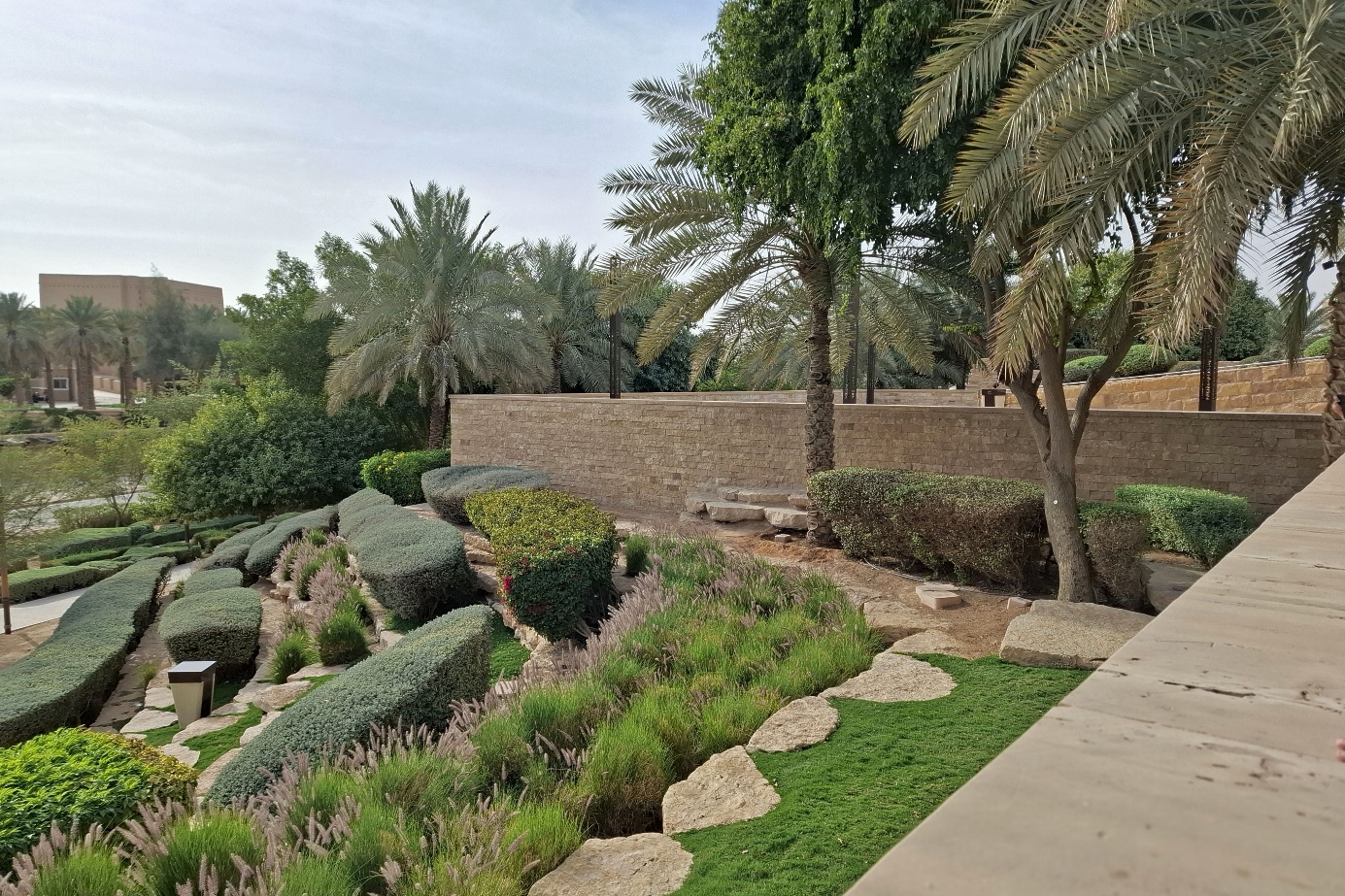
Wadi Hanifah
From the terrace, we look out over the centuries-old mud-brick city. At our feet lies Wadi Hanifah, the wadi that still supplies the vital water needed to sustain the lush growth of palm trees and shrubs. This was where the Banu Hanifah, the tribe from which the Saudi royal family would eventually emerge, settled around 400 CE, having come from the western Hejaz. Initially, these were small settlements of sedentary farmers scattered along the wadi. It was not until 1446 that a town was founded here, bearing the name Al Diriyah.
The towering walls of the Salwa Palace immediately catch the eye. It was the largest building in Al Turaif, covering an area of more than 10,000 m² (107,600 ft²)
Salwa Palace |
|
|
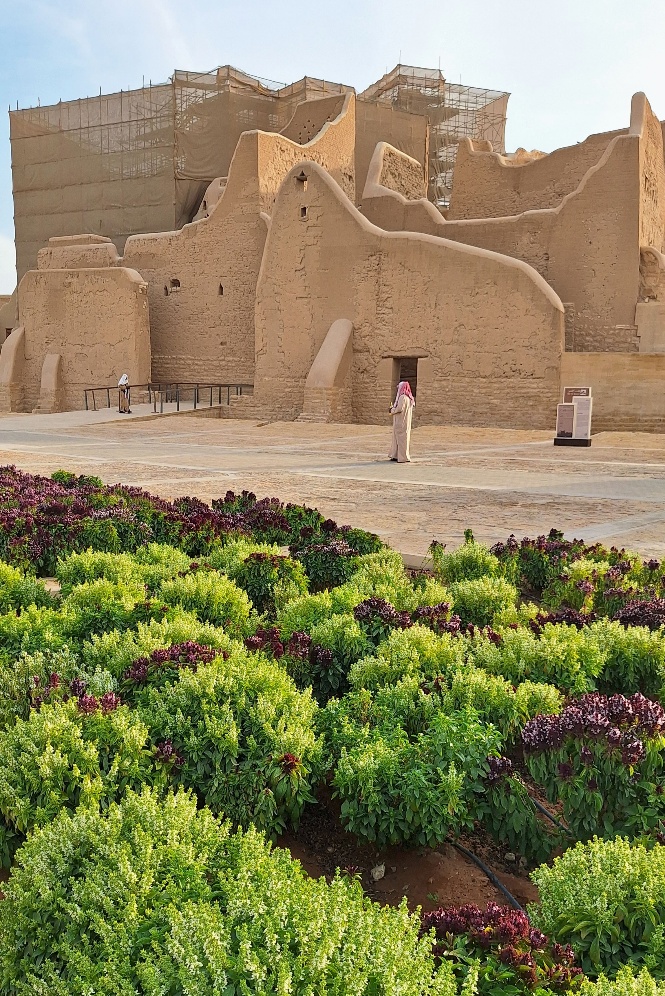
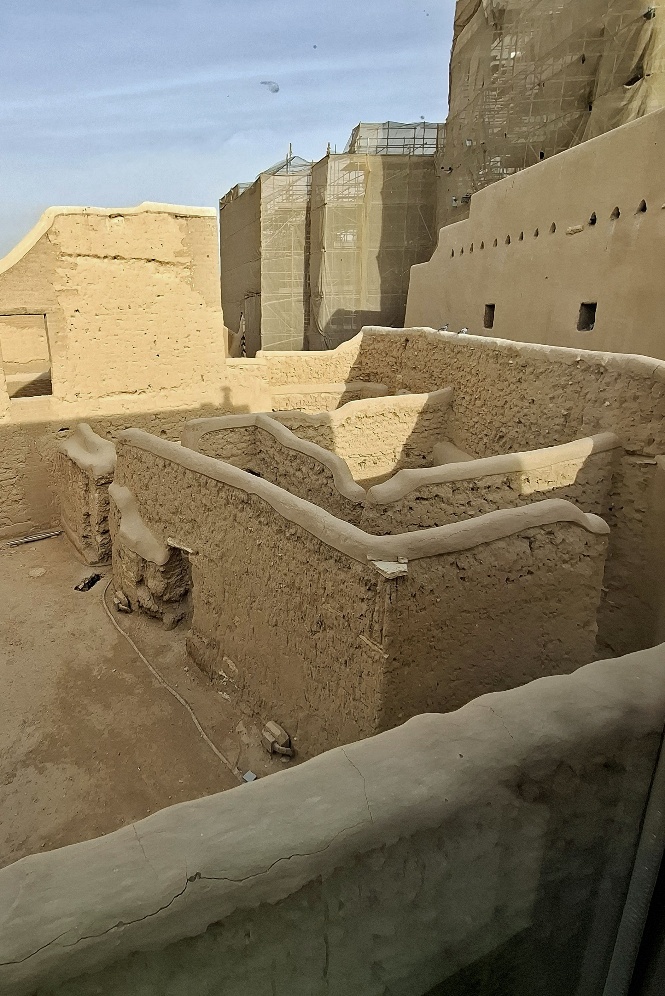
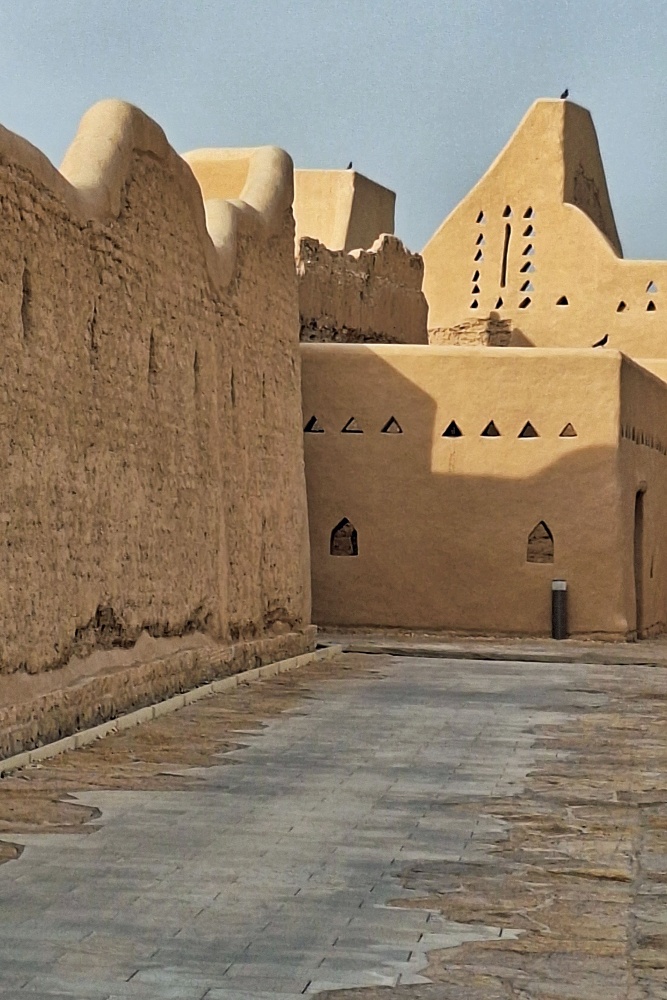
Across the way, the towering walls of the Salwa Palace immediately catch the eye. It was, after all, the largest building in Al Turaif, covering an area of more than 10,000 m² (107,600 ft²). Its construction began in 1766. The king – who was still known as the imam at the time – used it as his private residence, but it also served as a seat of government. The walls feature distinctive triangular openings designed to provide light and ventilation, a hallmark of Najdi architecture.
Water well |
|
|
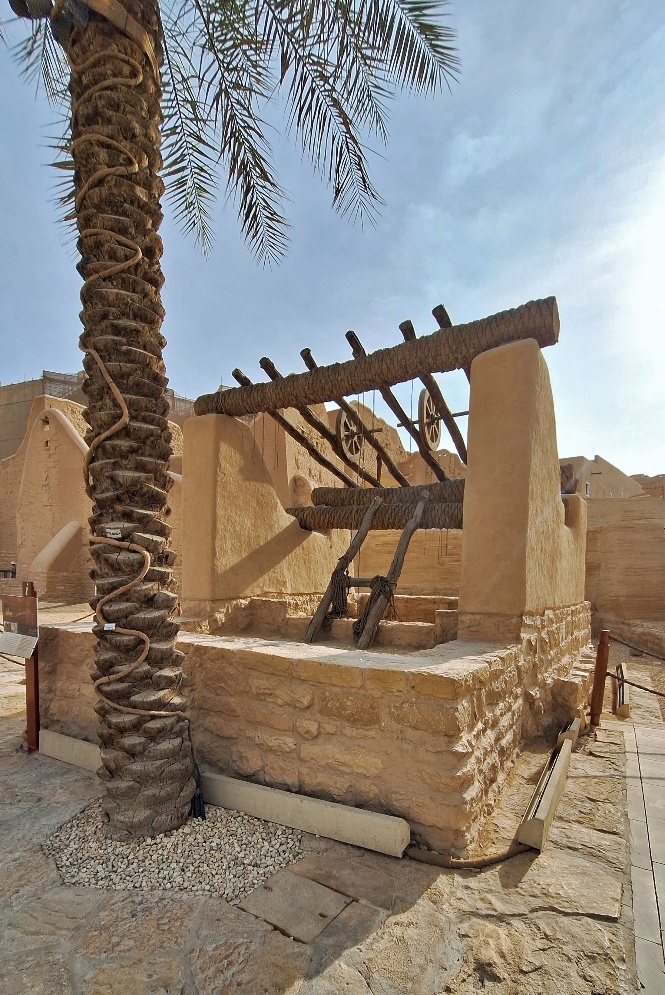
Several wells bear witness to the vital role water played in agriculture and everyday life. Water was hauled up in leather bags using a pulley system powered by two camels.
Of the many pillars that once supported the galleries, only a few sorry stumps remain
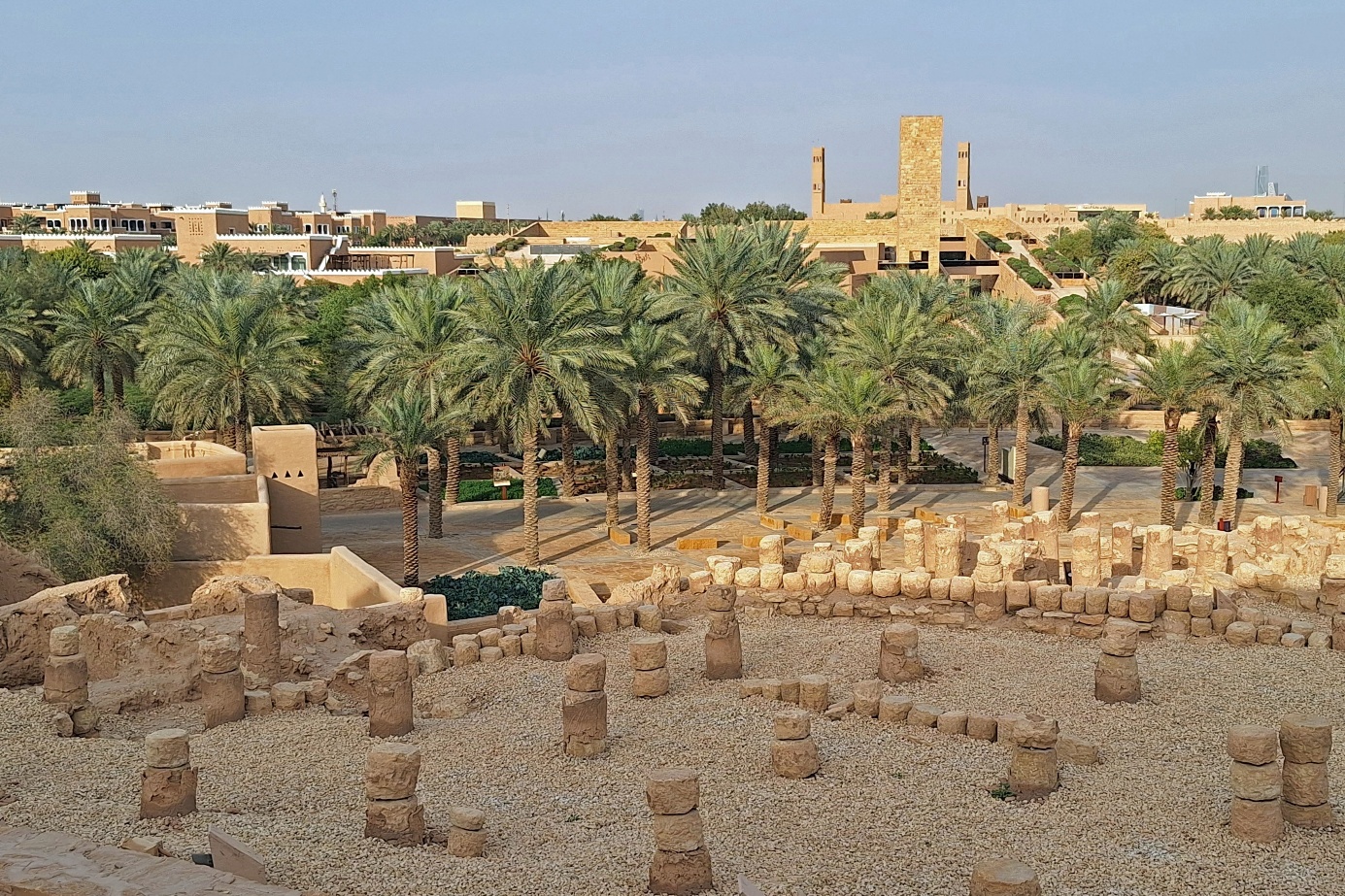
Grand Mosque of Al Turaif
One of the first buildings to be erected in Al Turaif was the Grand Mosque. It stands next to Salwa Palace and was even once connected to it by a bridge. It was Imam Abdulaziz who commissioned the mosque. In an ironic twist of history, he was also murdered there. The walls were built of natural stone and mud brick, while the roofs were made of tamarind wood, palm branches and palm leaves. Of the many pillars that once supported the galleries, only a few sorry stumps remain.
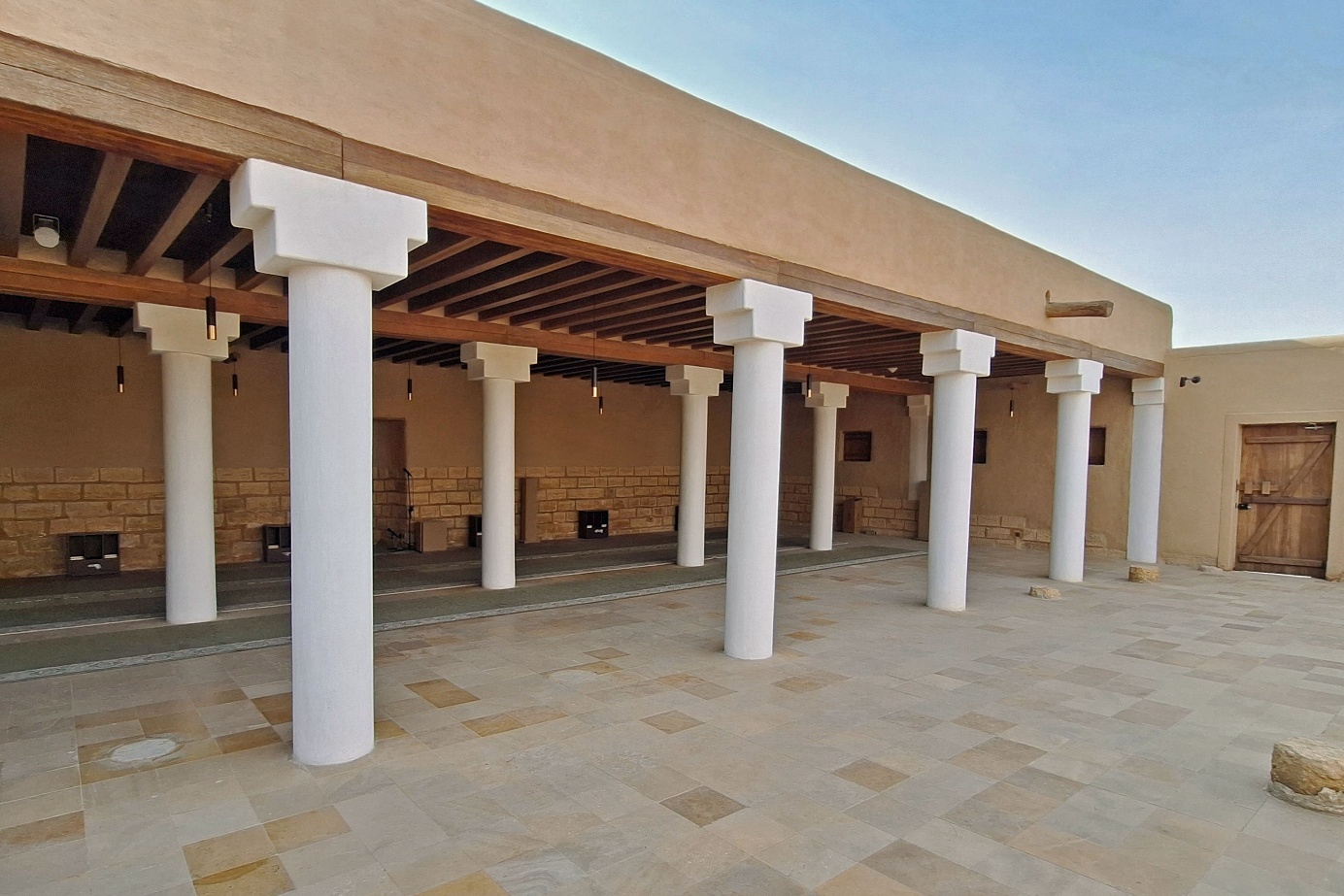
Grand Mosque of Al Turaif
The mosque stands high above Wadi Hanifah. Its strategic position made it an ideal platform from which to fire cannons. It stands to reason that, during the siege, the Ottomans specifically targeted the mosque. So it comes as no surprise to find several cannonballs dating from that period lying around the site.
Grand Mosque – Khalwa (underground prayer room) |
|
Ceiling |
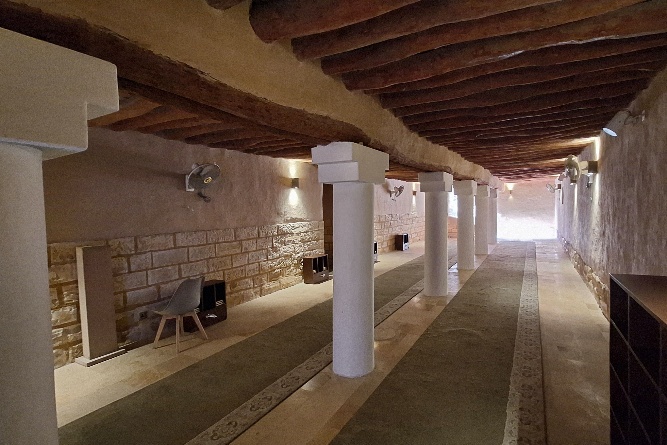
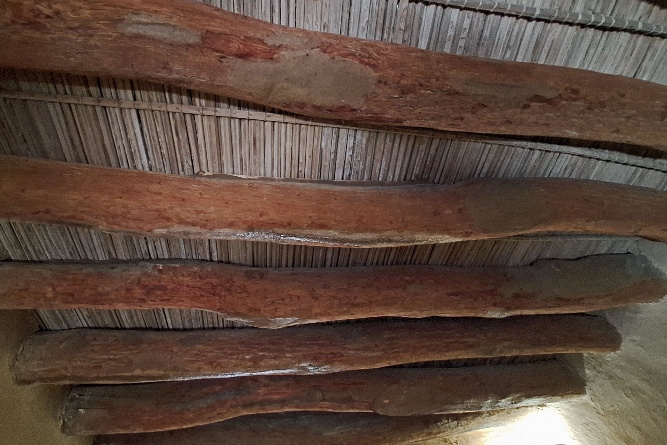
All that destruction was the work of the Ottomans, Noura emphasizes with a grim undertone. But barely six years after the dramatic siege, Imam Turki bin Abdullah had kicked the Ottomans out, she adds triumphantly. Sadly, by then Al Diriyah had been completely destroyed and largely deserted. Turki therefore designated Riyadh as the new capital of the Second Saudi State. And it has remained so to this day.
|
|
|
|
|
|
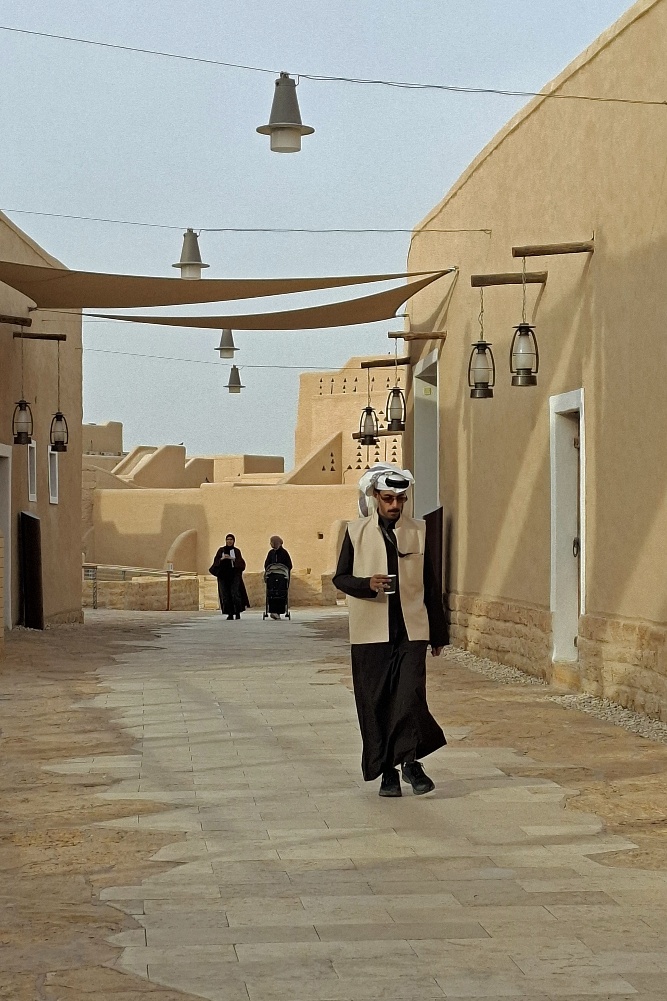
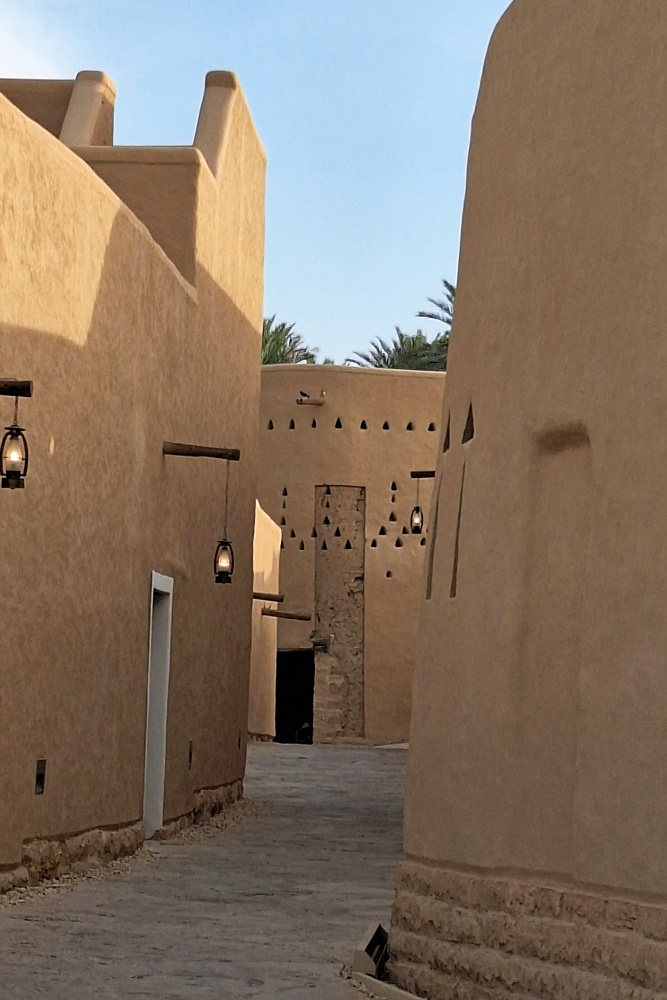
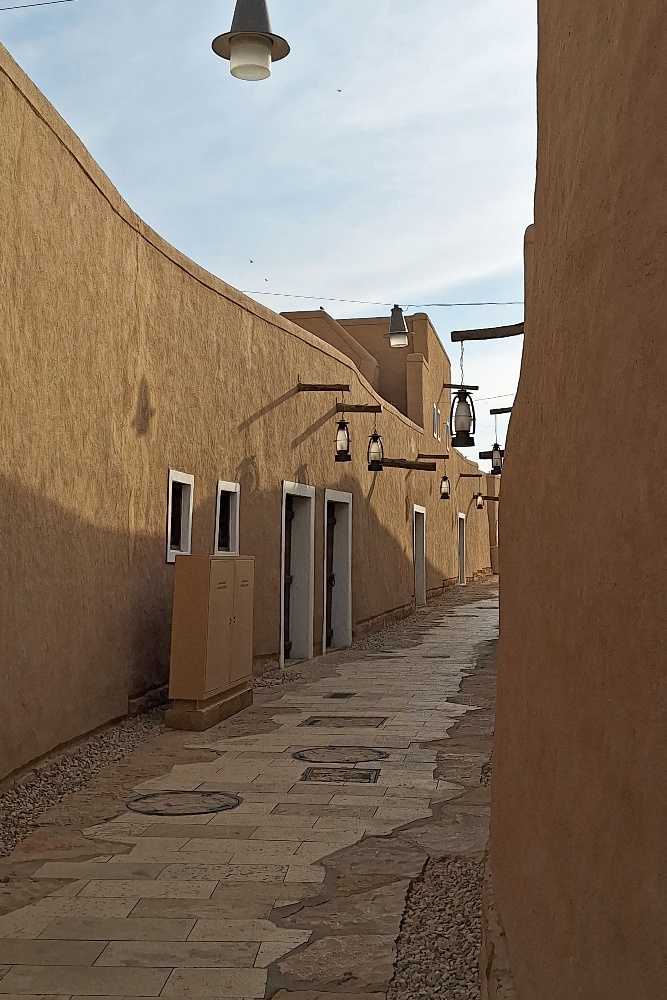
We wander through the clinically restored streets. There was certainly no shortage of palaces – we count twelve in all. Every prince worth his title had a palace somewhere in Al Turaif.
Every prince worth his title had a palace somewhere in Al Turaif
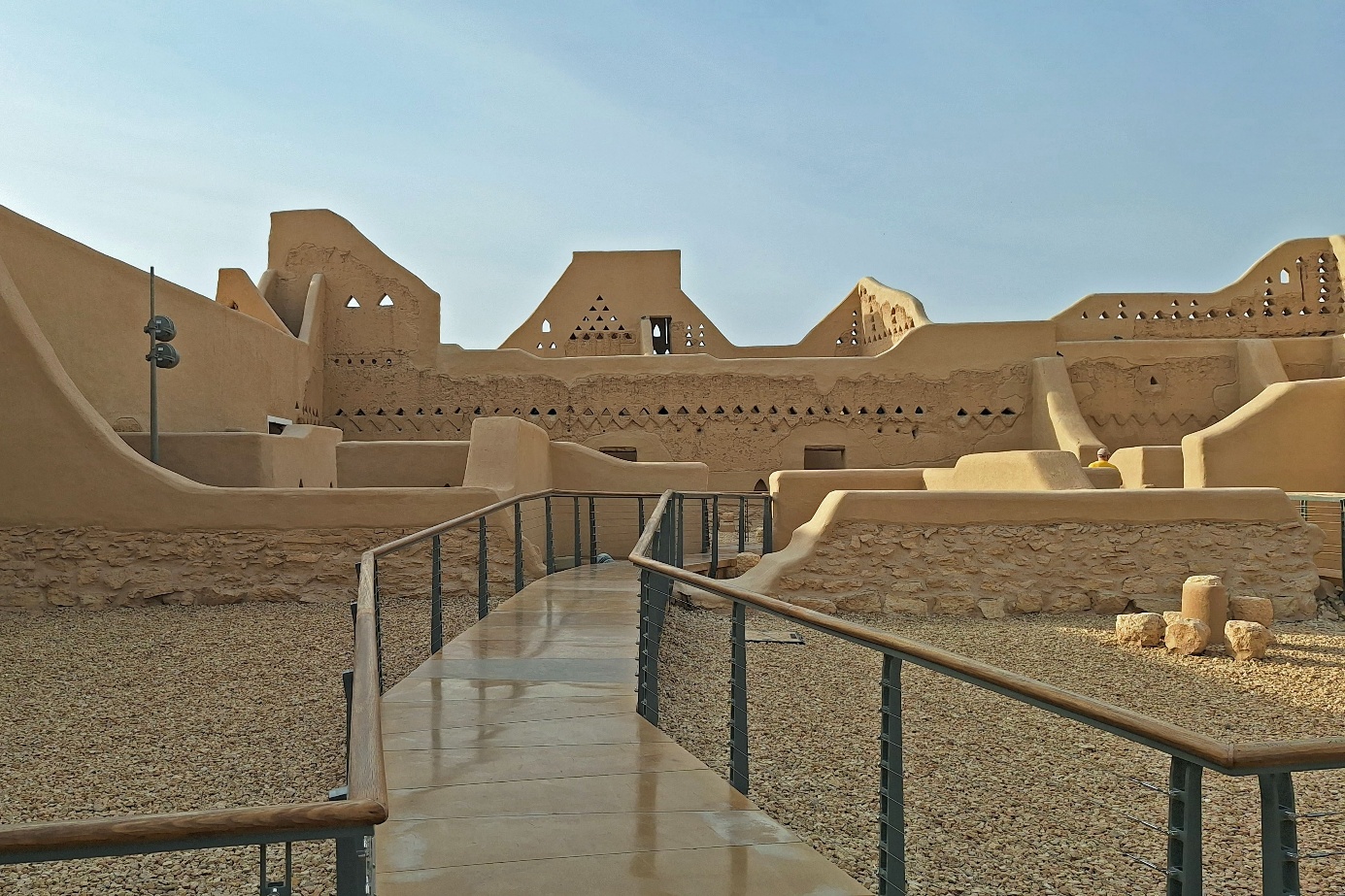
Palace of Imam Abdullah bin Saud
This was also true of Imam Abdullah bin Saud, the last ruler of the First Saudi State. He came to power in 1814 and immediately set about building one of the largest palaces in Al Turaif, right in the heart of the district. With its thick walls and numerous pillars, it must have been an impressive structure. The Imam did not, however, get to enjoy it for long. By 1818, the Ottomans were at the gates. And they certainly hadn't come to congratulate him on his splendid palace.
By 1818, the Ottomans were at the gates. And they certainly hadn't come to congratulate him on his splendid palace
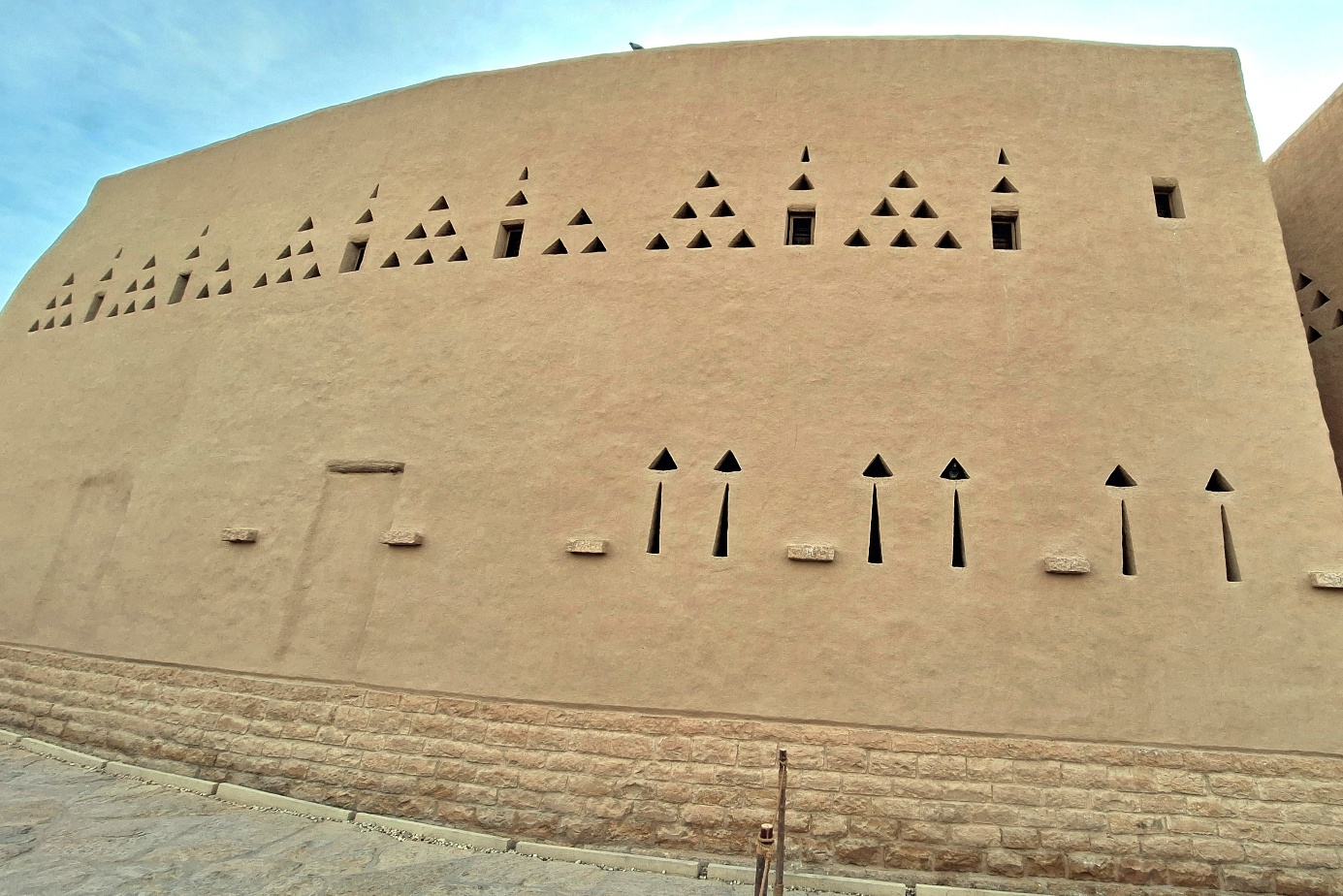
Palace wall
There were not only palaces in abundance, but also plenty of stables. After all, the Arabian thoroughbred was held in high regard in the First Saudi State, not only because of its importance in warfare, but also as a symbol of status and wealth. In the desert, Bedouins often brought their horses into the family tent to protect them from theft.
In the magnificent calligraphic inscription on the wall, we immediately recognise the flowing mane of a galloping horse
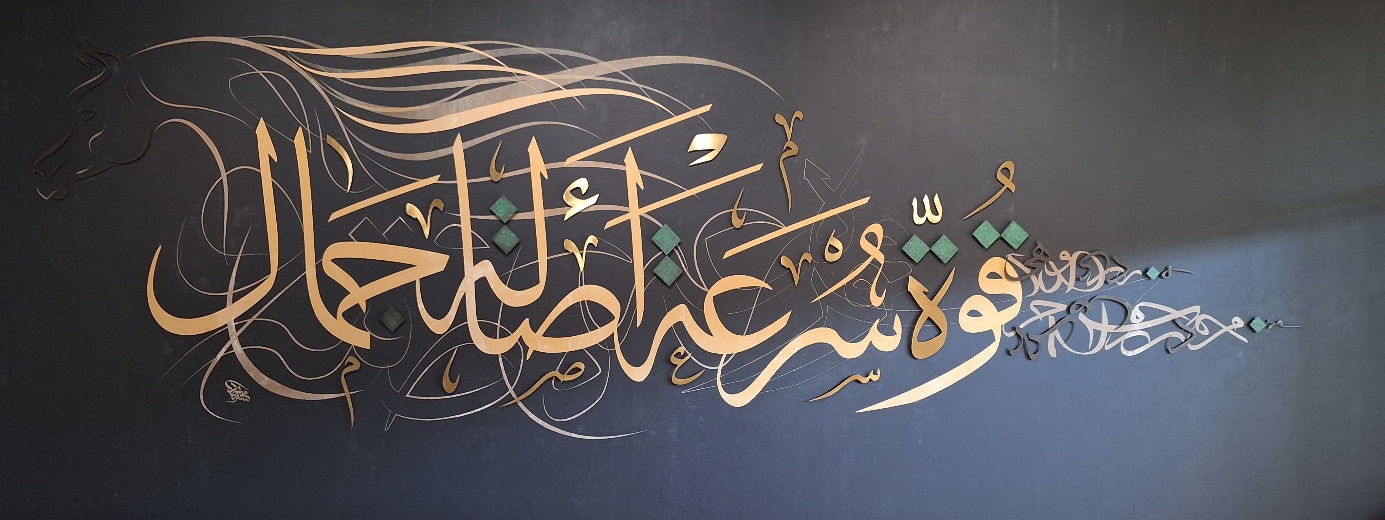
“Strength, beauty, speed and authenticity”
A Gallery of the Arabian Horse has been set up in the palace of Abdullah bin Saud to remind us of this. In the magnificent calligraphic inscription on the wall, we immediately recognise the flowing mane of a galloping horse. The text describes the qualities by which horses were judged – strength, beauty, speed and authenticity.
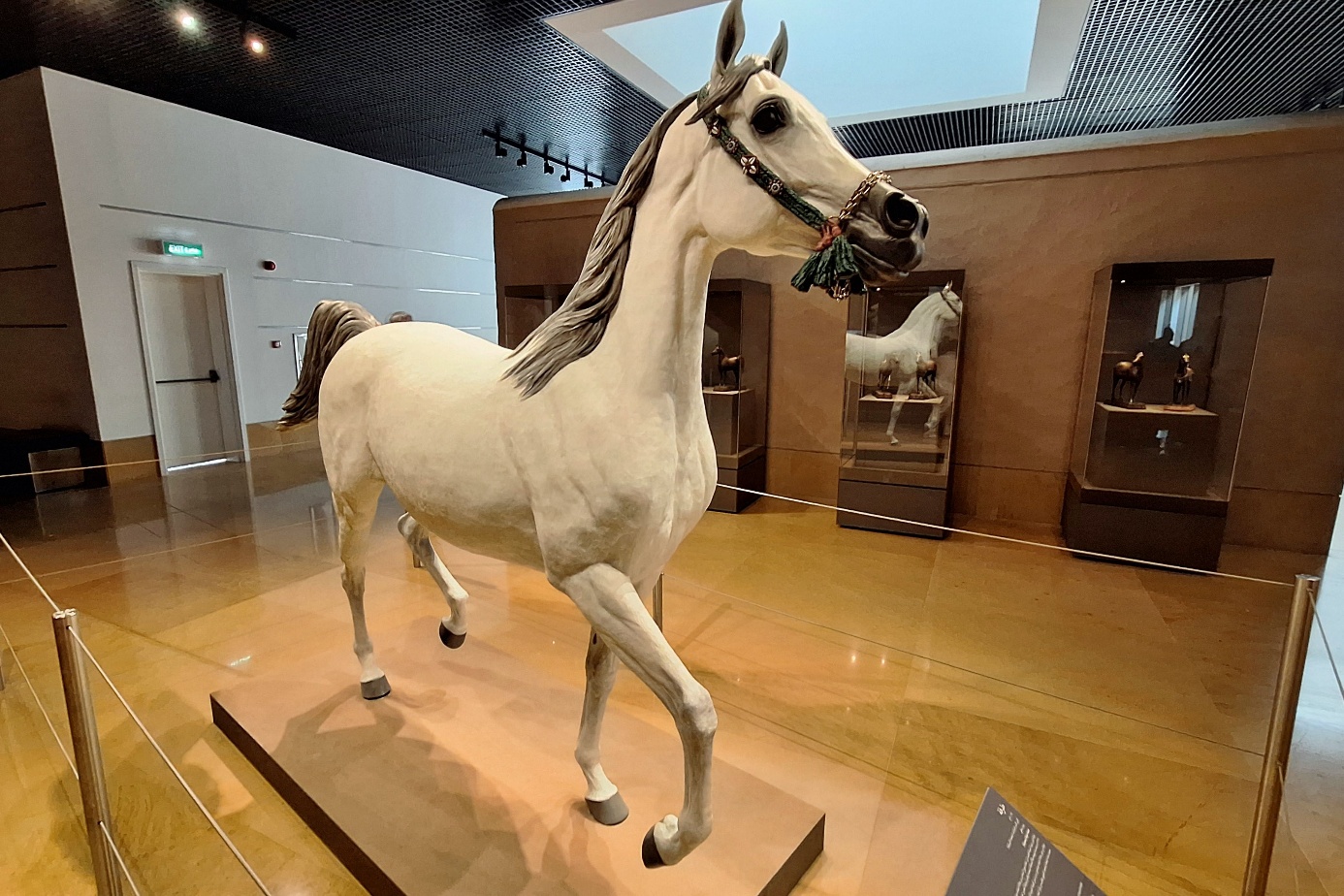
Gallery of the Arabian Horse – Turfa
Horses were already being domesticated here nine thousand years ago. This is illustrated by an ancient depiction of a horse and rider in a rock carving from Jubbah. At the heart of the exhibition stands a life-size sculpture in painted bronze of the mare Turfa, a magnificent white Arabian thoroughbred. It was a gift from Abdulaziz Al Saud to King George VI on his accession to the British throne in 1937.
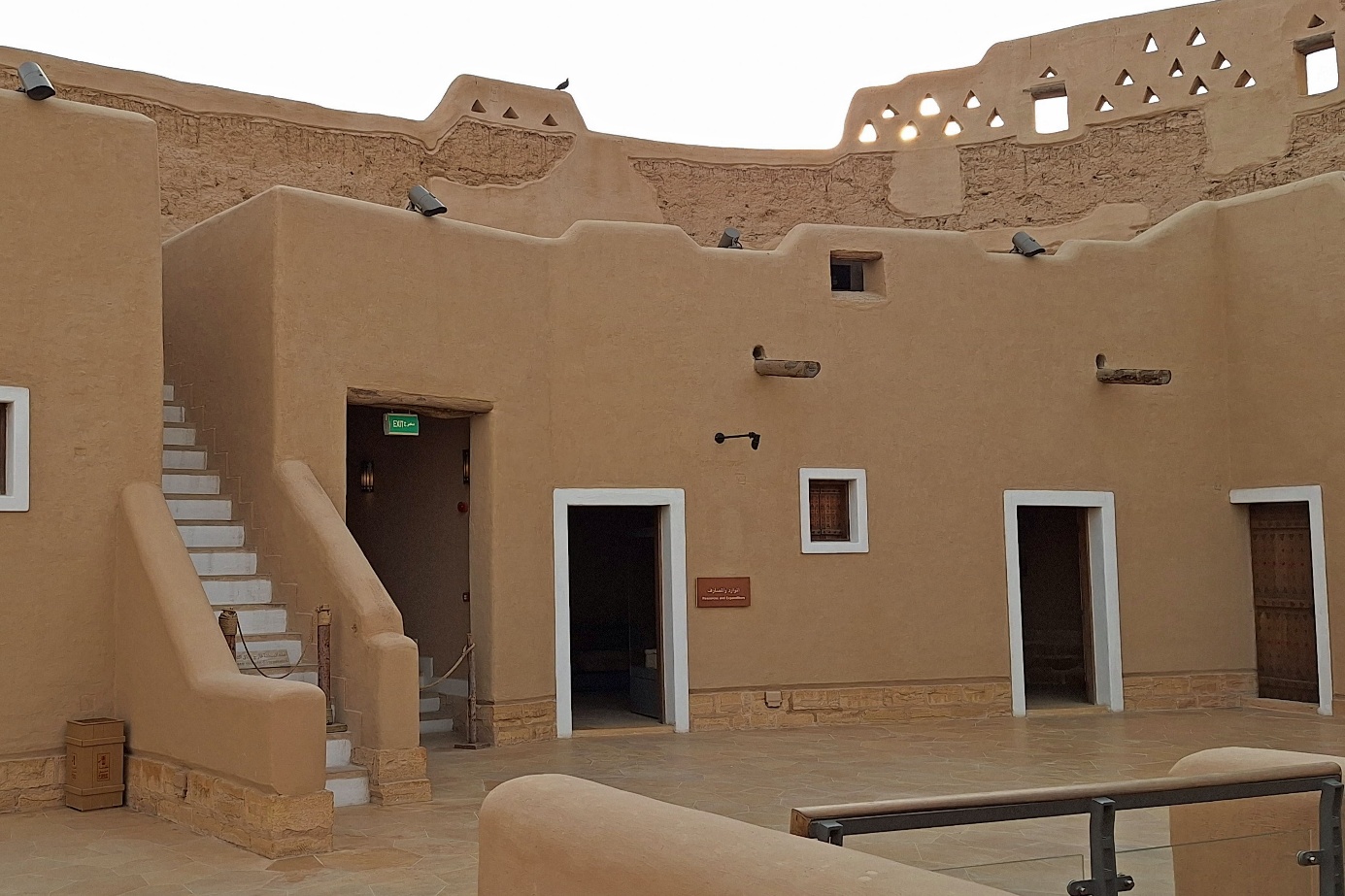
Bayt al Mal (Treasury)
Another obvious feature is the presence of a treasury near the royal residence. It is called Bayt al Mal, and this is where all the valuable goods were kept. We are a little surprised by what Noura includes in that category – gold, silver, grain, camels and horses.
Sbalat Modhi provided accommodation for merchants, visitors and students. A sort of luxurious caravanserai, in other words
Sbalat Modhi |
|
Saudi hospitality – Tea and dates |
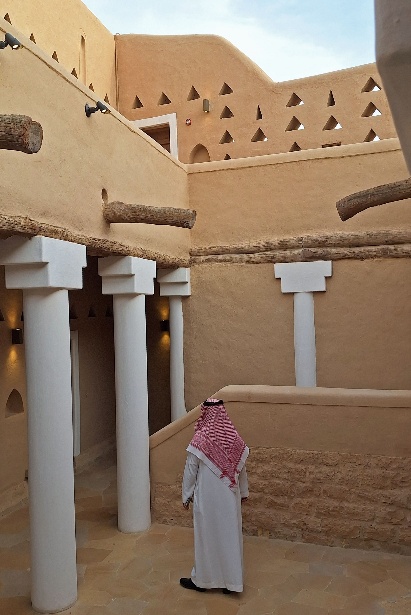
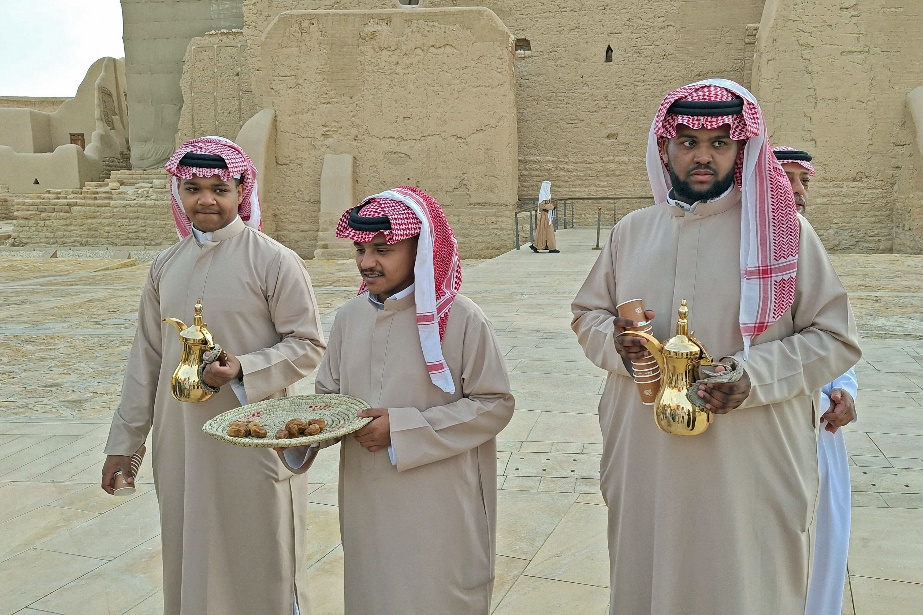
Right next door stands the beautifully restored Sbalat Modhi, a two-storey building complete with a mosque and stables for horses. It was named after Modhi, the wife of Imam Mohammed bin Saud, and provided accommodation for merchants, visitors and students. A sort of luxurious caravanserai, in other words.
The Kingdom Centre is sometimes irreverently referred to as The Bottle Opener. This nickname stems from the building’s striking design
Al Majdoul Tower |
|
Kingdom Centre |
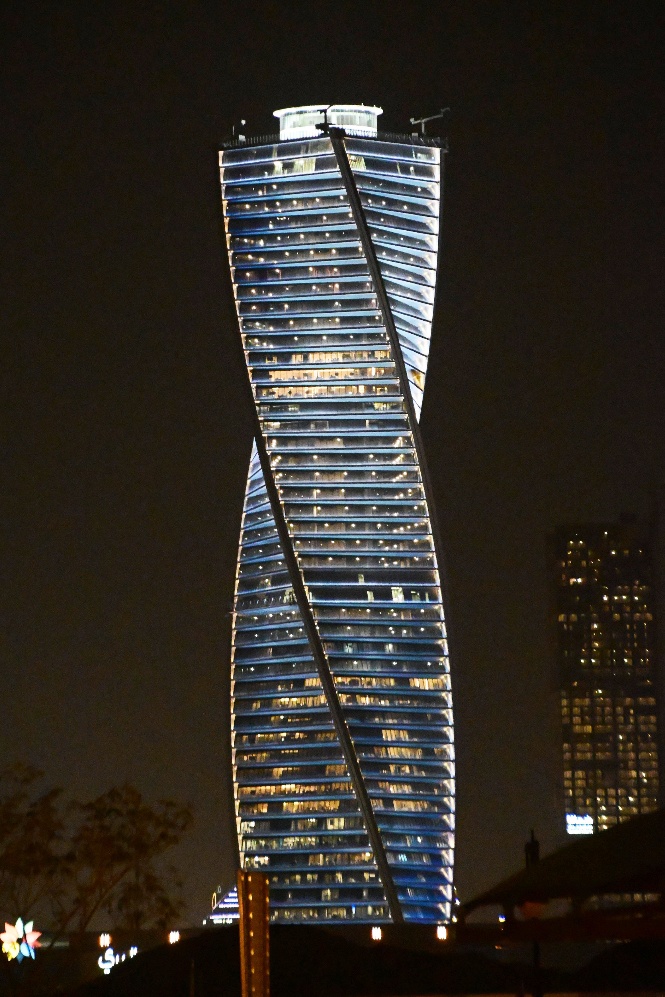
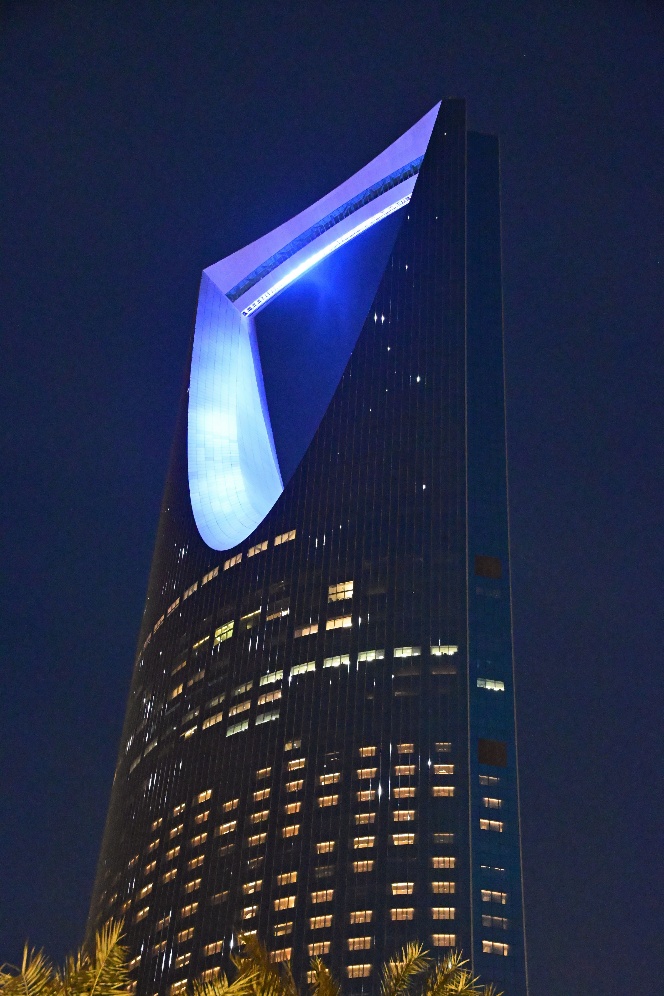
Gradually, darkness takes hold of the city. This is the moment Noura has been waiting for to guide us to the Kingdom Centre – arguably the most iconic high-rise in Riyadh, sometimes irreverently referred to as The Bottle Opener. This nickname stems from the building’s striking design: at the very top, there is an opening between its two symmetrical wings, making it look suspiciously like a bottle opener.
In the rather bizarre category of World's Tallest Buildings with a Hole, the Kingdom Centre holds an honourable third place
While the Kingdom Centre may be nothing more than a modest mid-ranking entry on the list of the world's tallest buildings, it has to be said that it holds an honourable third place in the rather bizarre category of World's Tallest Buildings with a Hole. What's more, the King Abdullah Mosque on the 77th floor is the highest mosque in the world, 183 metres (600 ft) above ground level. And all this for the mere sum of USD 1.2 billion.
Sky Bridge |
|
King Fahd Road (looking south) |
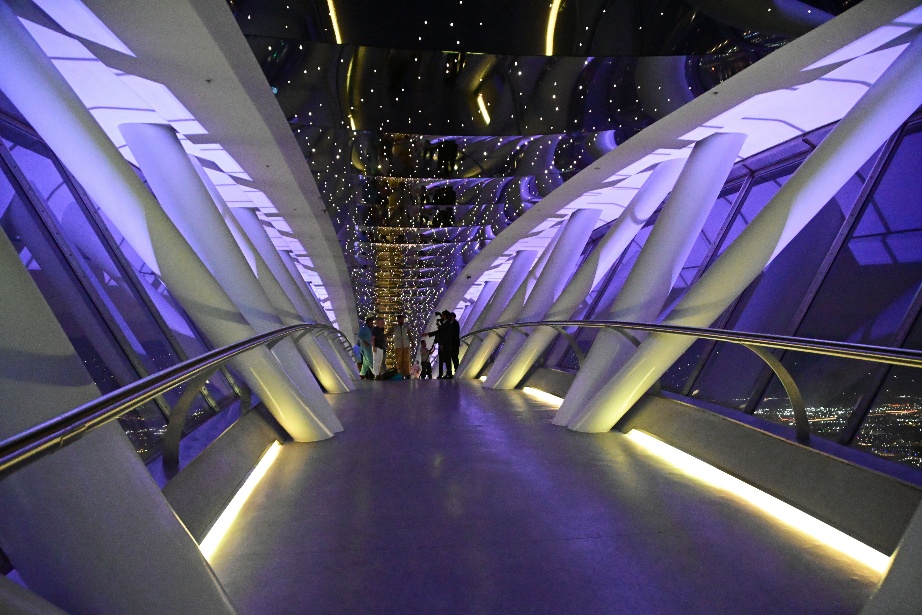
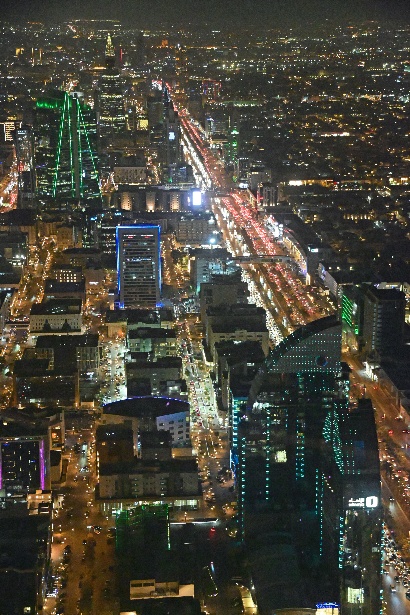
A first elevator takes us up 77 floors, followed by a second one that carries us another 22 floors higher. This brings us to the famous Sky Bridge, a 65-metre-long (213 ft) covered walkway connecting the two towers of the skyscraper. It feels as though we are floating in mid-air, 300 metres (984 ft) above the ground. The view of Riyadh by night is, needless to say, absolutely spectacular. The impression we had earlier is confirmed: modern Riyadh, with its impressive skyline, has developed mainly along Highway 65, known here as King Fahd Road.
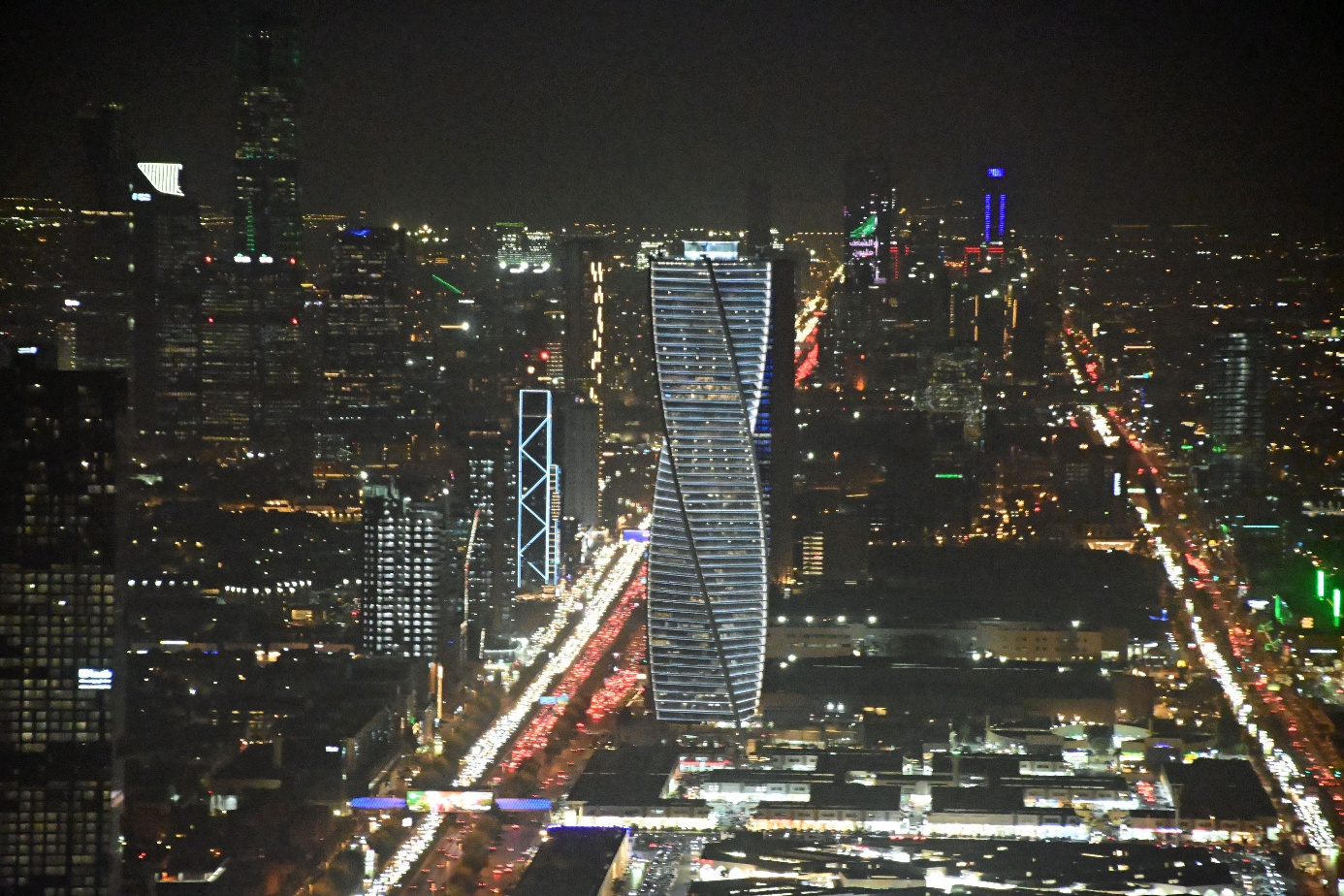
King Fahd Road with Al Majdoul Tower (looking north)
It must have been a truly spectacular sight: the Star in Motion project, brought to life here in 2021 by Belgian artist Koert Vermeulen. Suspended in the open space between the two towers at a height of 257 metres (843 ft) was a star-shaped light art installation, measuring 6.2 metres (20 ft) in diameter. Although it weighed five tonnes, it hung there with the elegance of a sparkling diamond on a necklace.
Although it weighed five tonnes, it hung there with the elegance of a sparkling diamond on a necklace
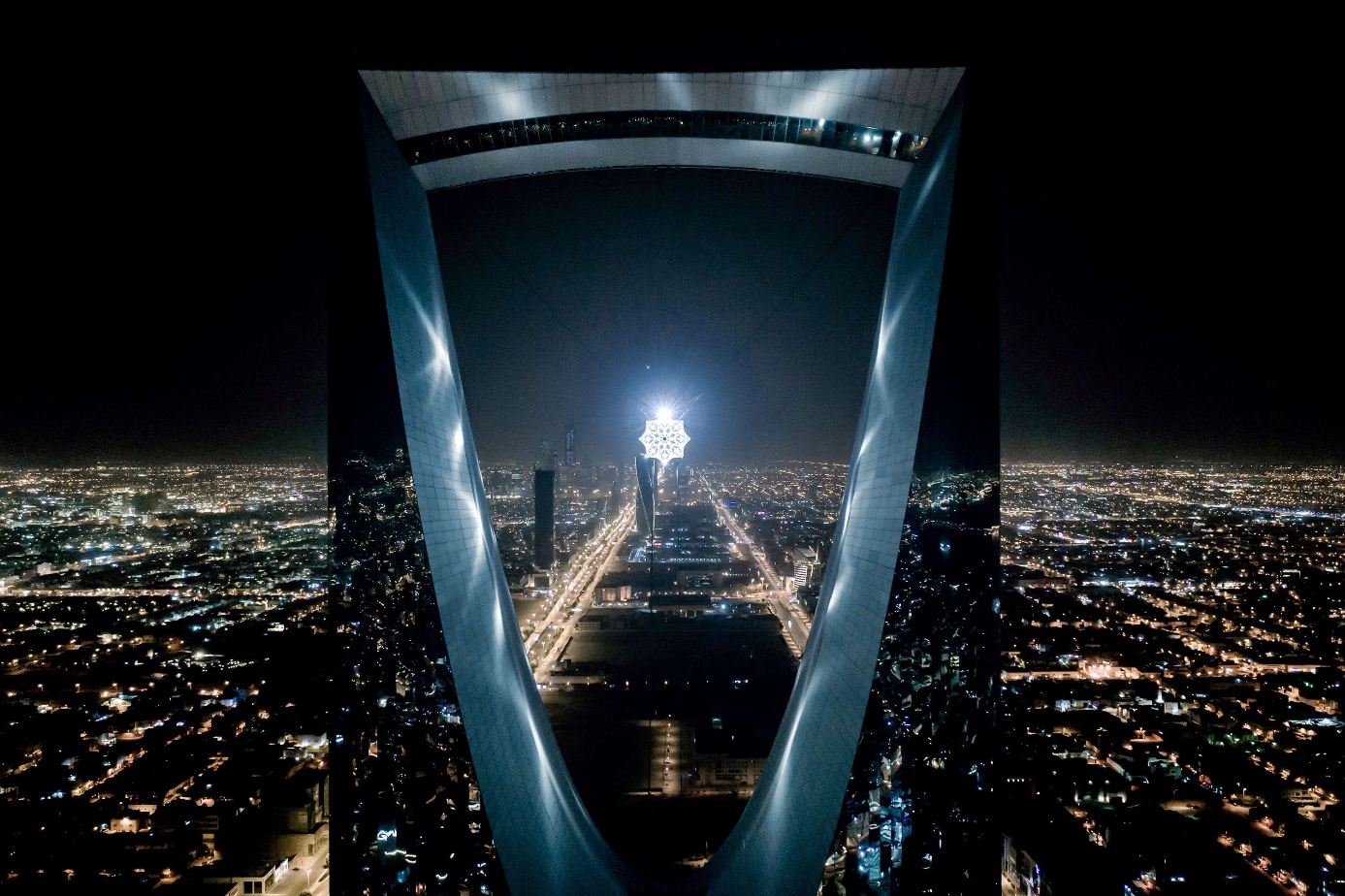
Kingdom Centre with Star in Motion (Koert Vermeulen, Fisheye, 2021)
Every hour, the birth and death of a star were simulated – a life cycle of three billion years compressed into 60 seconds. Stars, so the reassuring message went, are a universal bond. They bring harmony and unity to people all over the world and remind us that we all live under the same sky.
If only that were true. For in just over six months, on 18 October 2026, the management of the Kingdom Centre will instruct its employees not to come into the office, but to work from home until further notice. No explanation will be given, but the bombing raids on Riyadh by the Yemeni Houthi rebels are unlikely to be unrelated.
Wednesday 11 February | Riyadh – KAFD
It will be a quiet day. Later this afternoon, we will fly home via Abu Dhabi. But first, we have a visit to the KAFD, the King Abdullah Financial District, on the programme. This ultra-modern financial district in Riyadh is one of the regime's flagship projects. Construction began in 2007, and it has since grown into the Middle East's leading financial centre. Its 95 buildings are spread over an area of 160 hectares (395 acres). By way of comparison, London's business district of Canary Wharf covers 39 hectares (96 acres).
The towering, almost empty skyscrapers became the laughingstock of the city – a luxurious ghost town along Riyadh's main thoroughfare
King Abdullah Financial District (KAFD) |
|
|
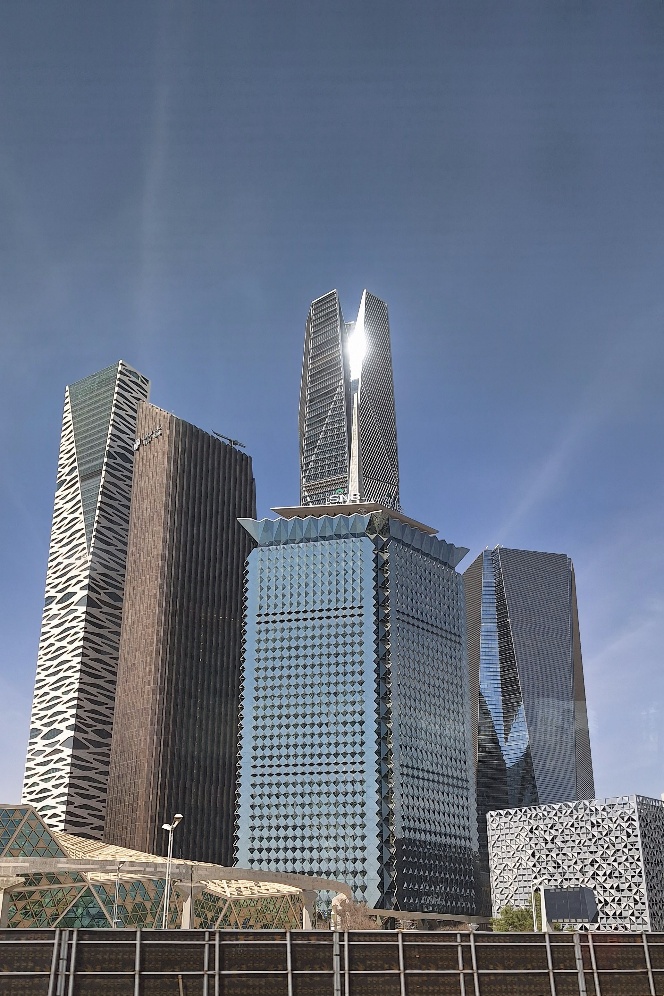
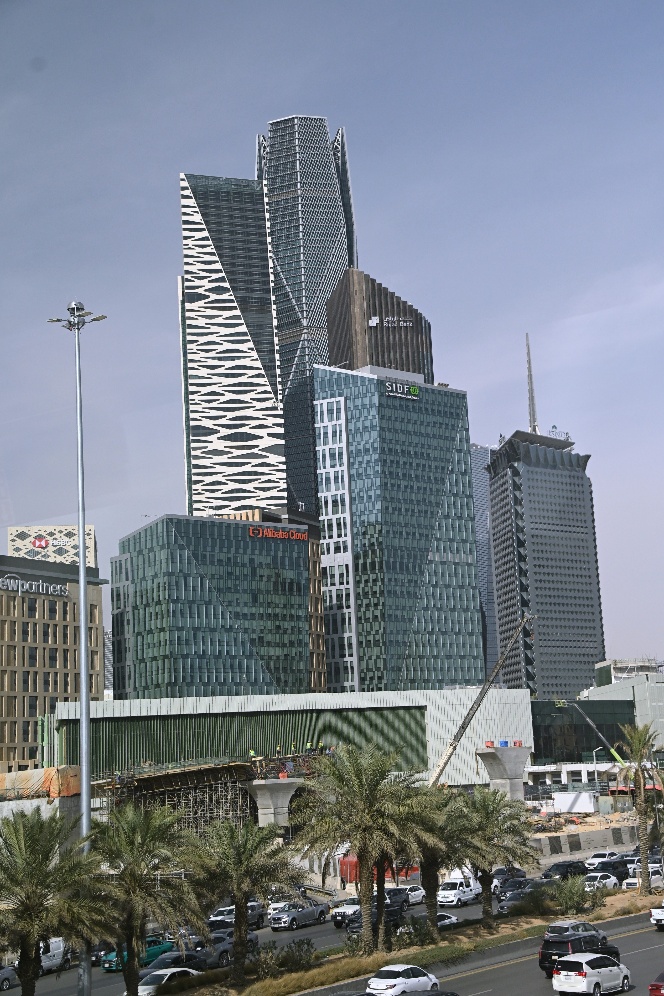
Originally, the intention was to build all 95 buildings simultaneously. But that ambition soon proved too ambitious. Developing everything at the same time sent costs soaring, while various disputes threw a spanner in the works. The planned opening in 2017 never materialised. The towering, almost empty skyscrapers became the laughingstock of the city – a luxurious ghost town along Riyadh's main thoroughfare.
The turning point came in 2016. MBS had taken charge and unveiled his Vision 2030. Failure was no longer an option. KAFD was placed under the control of the PIF, the Public Investment Fund, a sovereign wealth fund with USD 900 billion in assets. Management was restructured and the project finally regained momentum.
Foreign companies hoping to secure government contracts in Saudi Arabia would be well advised to establish their offices in KAFD. MBS leaves no doubt about that
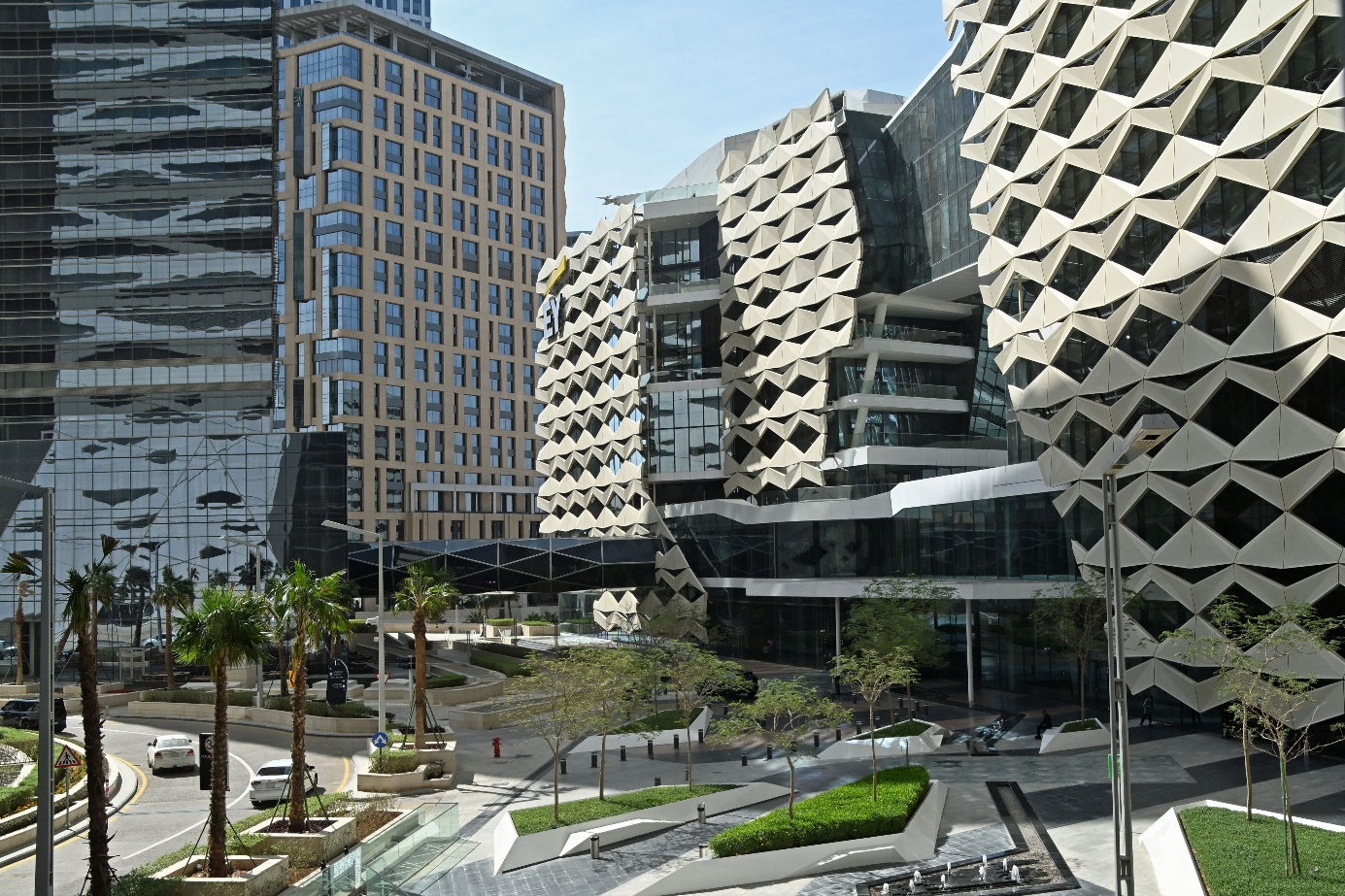
Ernst & Young Building
KAFD is much more than just a financial centre. Offices, residential complexes, hotels, shops, lifestyle facilities, sports and entertainment have all been deliberately integrated into the urban district. The intention from the outset was to create a vibrant neighbourhood. Today, 12,000 people actually live here. In the longer term, that figure is expected to reach at least 100,000. Foreign companies hoping to secure government contracts in Saudi Arabia would be well advised to establish their offices in KAFD. MBS leaves no doubt about that.
Metro Station KAFD |
|
|
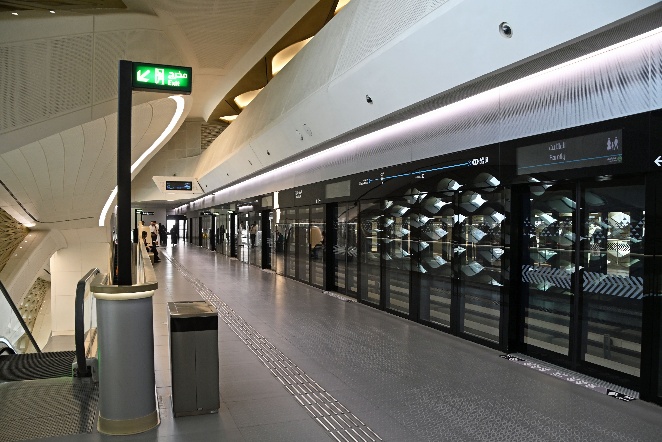
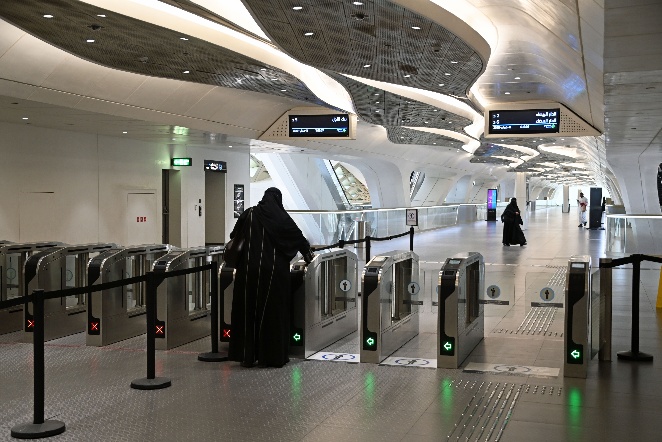
Sustainability is high on the agenda here. Cars are banned from most of KAFD. Pedestrians can get around using, among other things, a network of 42 air-conditioned skywalks connecting the buildings, stretching for a total of 15.46 km (9.6 miles). You won't see garbage trucks driving through the streets either. All waste is removed by an automated underground collection system. Solar panels, a water treatment plant and a central district cooling system complete the picture. The shade cast by the buildings and the air currents that typically develop between high-rises create a microclimate in which the perceived temperature is lower than elsewhere.
A short ride on Metro Line 1 takes us from Al Murooj to the highly acclaimed KAFD Metro Station. You couldn’t wish for a better gateway into the KAFD – for this gem was designed by the renowned Zaha Hadid, the Iraqi-British architect who created iconic buildings all over the world.
She drew some of her inspiration from the dune landscapes of the Arabian deserts
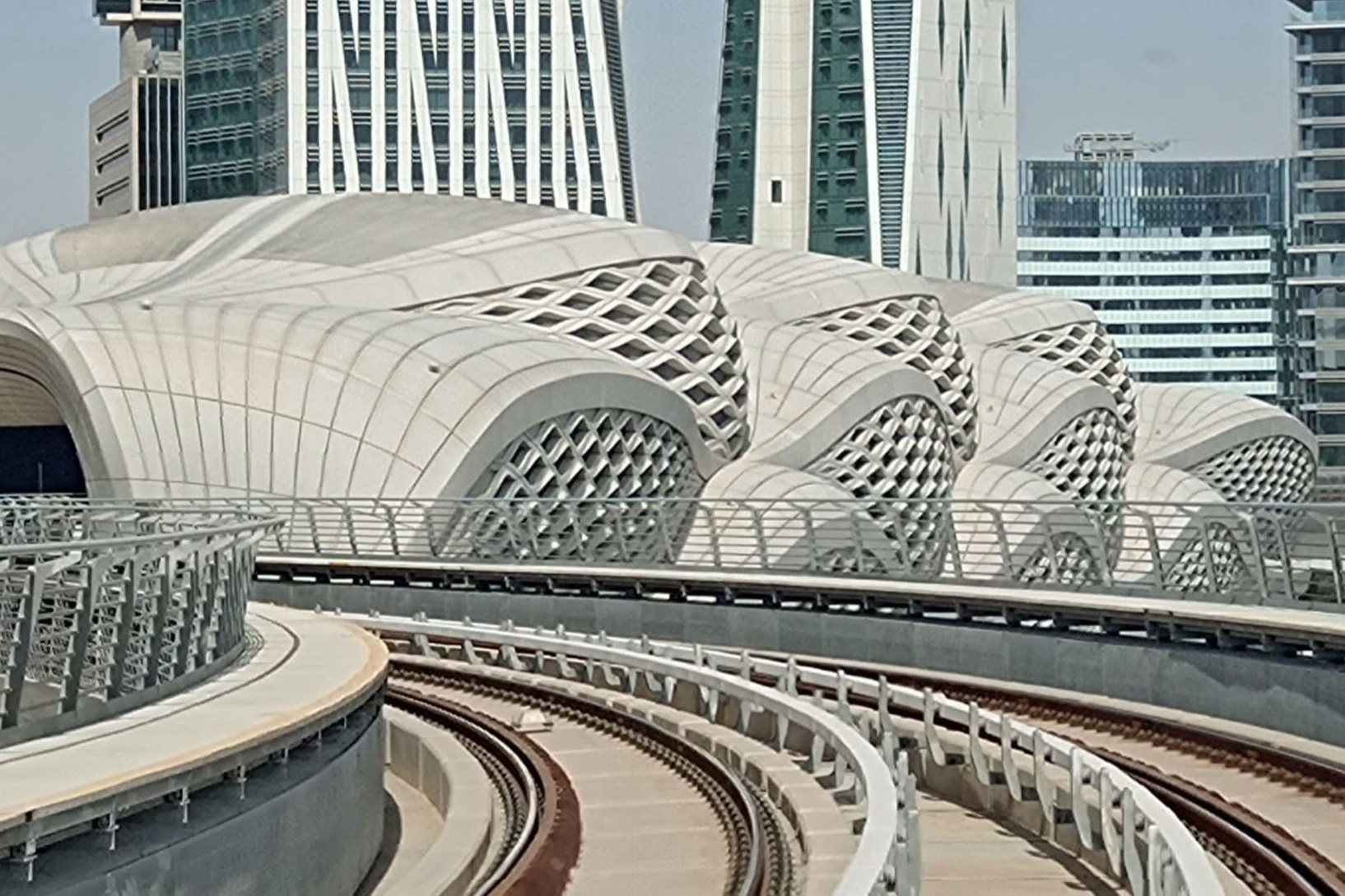
Metro Station KAFD
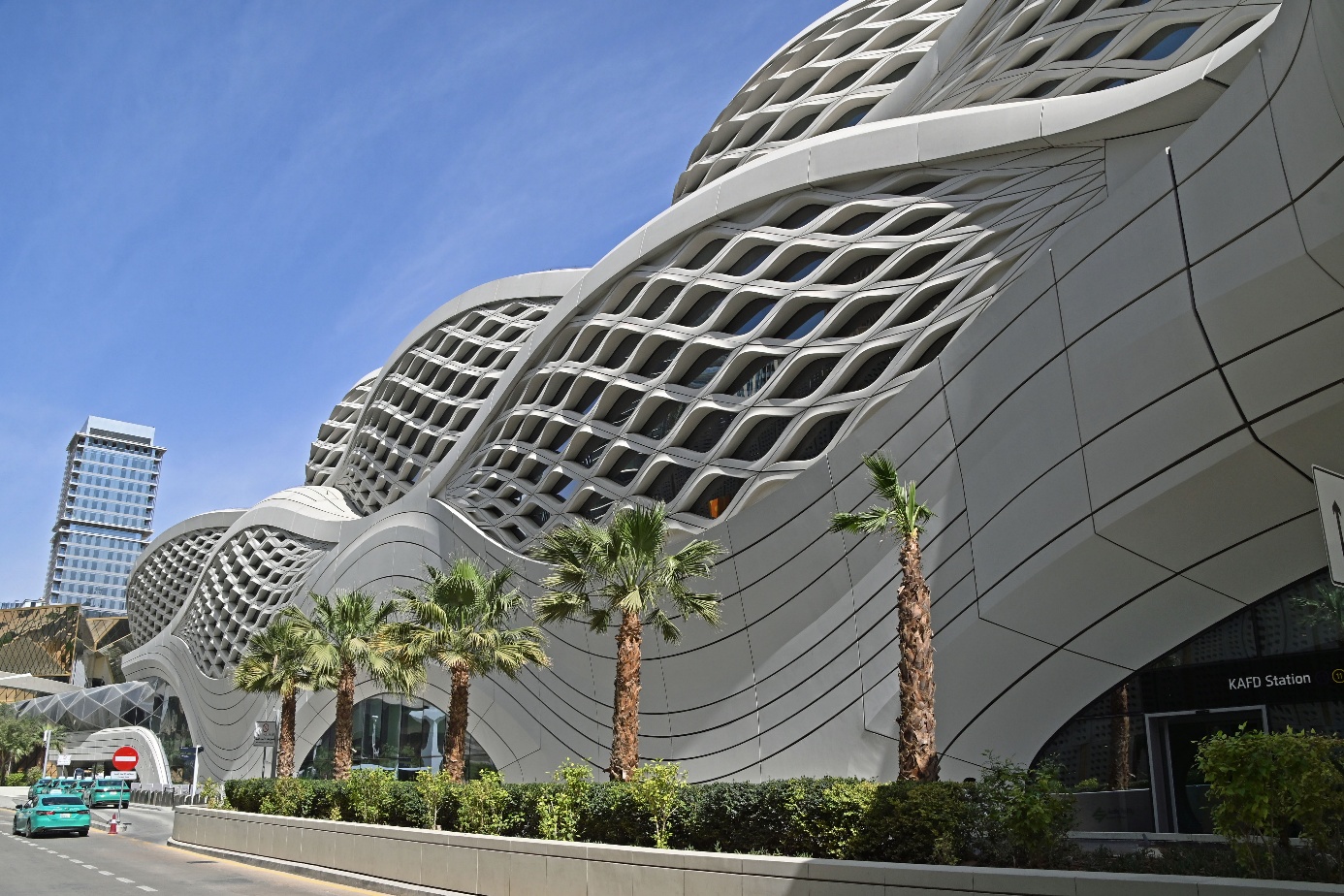
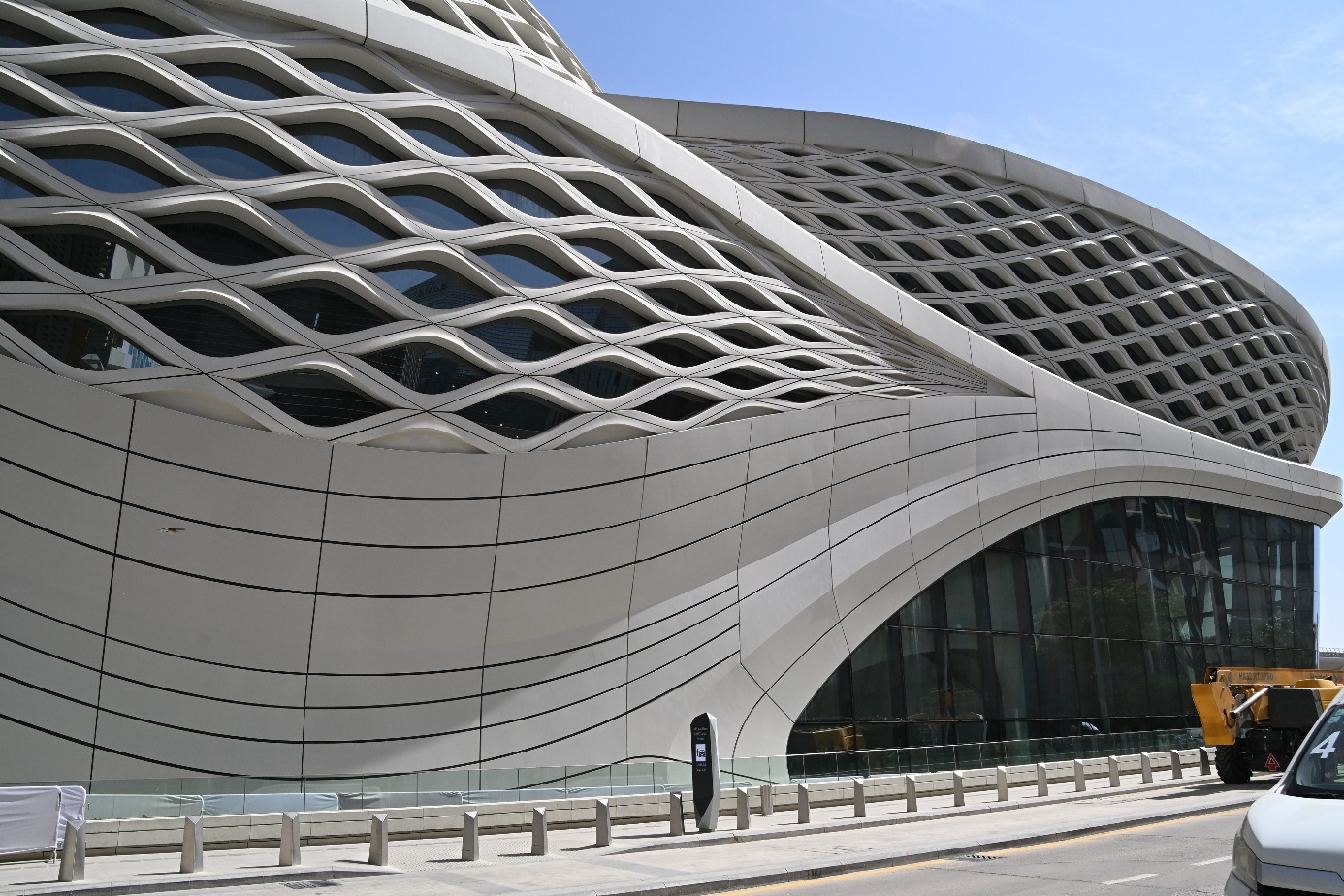
She drew some of her inspiration from the dune landscapes of the Arabian deserts. Hence the sweeping curves of the roof. For cooling, ventilation and natural light, she turned to traditional Arab architecture, where windows are often fitted with a mashrabiya, an intricately carved wooden lattice screen. Hence the diamond-shaped lattice pattern on the side walls. The flowing lines, harmonious shapes and graceful elegance make us forget entirely that we are standing in one of Riyadh's largest metro stations – a gigantic structure covering 45,000 m² (484,000 ft²). The station only opened its doors on 1 December 2024.
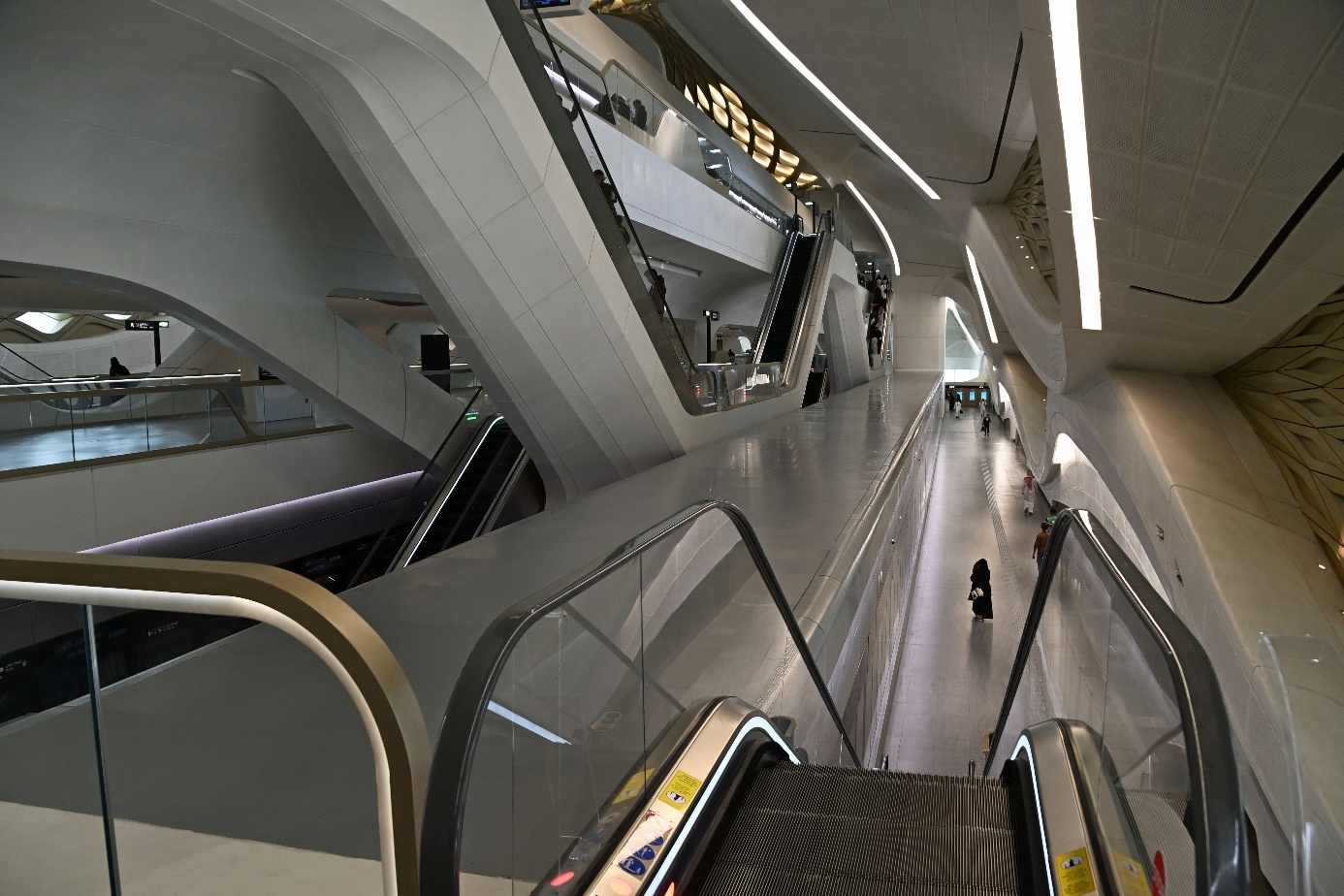
As soon as we step out into the brand-new building, we are overcome by a genuine sense of wonder and admiration, but also of confusion. Gone are all the straight lines, right-angled walls and box-like structures with their geometric shapes. Here, everything is elegance and grace, with flowing lines, rounded forms and futuristic settings bathed in light. It is not an environment our sense of direction is accustomed to. Fortunately, all we have to do is follow Noura. She expertly guides us through corridors, along escalators and across walkways until we finally reach the outside.
Air-conditioned skywalk |
|
Window cleaners |
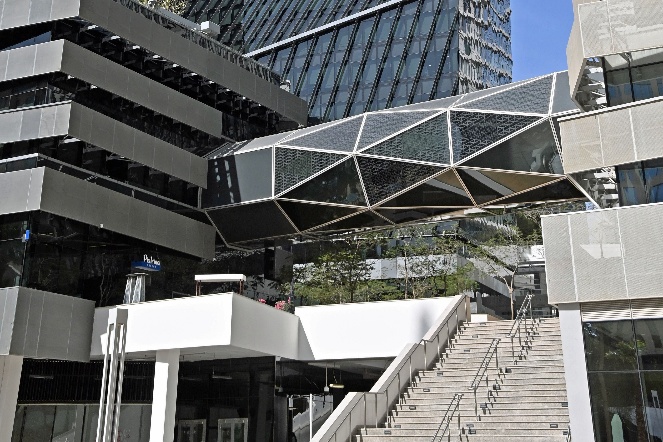
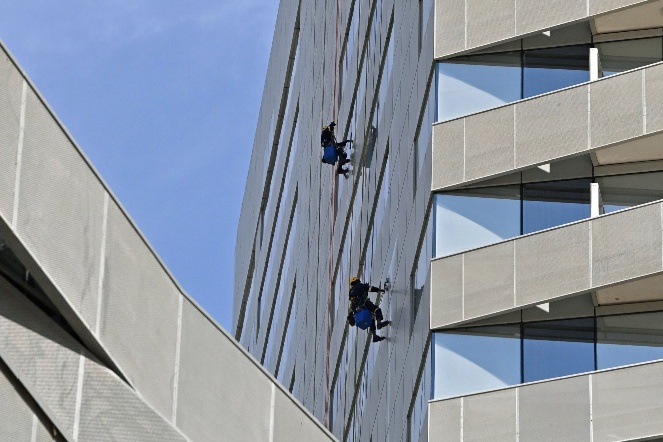
We are now in the heart of KAFD, where we can feast our eyes on the extraordinary collection of skyscrapers. More than 25 international architectural firms have contributed to the project. This explains the sheer diversity. Not one building has anything in common with any of the others. On the contrary, they seem to have made a game of standing out from one another and, above all, distancing themselves from anything remotely resembling classical architecture.
For the Great Mosque at KAFD, the architects drew inspiration from a desert rose
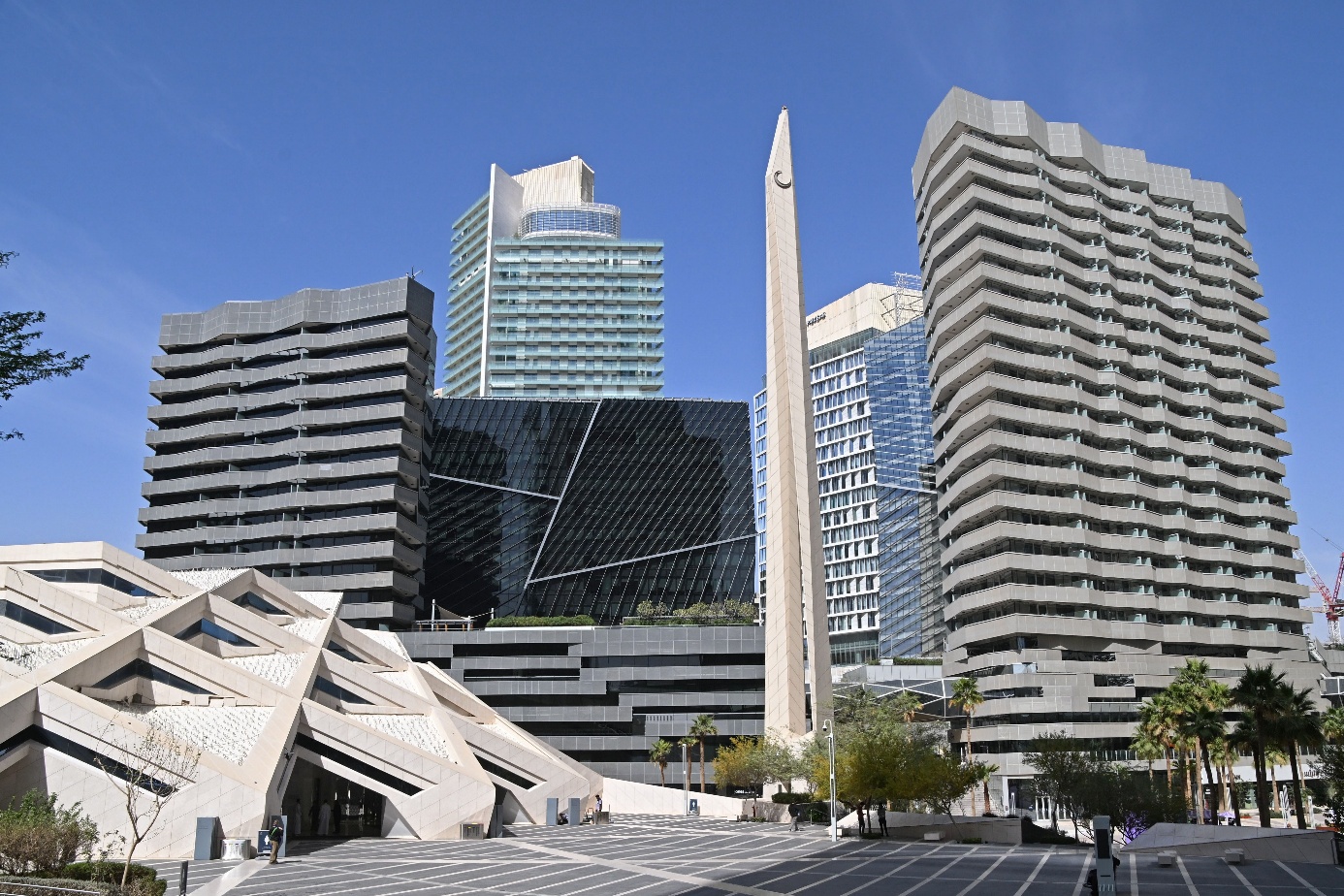
Grand Mosque (left) with minaret
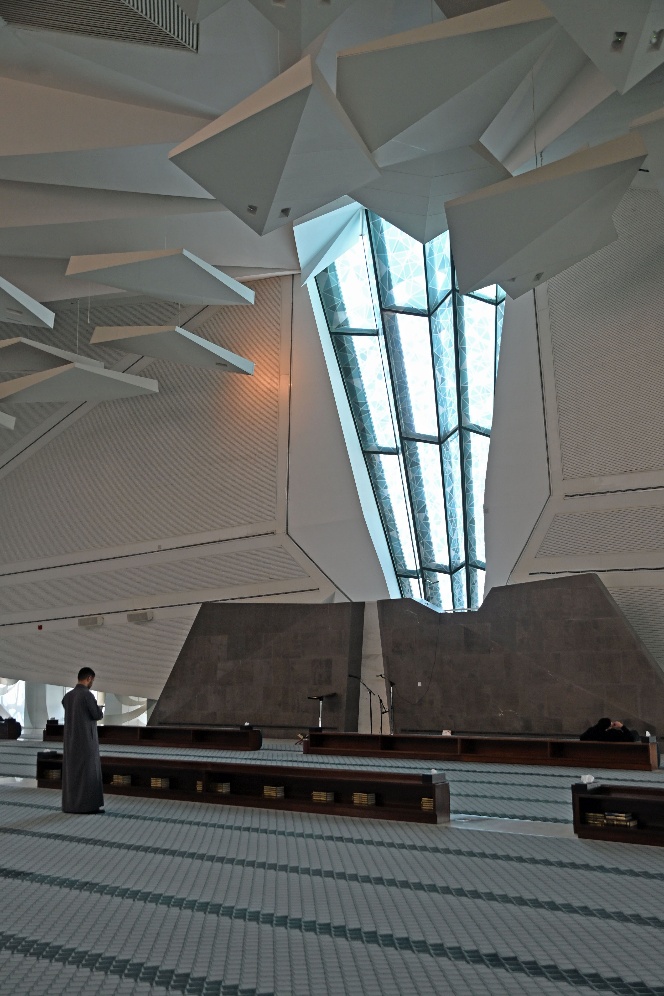
The Grand Mosque is particularly striking. Not because of its height – it looks like a dwarf among all those towering buildings – but because of its futuristic design. The architects drew their inspiration from the desert rose. At the same time, they made sure to incorporate traditional Islamic patterns into the building.
The result is an enormous prayer hall covering 6,103 m² (65,692 ft²), without a single pillar to support the ceiling. Together with the floating mezzanine, it can accommodate 1,466 worshippers. At the moment, a handful of the faithful are praying or meditating. The towering mihrab, which indicates the direction of Mecca, is made of coloured glass. Outside, two stylised minarets, each 60 metres (197 ft) tall, mark the entrance to the mosque.
Grand Mosque – Mihrab |
|
Minaret |
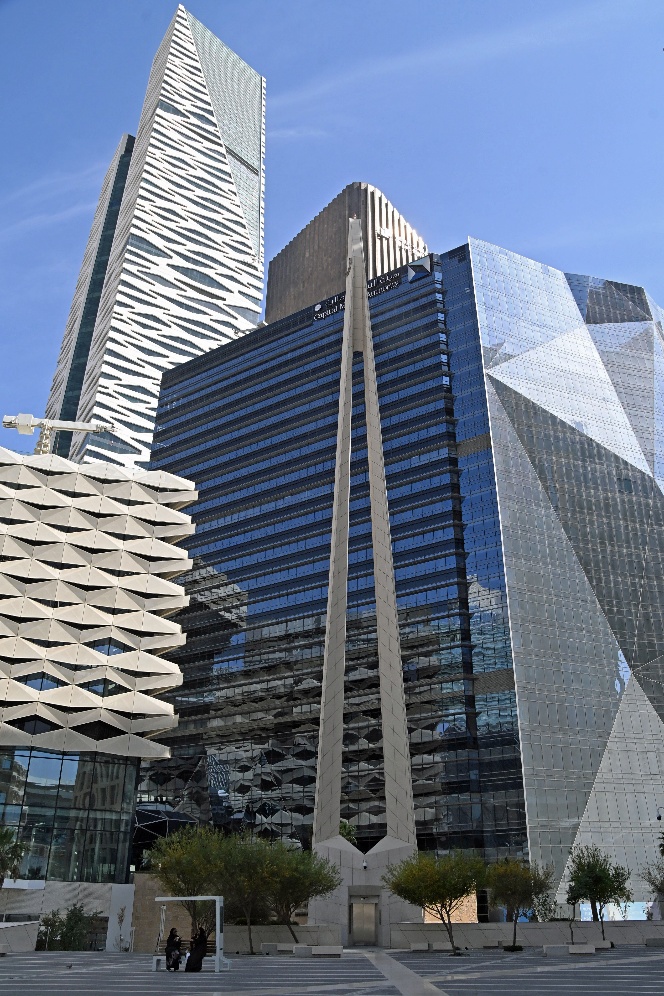
Al Wadi is the name given to the sunken open square in front of the mosque – a nod to the many desert valleys found throughout Saudi Arabia. From the Wadi, winding paths branch off in all directions. Greenery and small fountains add a touch of colour to this world of concrete, and, whenever possible, provide a little cooling and shade.
A 304-meter-long (997 ft) ‘fissure’ runs down the centre of the façade, creating the impression of a vertical ‘wadi’
Crystal Towers with PIF Tower |
|
World Trade Center with vertical ‘wadi’ |
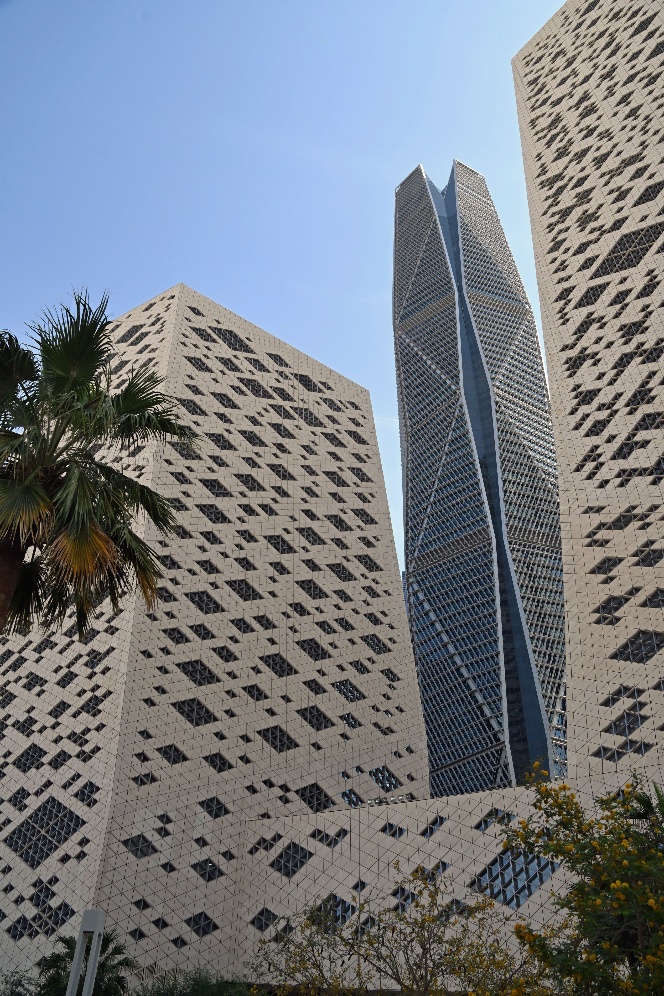
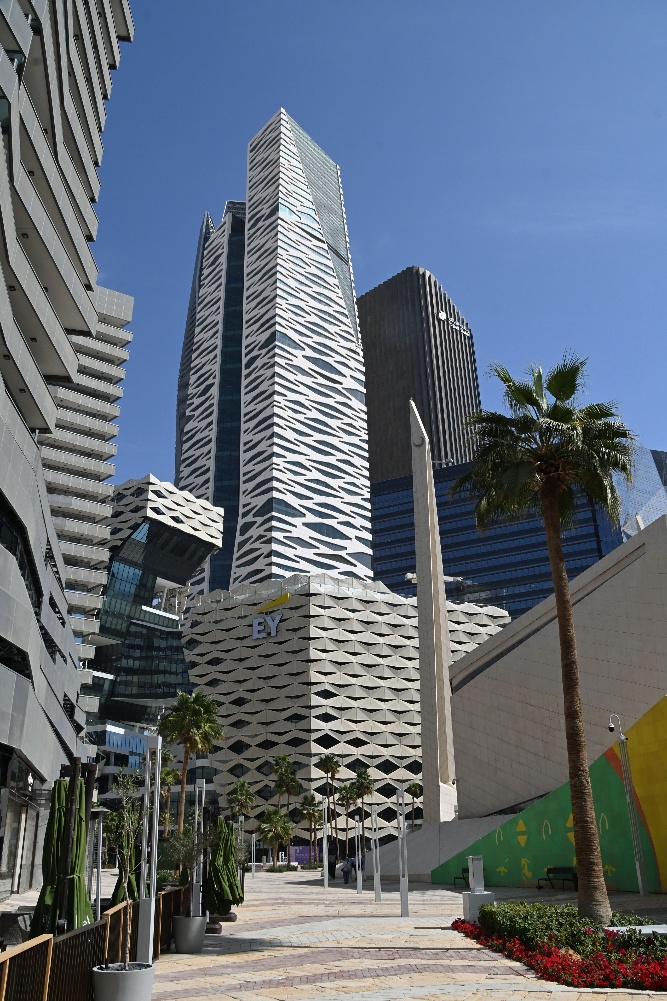
We wander through this surreal setting, craning our necks and gazing up at all the extraordinary features with which these colossal towers seem to be competing to outdo one another. At the centre stands the PIF Tower, the tallest of them all at 385 metres (1,263 ft), and arguably the most important too. For that is where the Public Investment Fund is headquartered, the sovereign wealth fund that owns KAFD. It is the enormous facets of its façade that really catch the eye. The six-sided building is supported entirely from the outside by steel tubes filled with concrete. This leaves each of its 80 floors with an open-plan interior free of columns, offering maximum flexibility.
The Crystal Towers, which house HSBC's offices, also seek to keep out the extreme desert heat with a structure inspired by traditional mashrabiyas. The deeply recessed windows form dark geometric openings in the light-coloured façade.
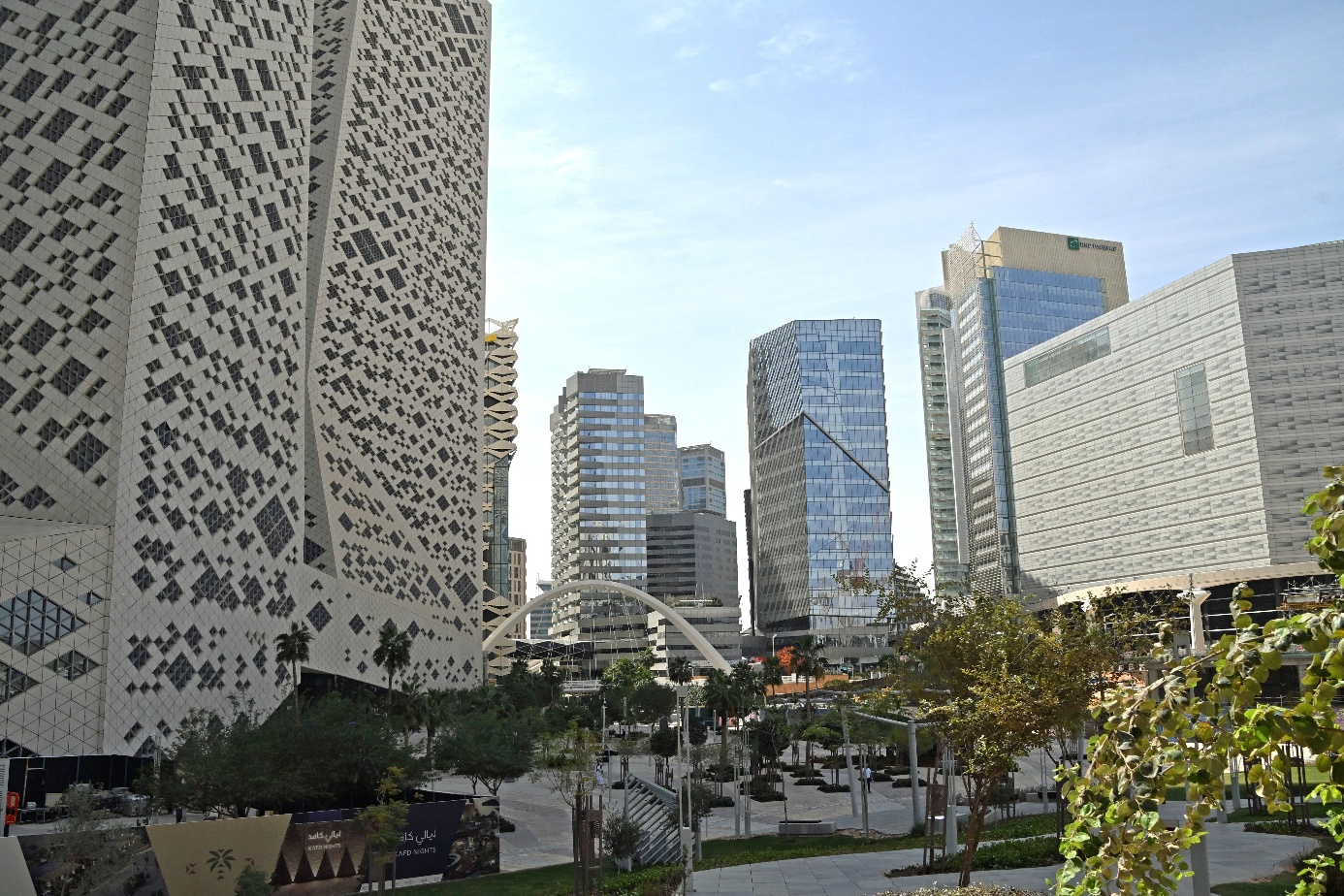
Al Wadi
The World Trade Centre, by contrast, has been designed to resemble a massive rock split in two. A 304-meter-long (997 ft) ‘fissure’ runs down the center of the façade, creating the impression of a vertical wadi. Behind the glass walls of this wadi, the office spaces are bathed in an oasis of light. Equally striking is the irregular pattern of white composite panels interspersed with dark openings across the exterior façades.
Dozens of triangular façade facets, each extending over some twenty floors, give the building an ever-changing appearance
Muqarnas Tower |
|
Hilil Tower |
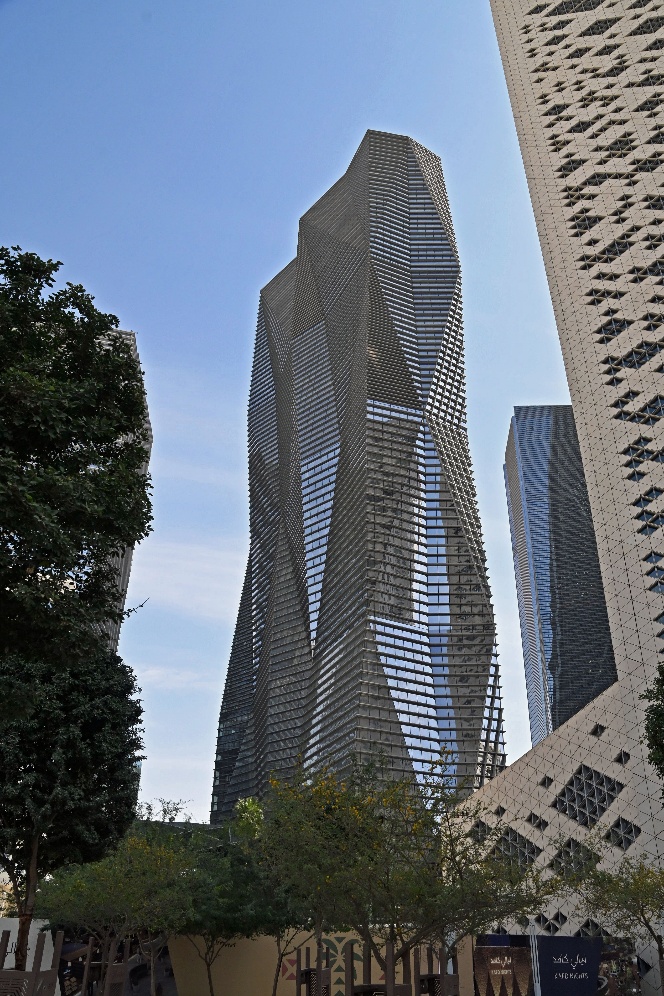
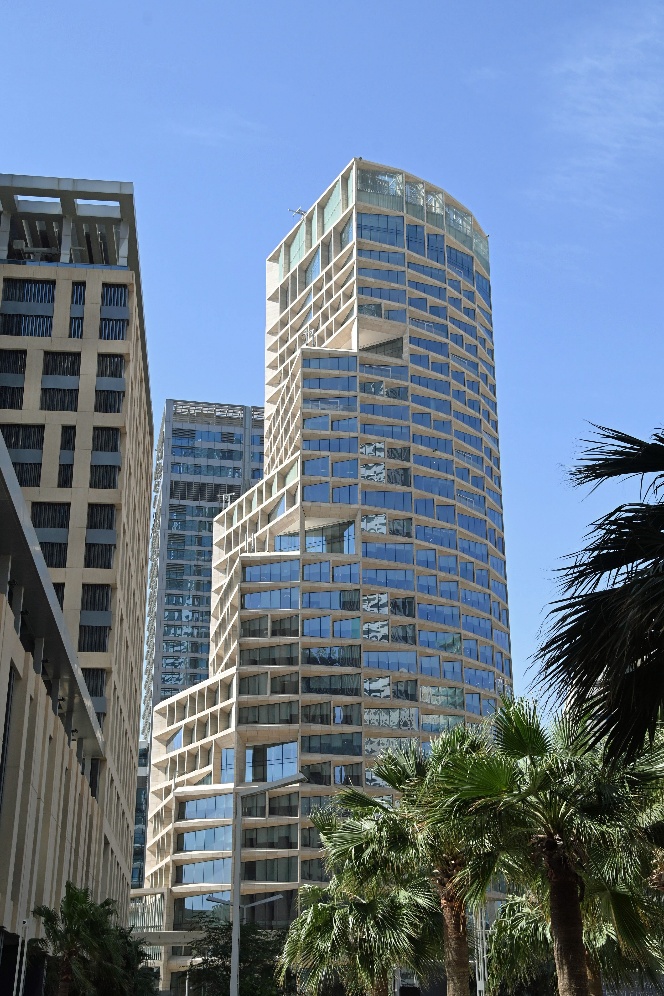
One of the most distinctive buildings is undoubtedly the Muqarnas Tower. Its name says it all: the façade design of this skyscraper is inspired by traditional muqarnas. This decorative feature is sometimes also referred to as honeycomb or stalactite vaulting. It is one of the most archetypal elements of Islamic architecture, and muqarnas can be found inside domes, vaults, portals, niches and the like. They are said to evoke the stalactites that the Prophet Muhammad must have seen when he took refuge in a cave.
Here, however, these characteristic three-dimensional patterns have been applied to the building's exterior façade. The result is a stunning structure. Dozens of triangular façade facets, each extending over some twenty floors, give the building an ever-changing appearance. What's more, this design makes it possible to create up to eleven corner offices on each floor – a significant advantage for executives who regard such offices as a status symbol.
Not one building has anything in common with any of the others
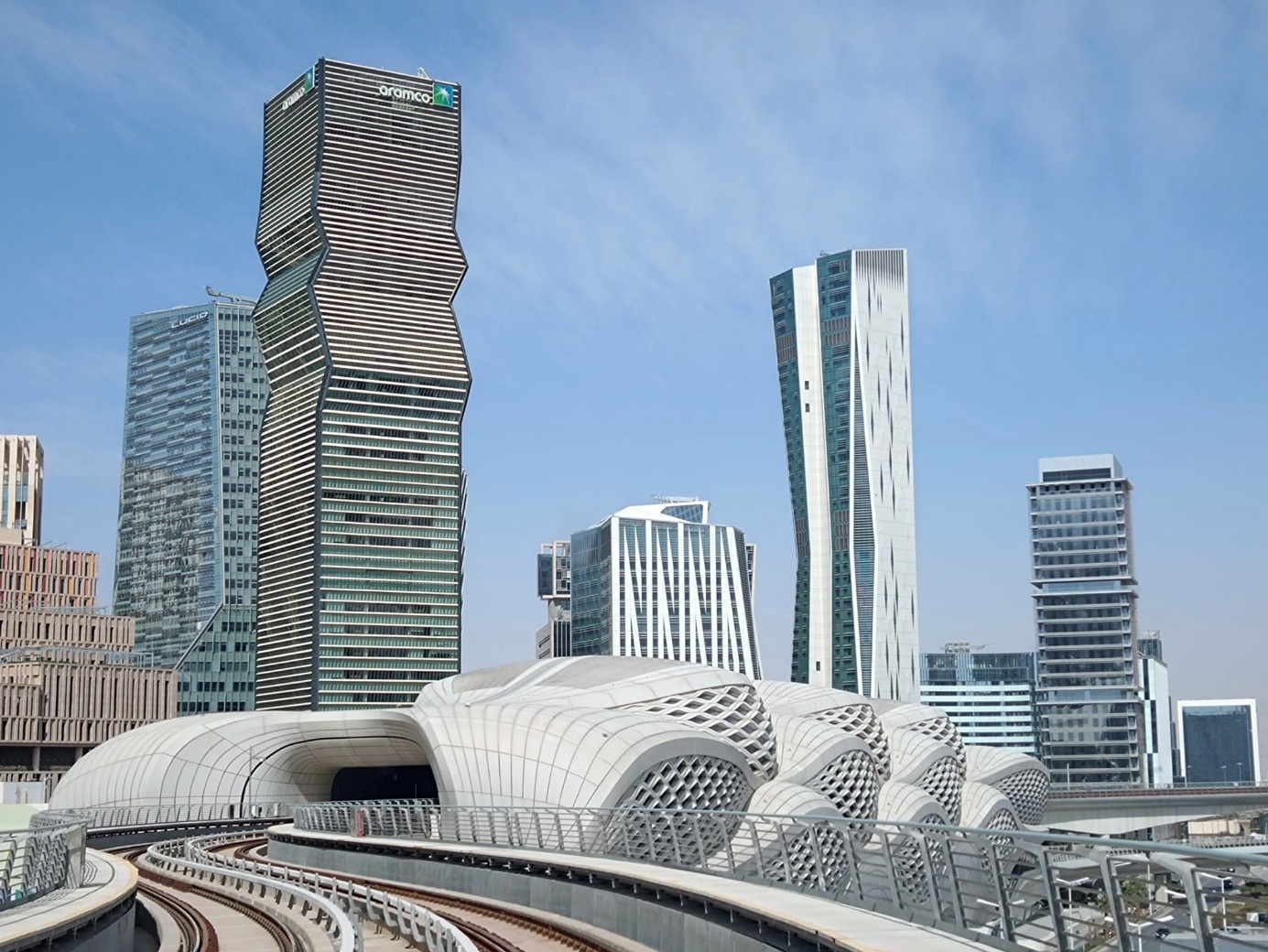
Metro Station with KAFD skyline
Our departure is now gradually approaching, not only from KAFD, but also from this country. If you leave KAFD by metro, it is best to take your place in the last carriage. That way, you get a magnificent view of the metro station and the futuristic urban district, which has few equals anywhere in the world. As this image becomes etched in our minds, we cannot help reflecting on the enormous gulf between this showcase of ultra-modern architecture and the many anachronisms of the deeply conservative regime that has the country in its grip.
Jaak Palmans
© 2026 | Version 2026-11-01 14:00
