Little blonde, great past
Saudi-Arabia | Anno 2026
Sunday 8 february | Buraydah
Monday 9 february | Buraydah – Ushaiger – Riyadh
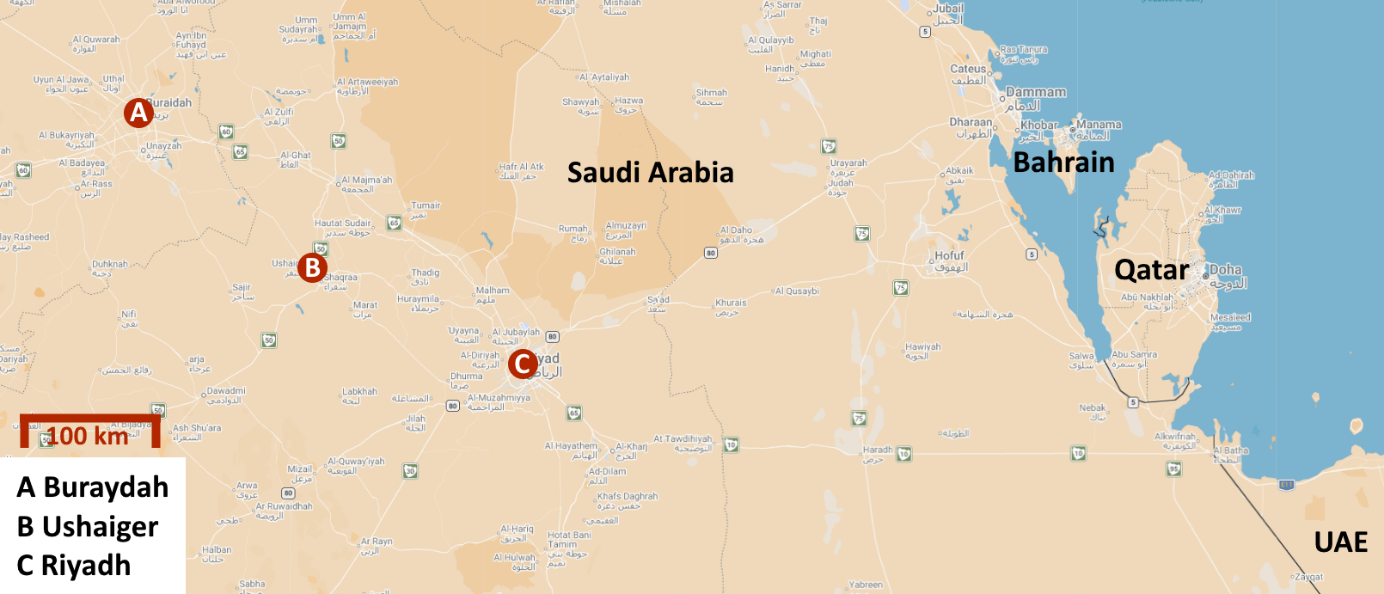
Sunday 8 february | Buraydah
Without dates and dromedaries, Saudi Arabia simply could not have existed. The man to whom this bold statement is attributed knew what he was talking about, for he was the legendary founder and first king of modern Saudi Arabia.
What King Abdulaziz Al Saud was really drawing attention to was the fundamental problem of survival in the unforgiving Arabian desert. The dromedary was above all an indestructible means of transport, but it also provided meat and milk. The date palm, meanwhile, was readily available as a nutritious source of calories – not only in the oases, but also among the nomads of the desert, because once dried, dates were easy to transport. Together, dates and dromedaries made life on the peninsula possible for millennia. Without them, the vast interior would probably have remained uninhabited.
Together, dates and dromedaries made life on the peninsula possible for millennia. Without them, the vast interior would probably have remained uninhabited
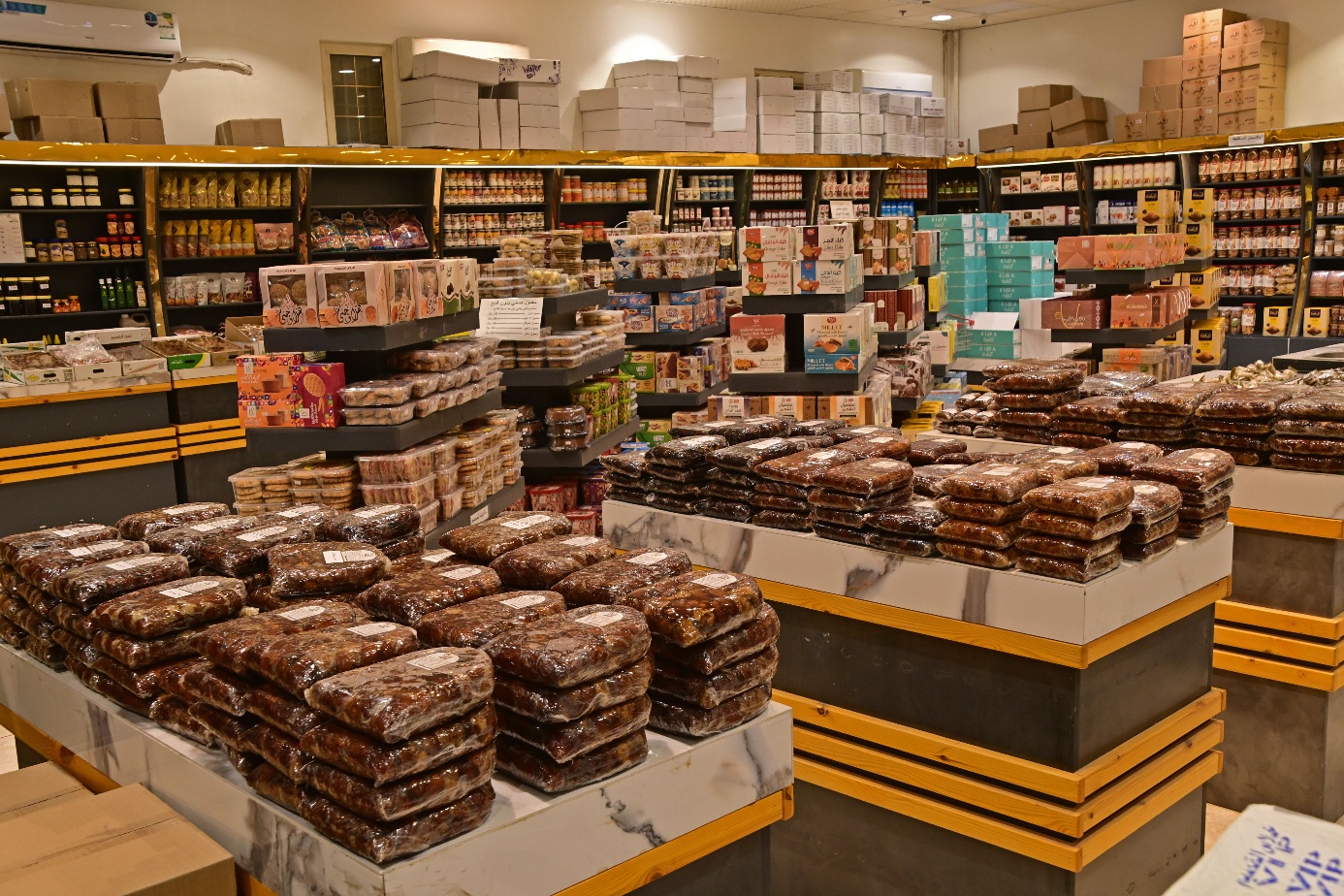
Buraydah – Date market
Dates and dromedaries – in Buraydah, they know all about them. It is no coincidence that this city of more than half a million inhabitants is known as the agricultural capital of Saudi Arabia. The city is home to one of the largest date markets in the world, while thousands of camels are offered for sale every day at the camel market. There are also extensive livestock markets for sheep, goats, cattle and poultry. In the surrounding area, farms produce enormous quantities of fruit and vegetables – especially figs, strawberries, grapes and pomegranates.
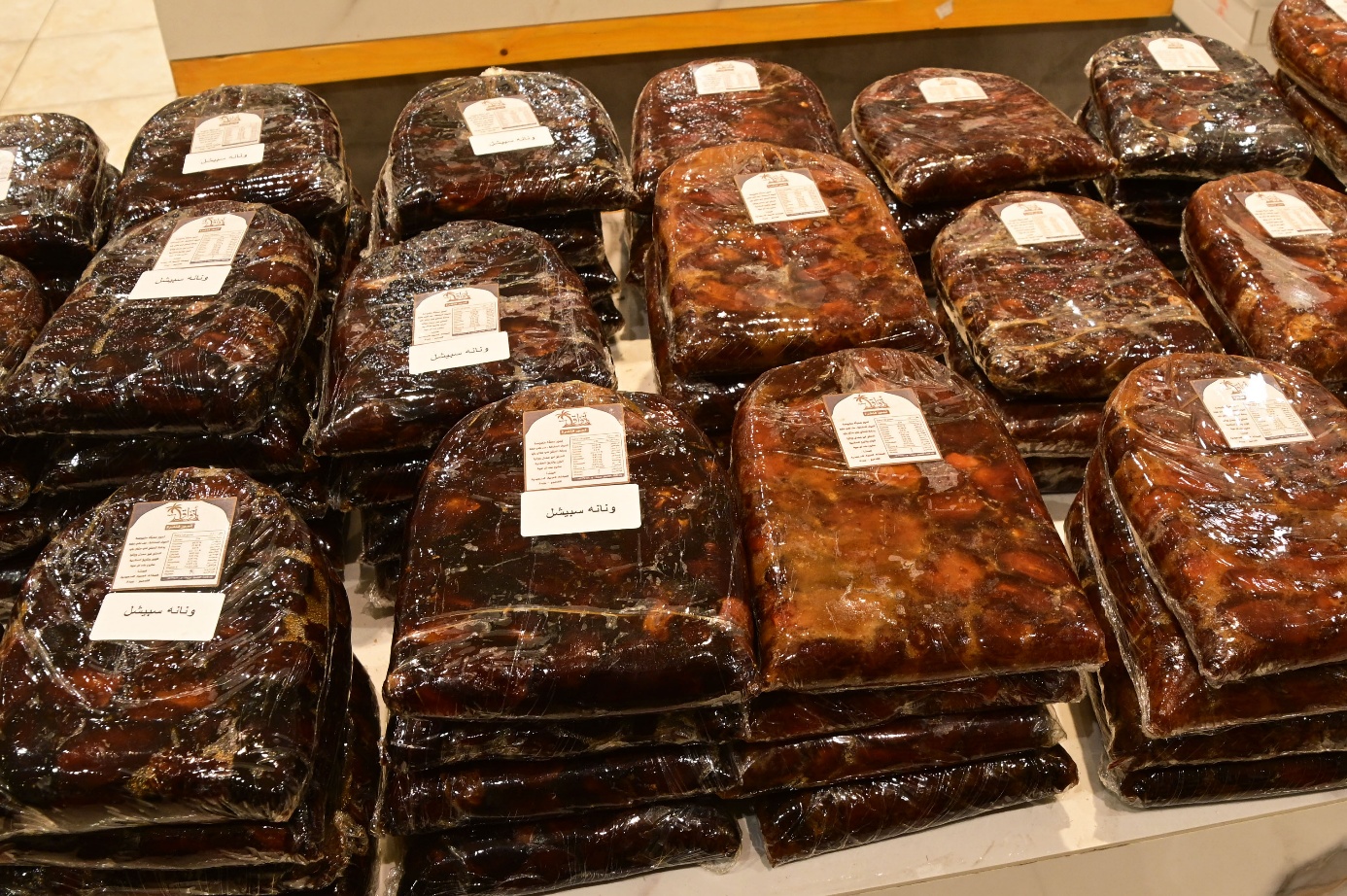
It is already quarter to seven when we arrive in Buraydah in complete darkness. A visit to the date market itself is no longer an option, so we have to make do with a series of shops that are still open. But even these manage to astound us. They are small supermarkets stocking nothing but dates and products derived from them – fresh dates, dried dates, preserved dates, date paste, date syrup, date jam, date vinegar, date juice, date butter, date powder, date dough, liquid sugar made from dates, and even medicinal preparations and baby food made from dates.
They are small supermarkets stocking nothing but dates and date-derived products
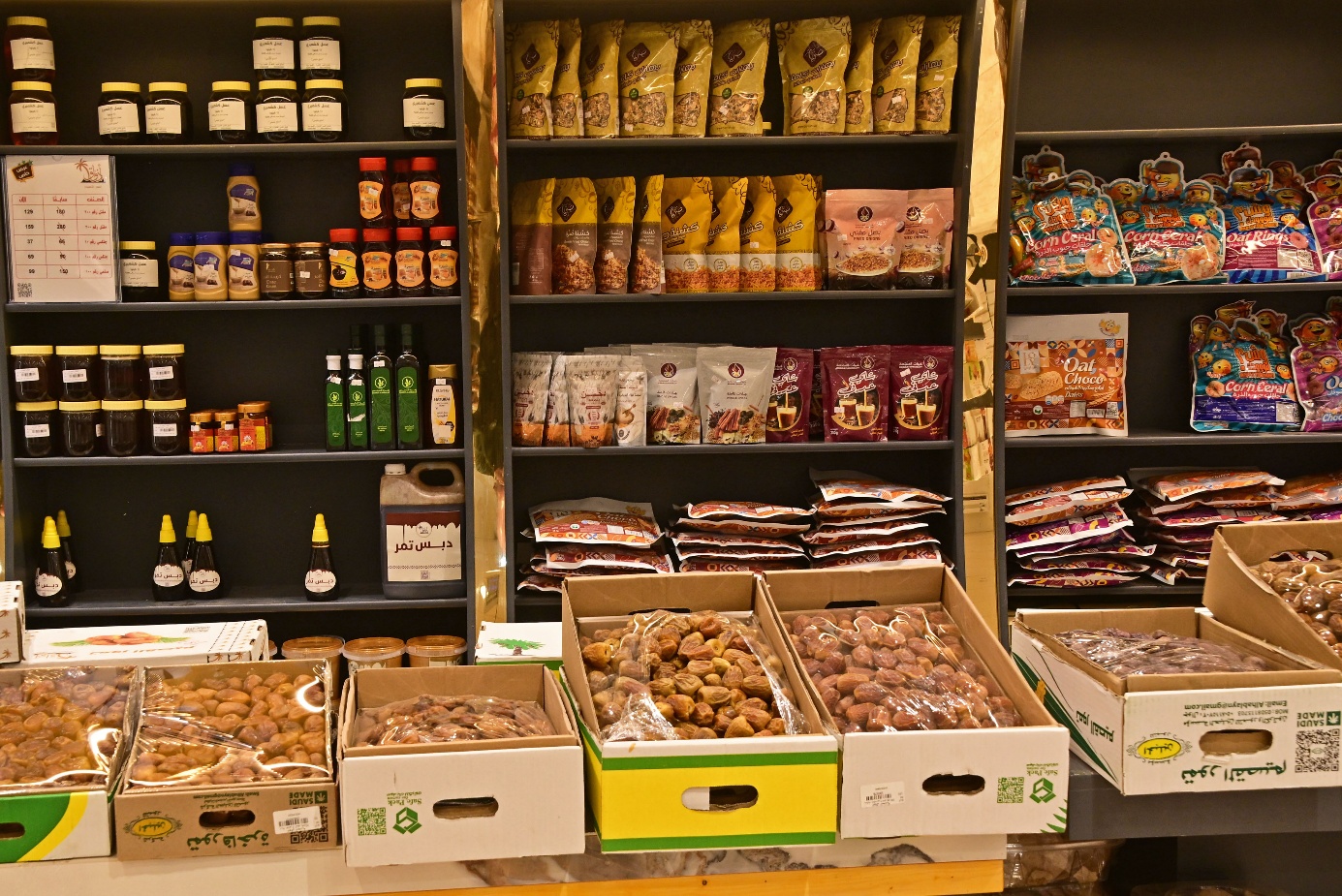
With such a wide variety to choose from, it is hardly surprising that every Saudi – children, adults and the elderly alike – consumes an average of 35.1 kg (77 pounds) of dates a year. There are no fewer than 34 million date palms spread across the country. Just slightly fewer than the number of inhabitants. A mature date palm can be expected to produce around 70 to 140 kg (154 to 309 pounds) of dates each year, bringing the annual production to 1.5 million tonnes. In short, this is a multi-billion-dollar industry.
Dates are therefore an essential part of Saudi culture, economy and gastronomy. This is not only a matter of taste and nutritional value, but also of religious significance. Muhammad, after all, used to break his fast by eating dates – always an odd number, incidentally. Today, dates are the first thing Muslims consume at iftar, the meal with which they break their fast shortly after sunset during Ramadan.
Pollination is carried out by hand, by workers climbing up ladders to literally lend nature a helping hand
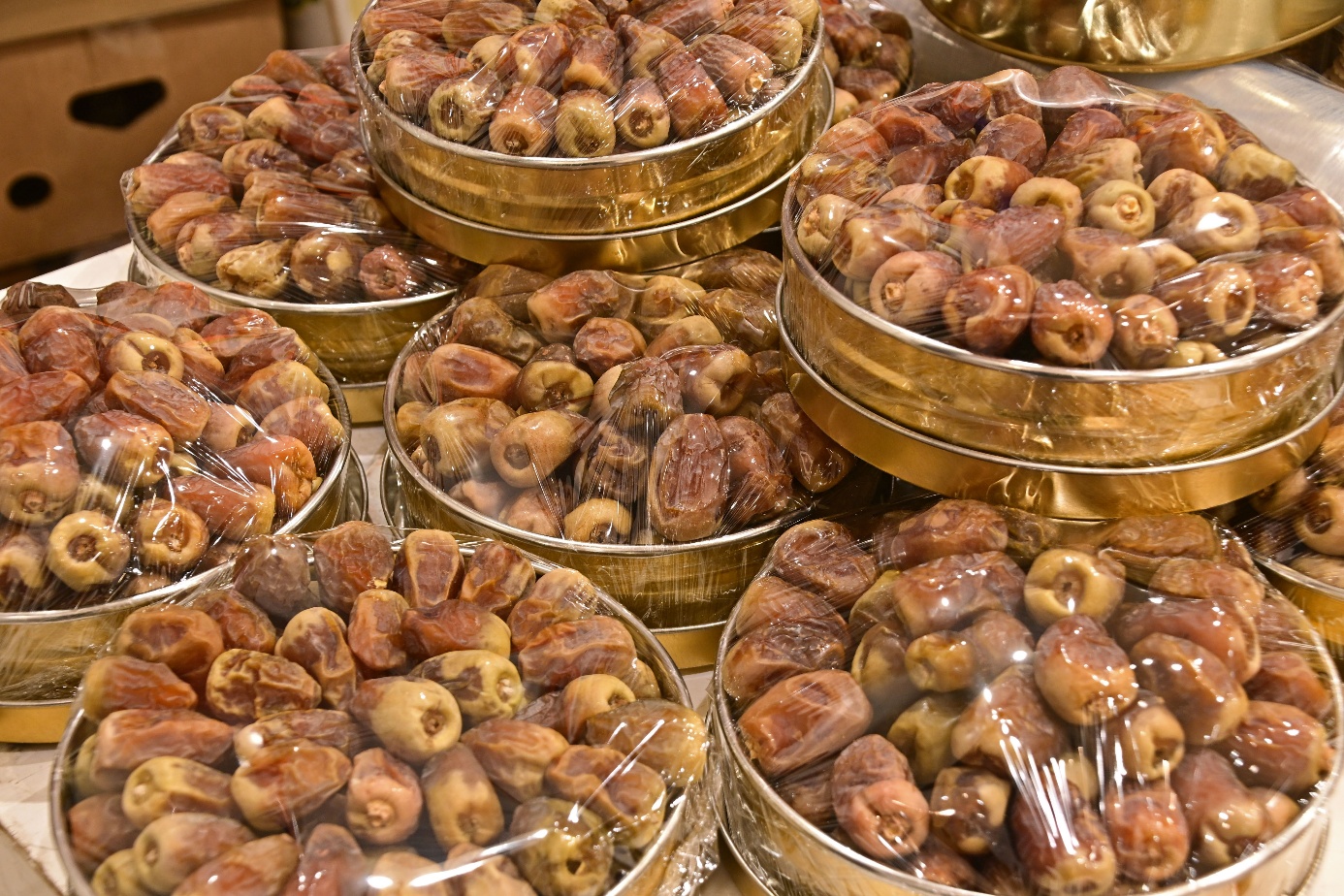
According to Islamic tradition, moreover, an iftar is said to earn a thousand times as much thawab, or reward for a good deed, if you break your fast with a date. One of Muhammad’s recommendations was even to eat seven dates in the morning, because doing so would protect you from poison or magic for the rest of the day.
There are between 250 and 300 varieties of dates known worldwide, around fifty of which are found in Saudi Arabia. But they are not all equally delicious. The ajwa is generally regarded as the finest. Originally, it grew only in the area around Medina. The ajwa is particularly prized for its rich flavour and exceptional nutritional value. Also very popular are the soft, extremely sweet sukkari and the khalas, which keeps well for long periods. It is mainly these latter two varieties that are exported abroad.
Rich in fibre, rich in essential minerals, rich in antioxidants, rich in energy from natural sugars – so, healthy and delicious
Another important fact is that date palms are dioecious. This means that there are male and female palm trees, and that the wind is responsible for pollination. This is hardly ideal for growers, as they are entirely at the mercy of nature. What is more, half of their trees – the male ones – produce no fruit at all and simply stand there doing nothing.
Commercial plantations therefore take reproduction into their own hands. For every hundred or so female trees, they cultivate just one male tree. Pollination is carried out by hand, by workers climbing up ladders to literally lend nature a helping hand. Harvesting takes place from July to September – during the hottest days of the year, in other words.
Meanwhile, we marvel at the enormous selection in the date shop, the many varieties and their numerous uses. Dates are widely praised for their many qualities – rich in fibre, rich in essential minerals, rich in antioxidants and rich in energy from natural sugars. Healthy and delicious – what more could you ask for? Laden with all manner of boxes, packets and bottles, we climb back onto Mouhajir’s bus and let it take us to the hotel.
Monday 9 february | Buraydah – Ushaiger – Riyadh
Not only is Buraydah's date market the largest in the world, but its camel market has also claimed that title. The fact that they make exactly the same claim in the Indian town of Pushkar does not detract from it. For Pushkar’s camel market is indeed the largest in the world when it comes to an annual event. But when it comes to a permanent market, where you can buy and sell camels day in, day out, Buraydah leaves the competition trailing far behind.
Not only is Buraydah's date market the largest in the world, but its camel market has also claimed that title
Buraydah – Camel market
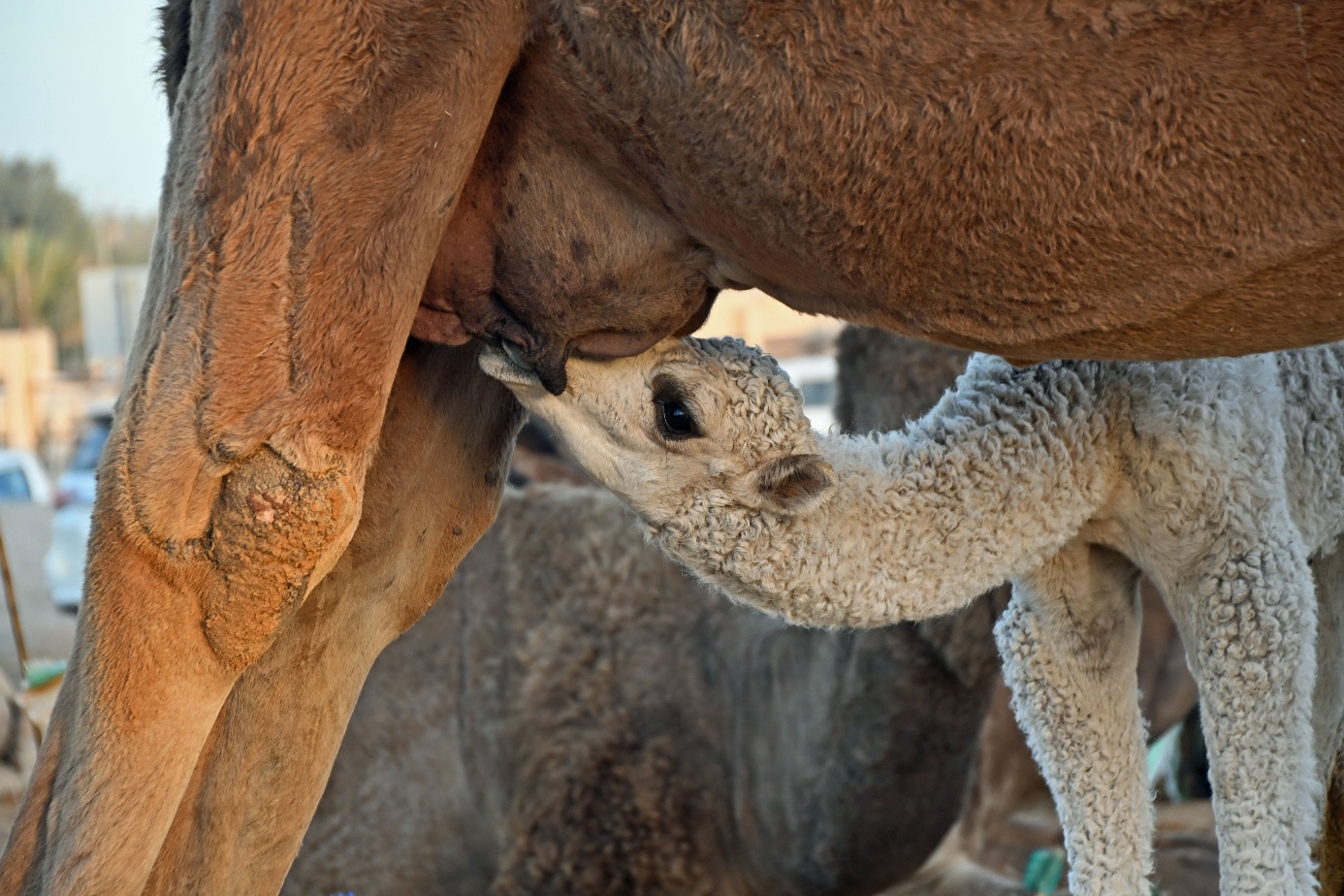
We won't notice much of that today, though, because this camel market only really gets busy at the weekend – on Thursday and Friday, that is. On a Monday like today, things are likely to be fairly quiet. Even so, the spectacle is still fascinating enough to get out of bed early for. Early, in this case, means half past five. For the market gets under way at around six in the morning, just after fajr, the first prayer of the day.
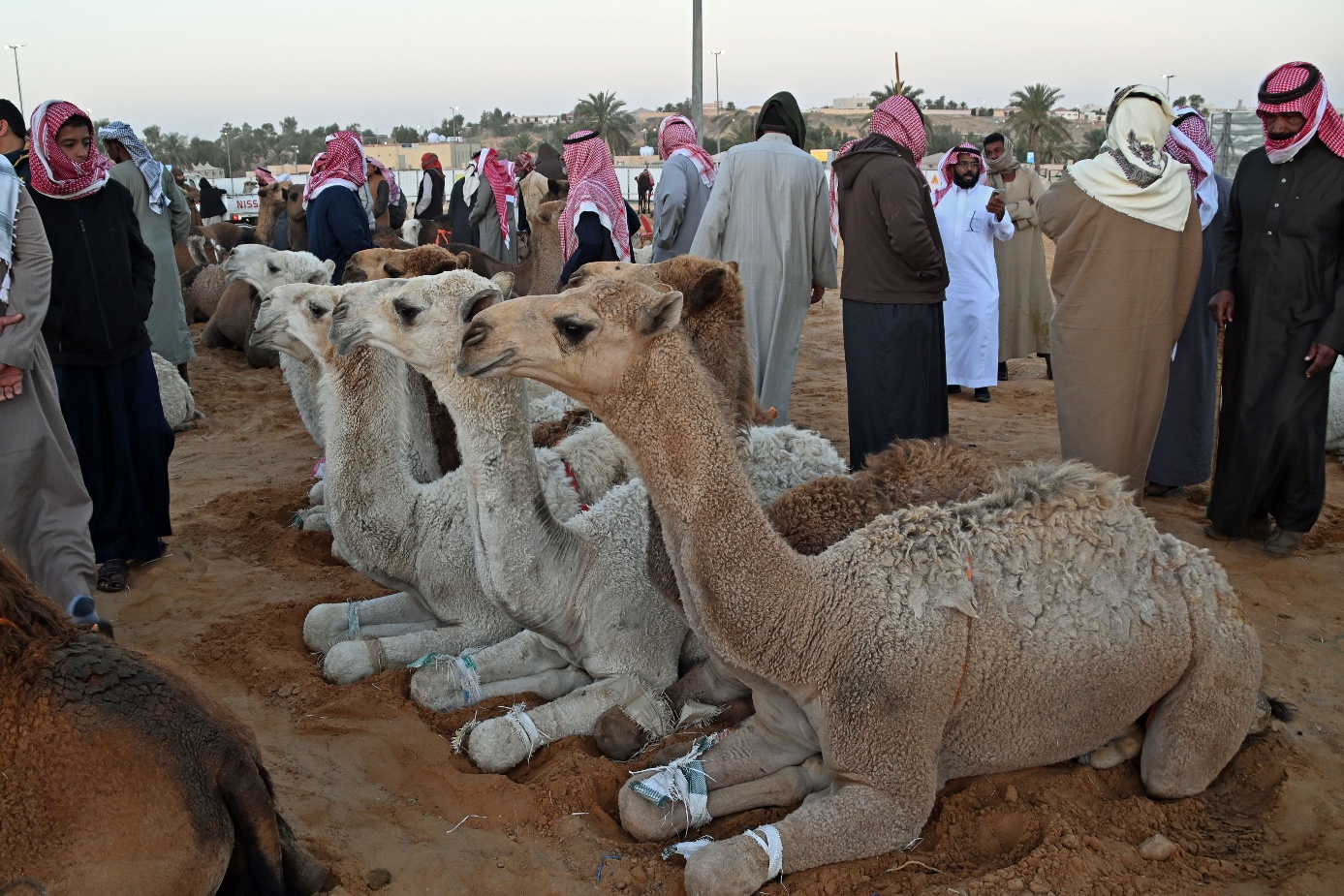
On the sandy site on the eastern edge of the city, it is indeed a hive of activity. As the first rays of the rising sun sweep across the sandy ground, a hectic spectacle unfolds, with busy Bedouins, often smartphone in hand, and hundreds of dromedaries in every colour and size. One thing that immediately stands out is that the camel market is an exclusively male affair. There is literally not a single woman in sight.
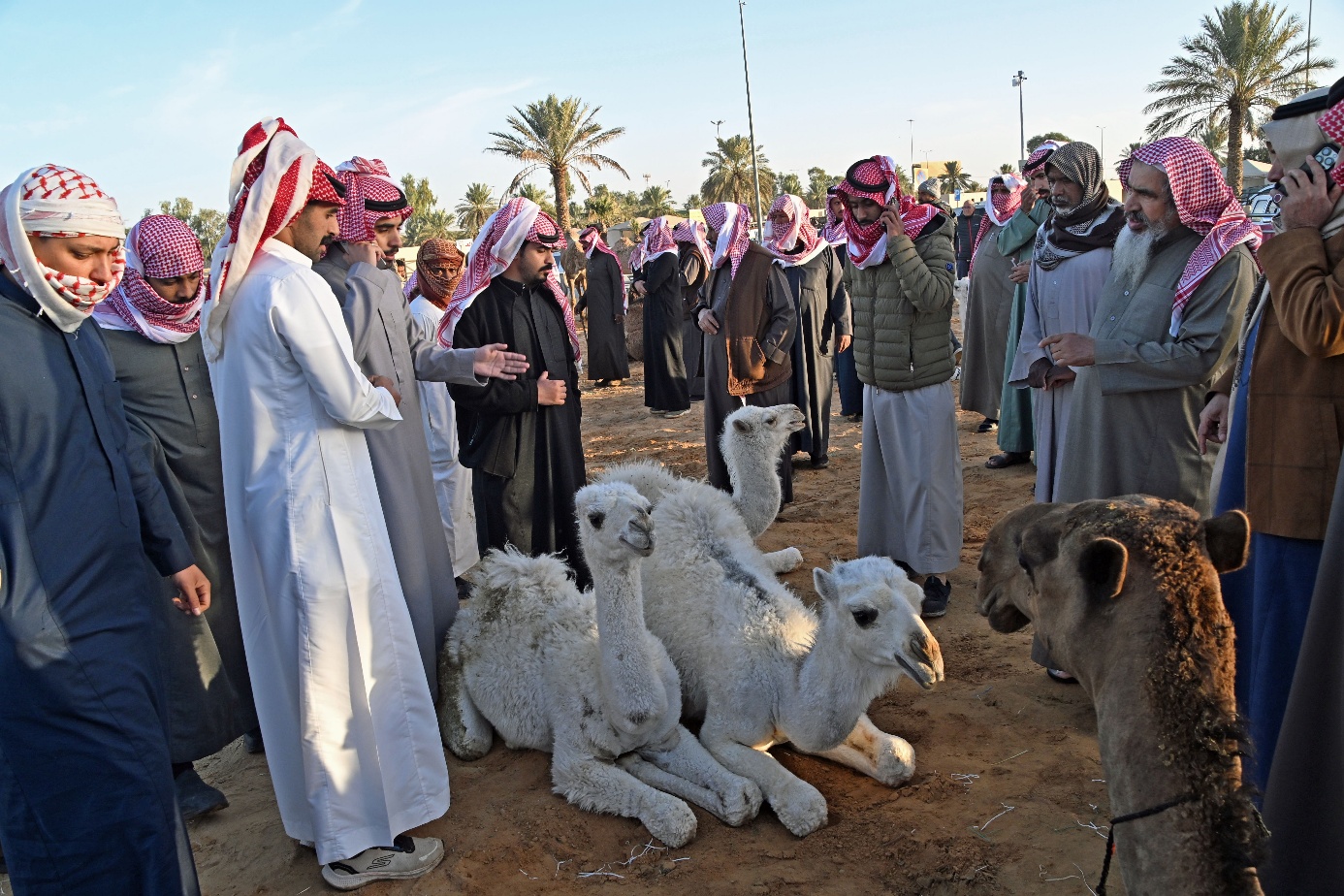
The camel market is an exclusively male affair. There is literally not a single woman in sight
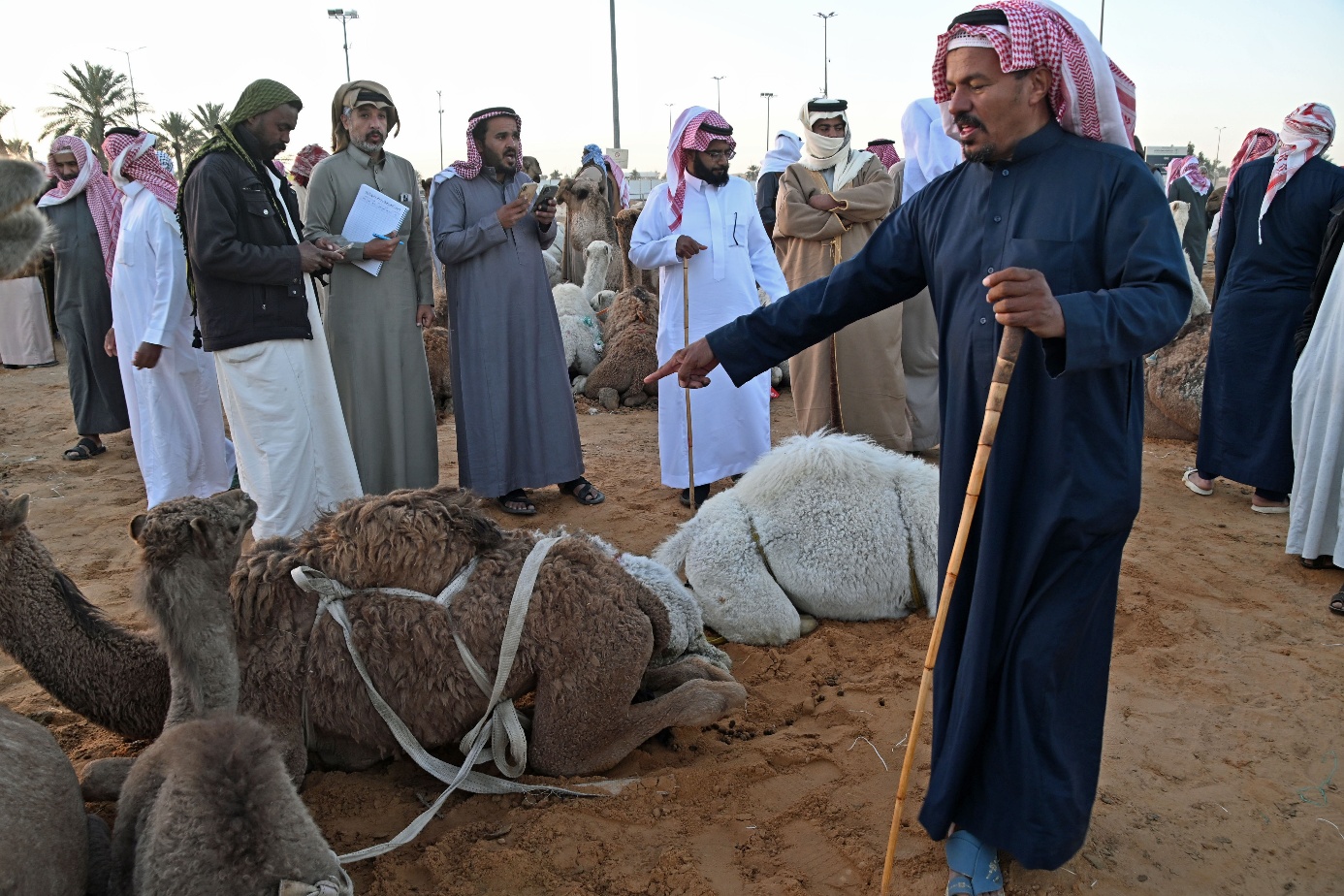
But what stands out even more is the fact that most of the dromedaries are forced to sit in the sand. They have no choice, because their owners have tied the calves of their front legs against their thighs. Getting to their feet is impossible in that position. Some dromedaries have only one front leg tied up, allowing them to stand and even take a few steps. That is, if their owner permits it. Although ‘hobbling along’ would be a better description of the resulting movement.
Adult animals barely bat an eyelid during their brief flight through the air. With young dromedaries, however, the fear is plain to see in their eyes
|
|
|
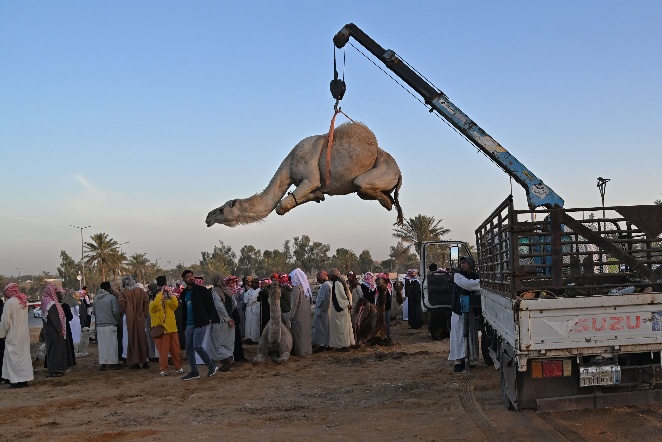
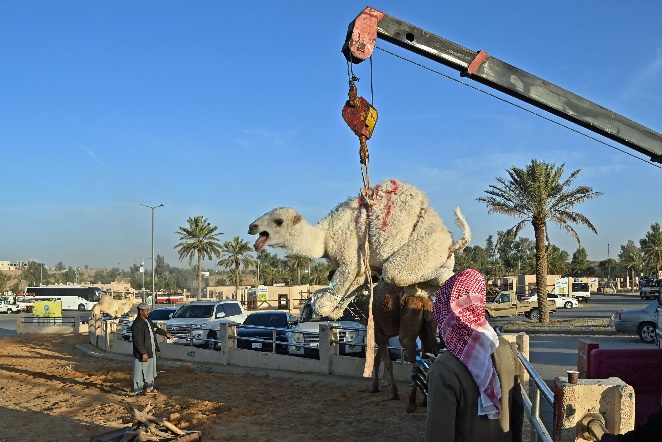
The way the dromedaries are brought in is quite spectacular. They are usually transported in a pick-up truck fitted with a small crane, which lifts each animal out of the truck bed and lowers it onto the ground. Adult animals are apparently accustomed to this and barely bat an eyelid as they are briefly suspended in mid-air. With young dromedaries, however, the fear is plain to see in their eyes.
A firm, upright hump is certainly a sign of good health and ample fat reserves
Buying and selling – that is what it is all about here. What you are going to use it for is, of course, the first question you ask yourself when considering the purchase of a dromedary. Are you buying it for its meat and wool, or for milk production? Do you want to breed with it, or use it for transport across the desert? Or are you looking for a true pedigree animal that you can enter in beauty contests or races?
|
|
Dental examination |
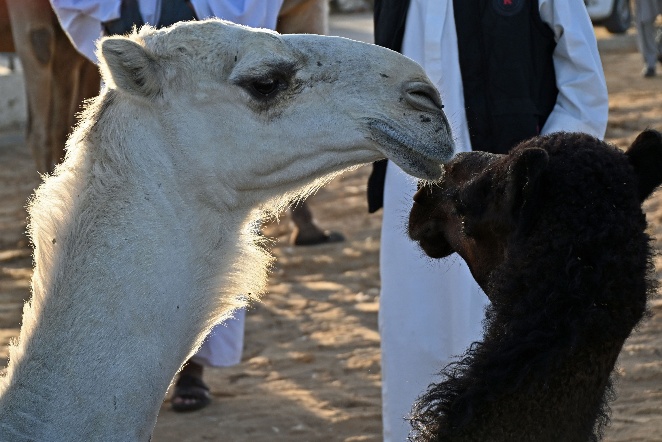
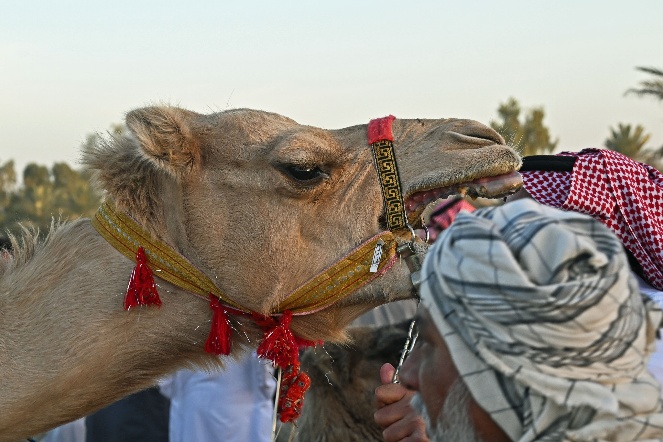
Depending on your intentions, you will scrutinise the animal carefully. Its posture, body shape and size give you a first impression. A firm, upright hump is certainly a sign of good health and ample fat reserves. The teeth and gums, meanwhile, tell you something about its age. If you are interested in milk production, you will examine the udder closely. Is it large and healthy, with evenly shaped teats and a good texture, without any visible abnormalities or scars?
|
|
|
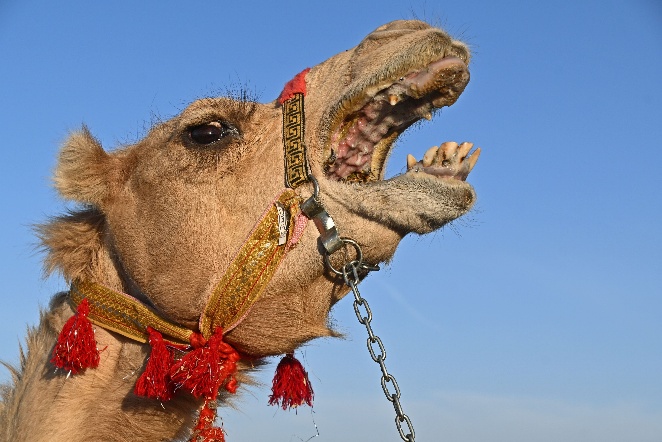
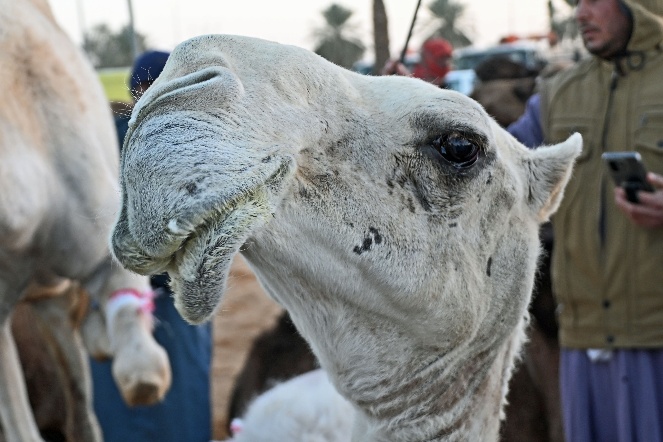
The lips should be full, hang gracefully downwards and, above all, cover the teeth
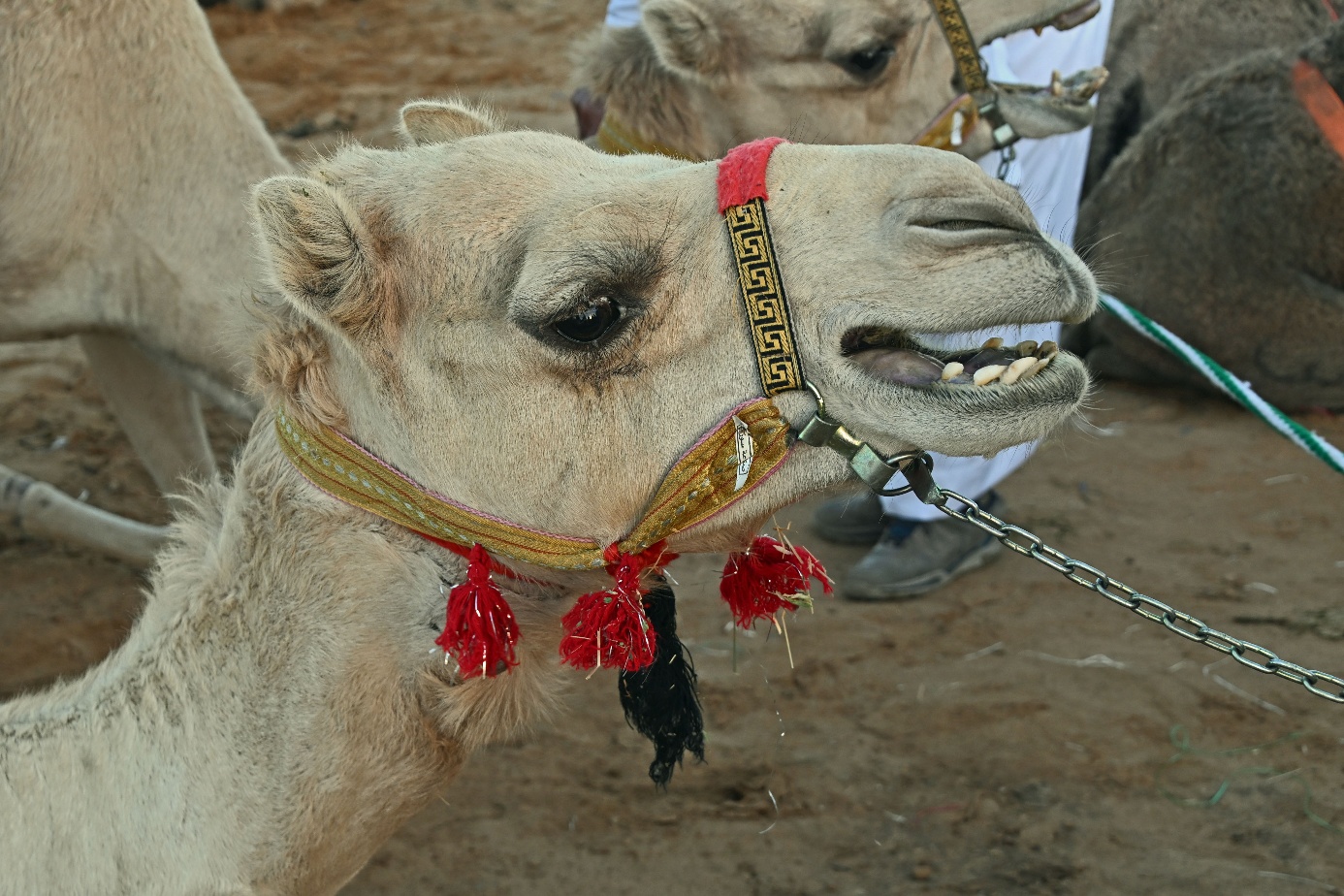
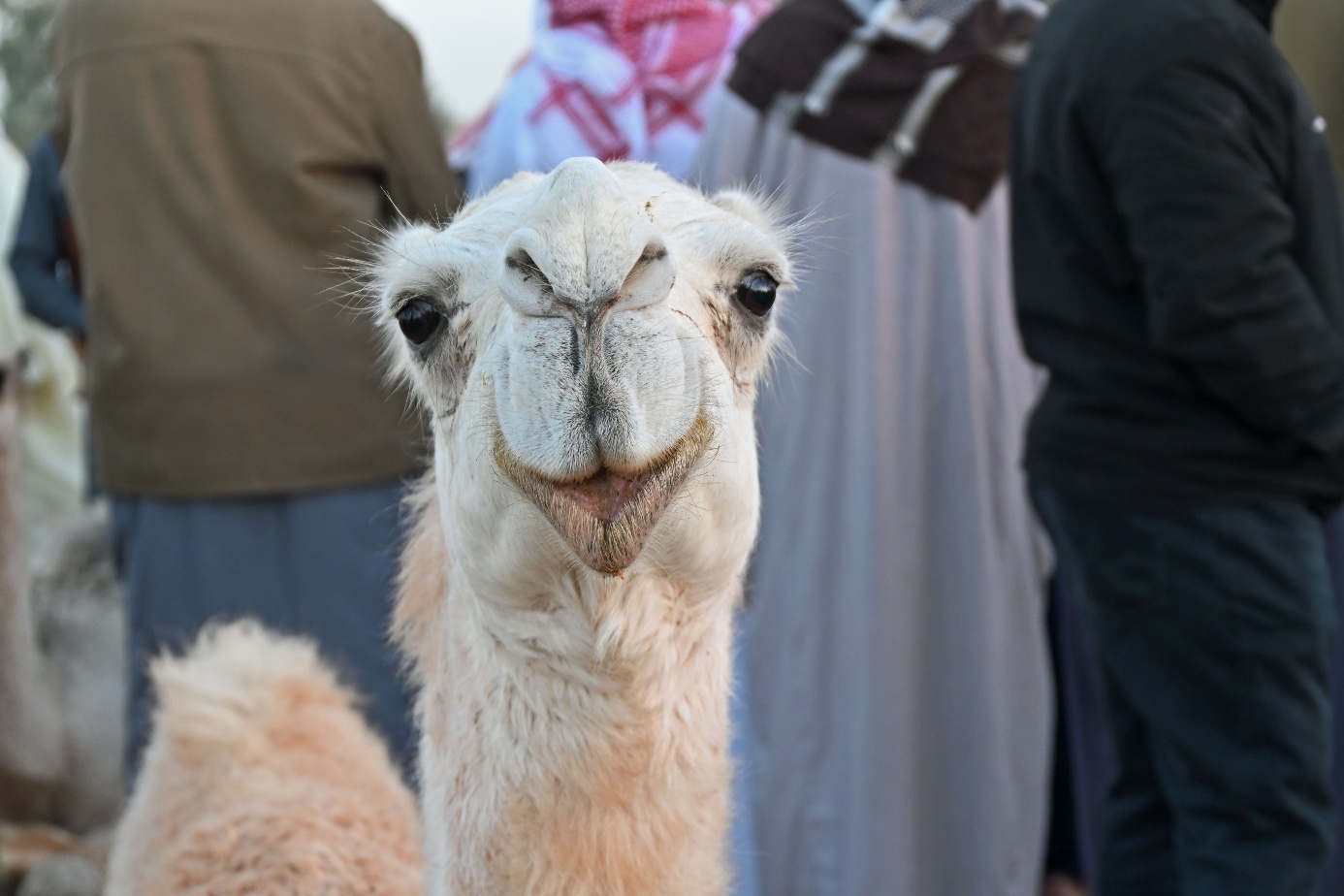
If you are looking for a beauty queen among the dromedaries, you naturally pay attention to many more features. For starters, the eyes should be large and expressive, with strikingly long, dark eyelashes. The lips should be full, hang gracefully downwards and, above all, cover the teeth. The coat is expected to have a natural, healthy sheen. If the nose is rather broad and has an elegant curve, the dromedary has an extra advantage. If, on the other hand, the hump droops somewhat limply to one side, the dromedary can be ruled out straight away.
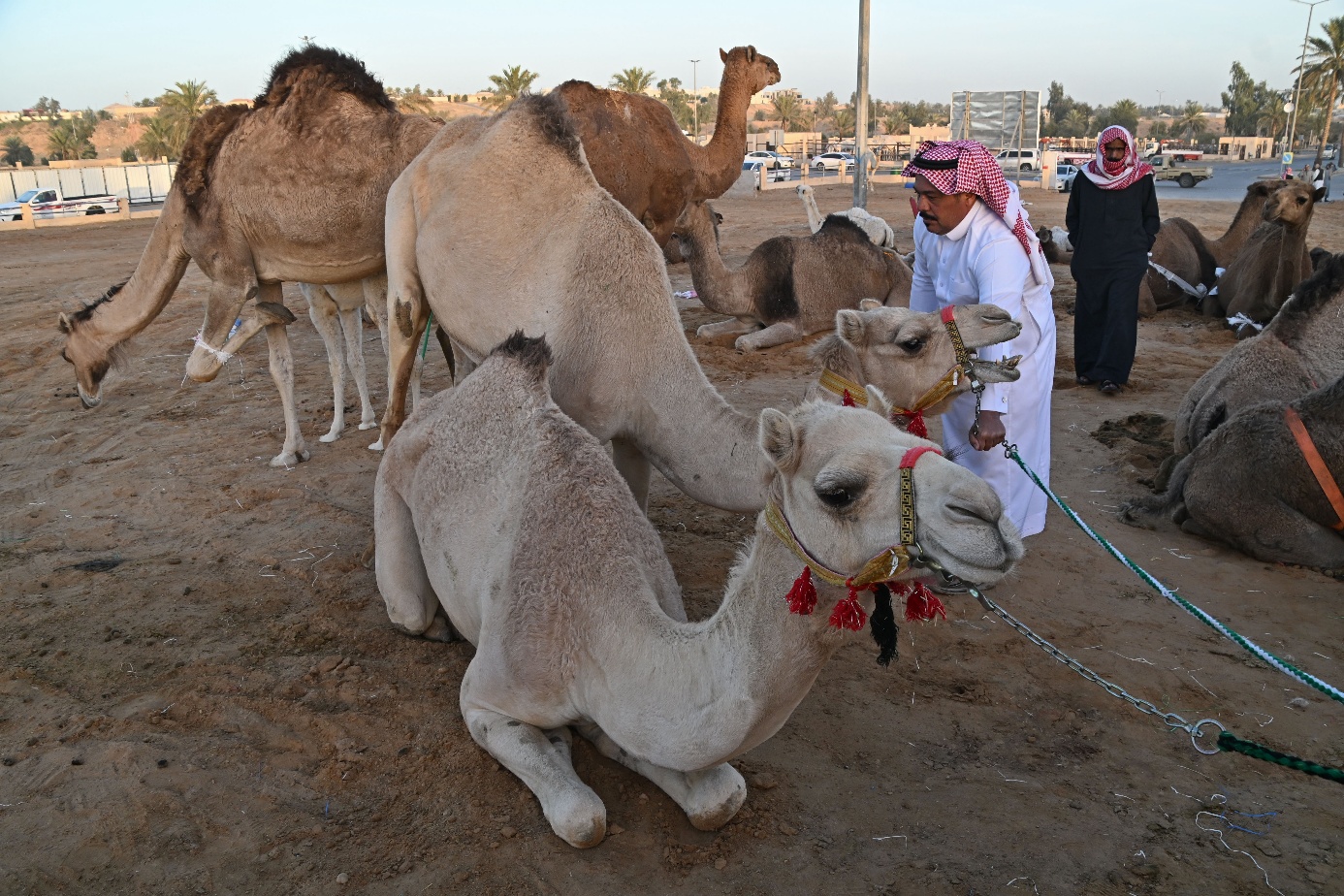
Or are you looking for a true pedigree animal that you can enter in beauty contests or races?
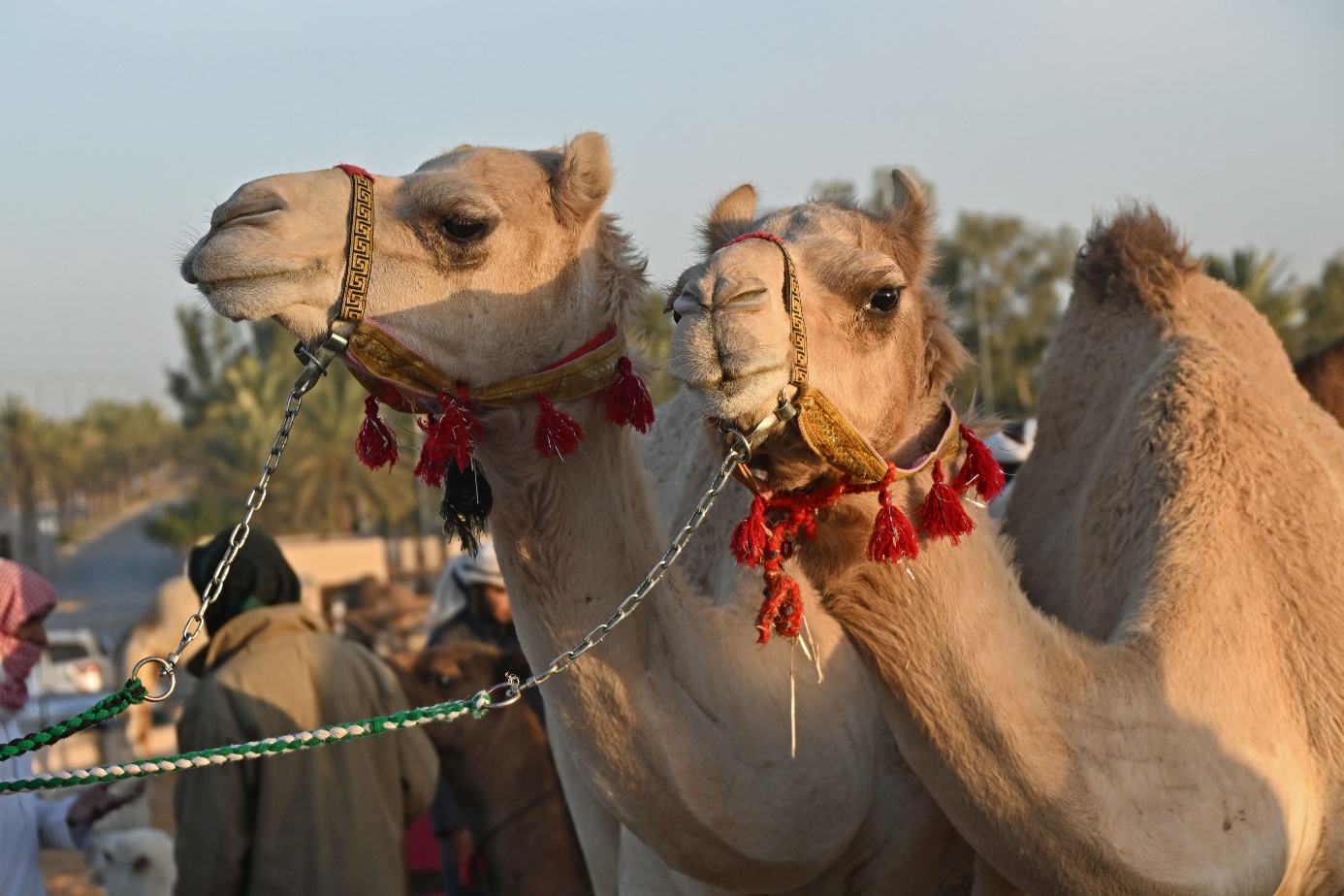
It goes without saying that Botox, fillers, artificial inflation of the hump and muscle-building hormones have inevitably found their way into this select world. And competition judges do everything they can to detect animals with such illegal enhancements and disqualify them.
Back to the market. For a dromedary bought for its meat, you can expect to pay 3,000 to 5,000 riyals, or perhaps even 8,000 riyals (800, 1,341 or 2,141 USD). A riding dromedary will set you back between 8,000 and 20,000 riyals (2,141 to 5,353 USD), while a dromedary that takes part in a beauty contest can cost as much as one million riyals (270,000 USD).
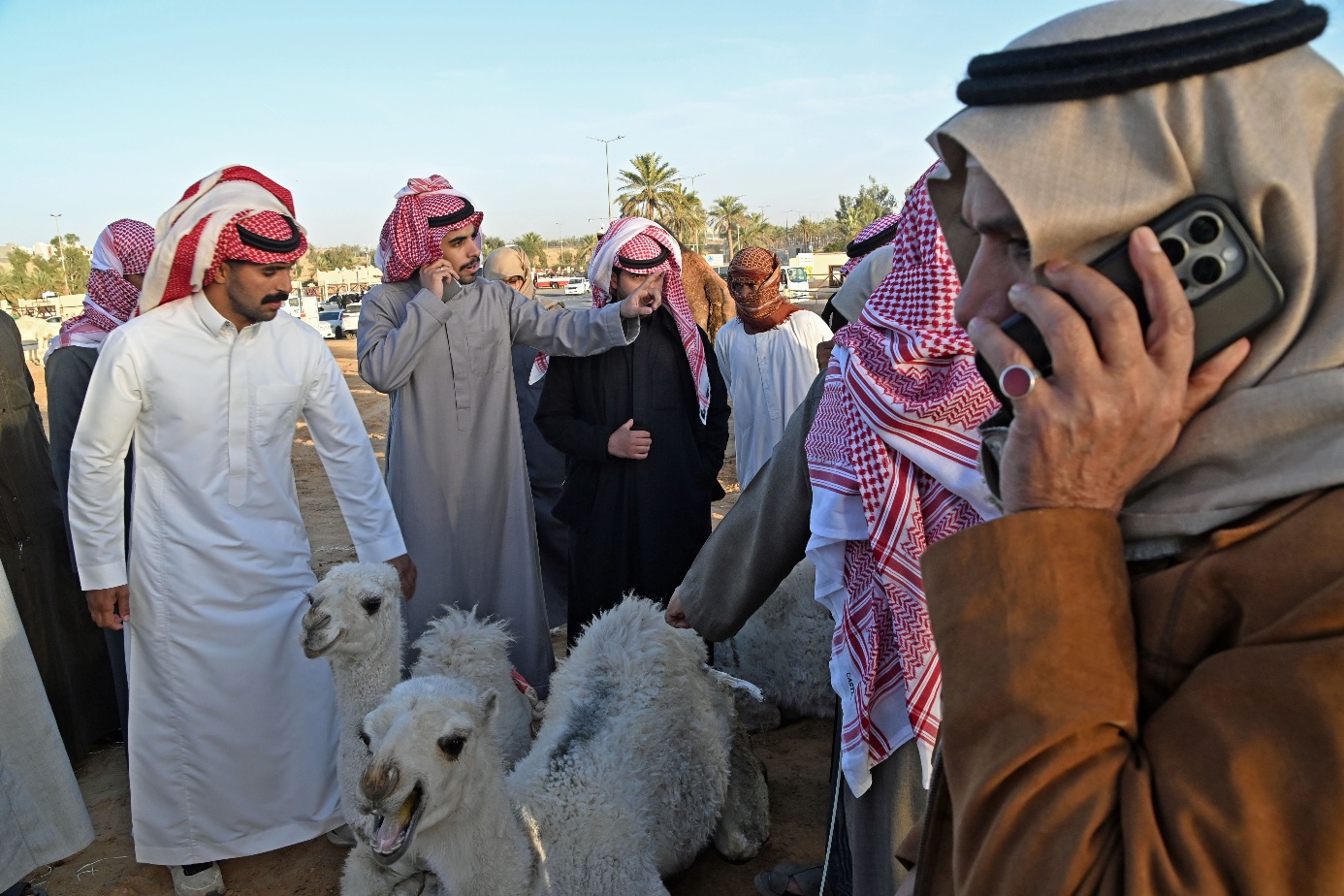
Every now and then, a dromedary refuses to obey its owner’s commands. The owner then strikes the rebellious animal with a thin bamboo stick
|
|
|
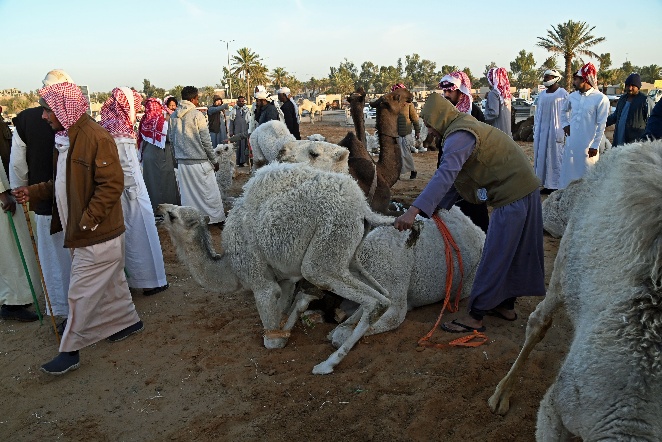
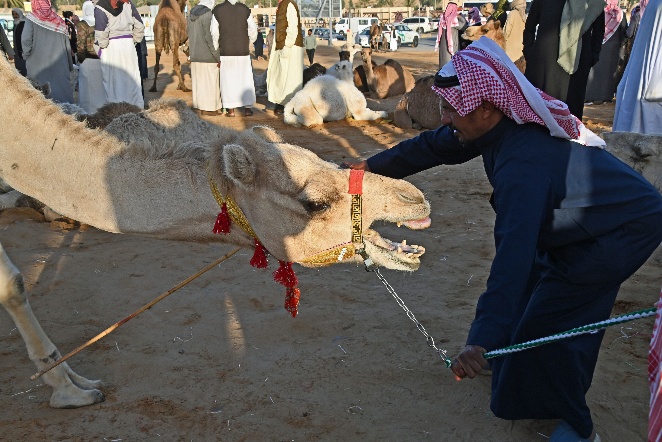
Sales are conducted by auction. We hear men shouting loudly and dromedaries groaning miserably. The latter has nothing to do with the bidding process, but rather with the uncomfortable position in which the animals have to remain throughout. Every now and then, a dromedary refuses to obey its owner’s commands. The owner then strikes the rebellious animal on the body or the calves with a thin bamboo stick. If that is not enough, he resorts to the ultimate – and most painful – punishment: striking one of the dromedary’s eyes with the flat of his hand.
Sheep market |
|
|
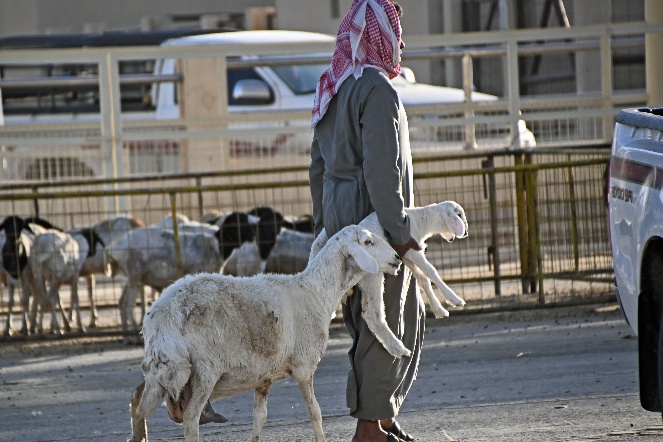
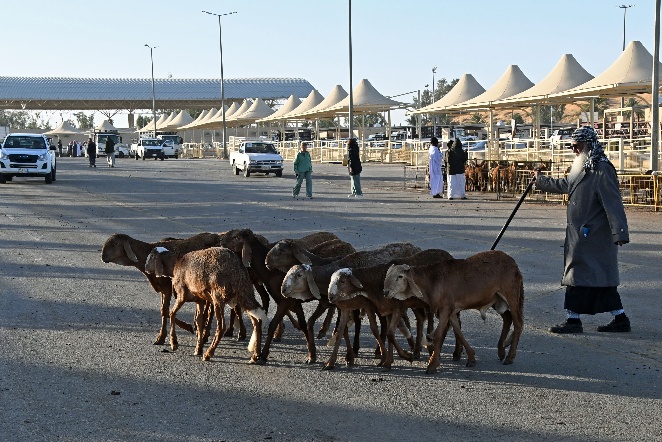
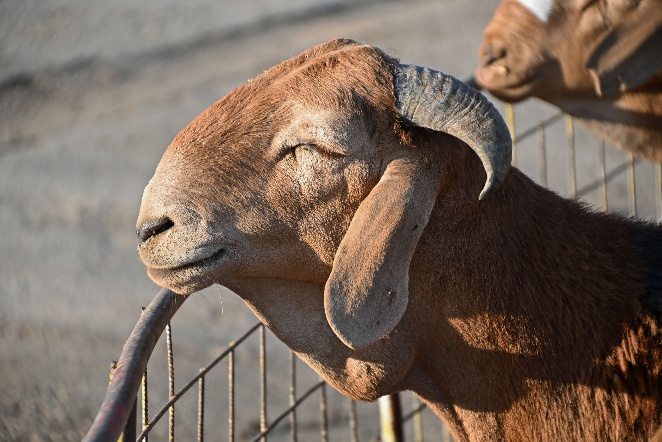
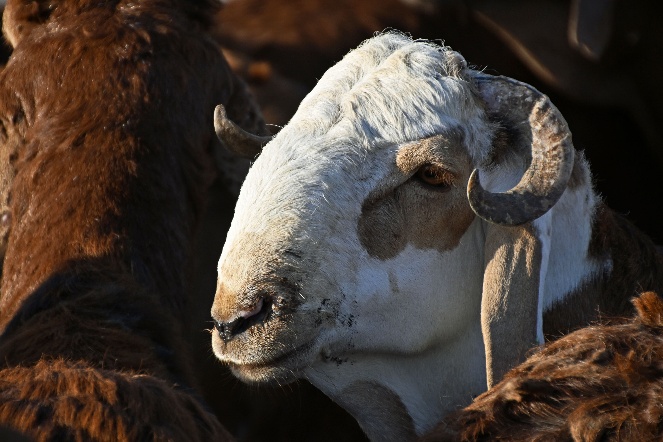
More modest in scale is the adjoining sheep market. Here the animals are brought in in a small pick-up. Sometimes they remain standing in the truck bed, waiting for a potential buyer; sometimes the owner drives them together into an enclosed area. This market is not particularly large, but what a variety it offers. It is almost as if every sheep farmer has specialised in a different breed.
|
|
|
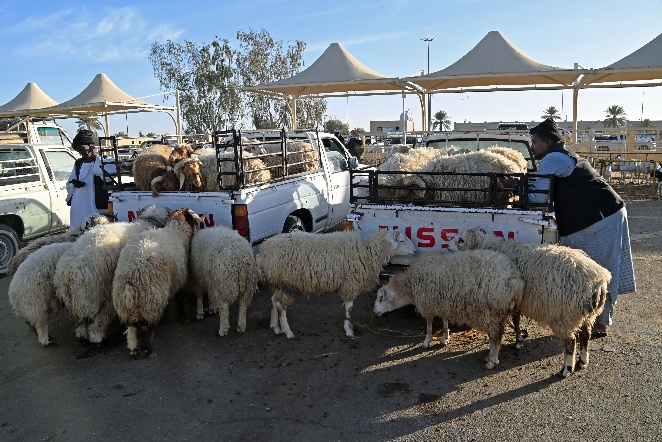
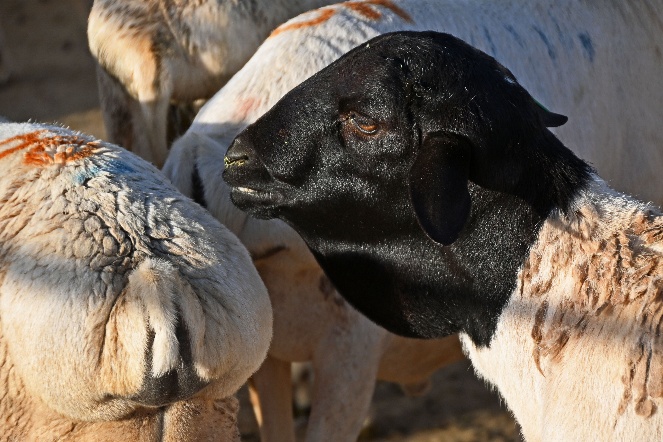
It is almost as if every sheep farmer has specialised in a different breed
|
|
|
It is now a two-hour drive to Ushaiger, a small village nearly 200 kilometres (124 miles) south-east of Buraydah. At first, it is the comfortable Route 65 that carries us across the barren plateau, then the somewhat neglected Route 505. As far as the eye can see, nothing seems to grow here, apart from patches of grass that somehow manage to survive. Here and there, free-roaming dromedaries still manage to forage enough food to get by. Closer to our destination, a few red sand dunes begin to appear.
Ushaiger is Arabic for ‘Little Blonde’. The village derives this charming name from the golden-hued hills that surround it
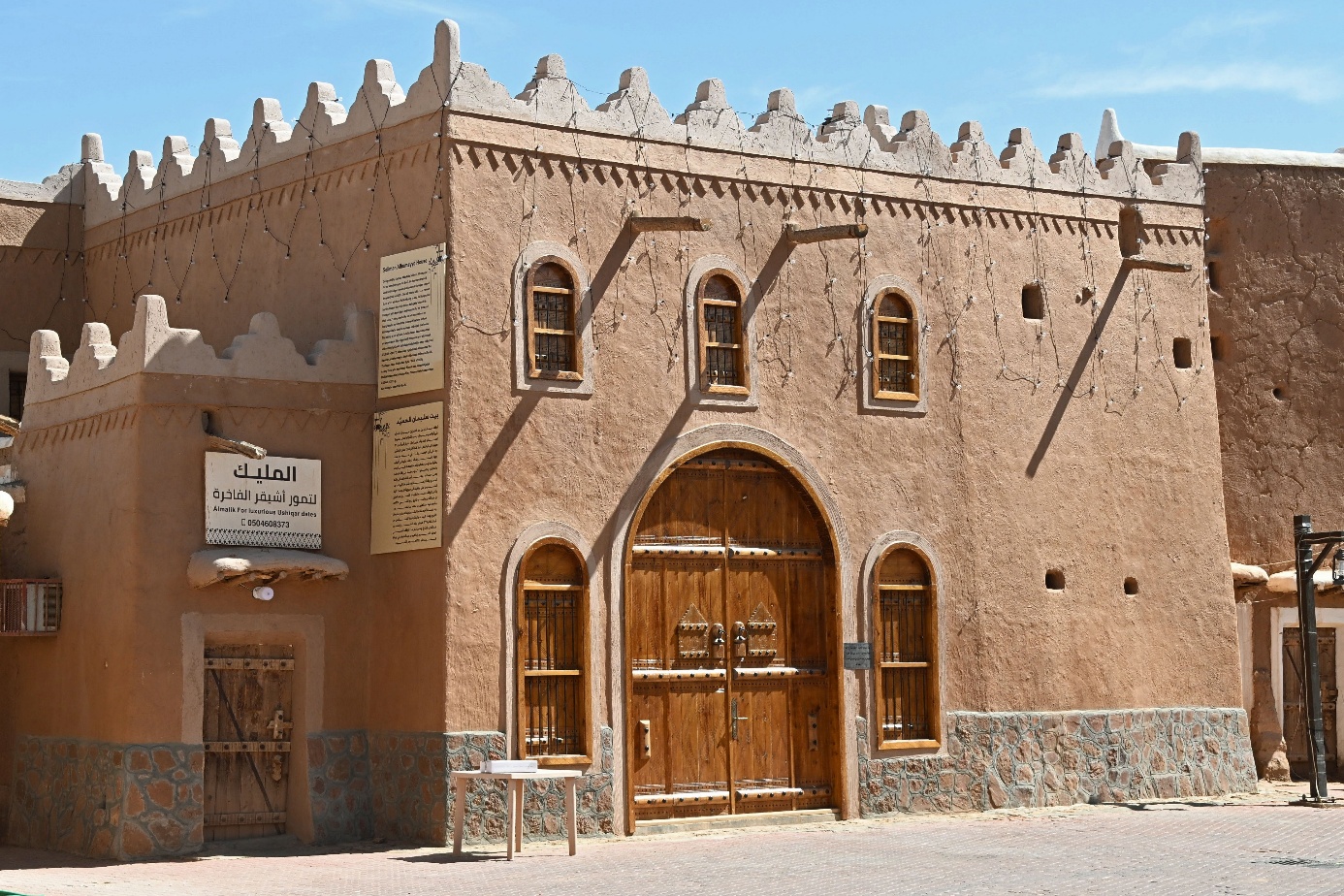
Ushaiger – Home of Sulaiman al Humayyd
Shortly after twelve, we reach Ushaiger, Arabic for the Small Blonde. The village owes its charming name to the golden-coloured hills that surround it. It is not large, with barely 9,000 inhabitants. Yet it has existed for more than fifteen hundred years and was once a regular stopping place for pilgrims travelling to Mecca from what are now Kuwait, Iraq and Iran.
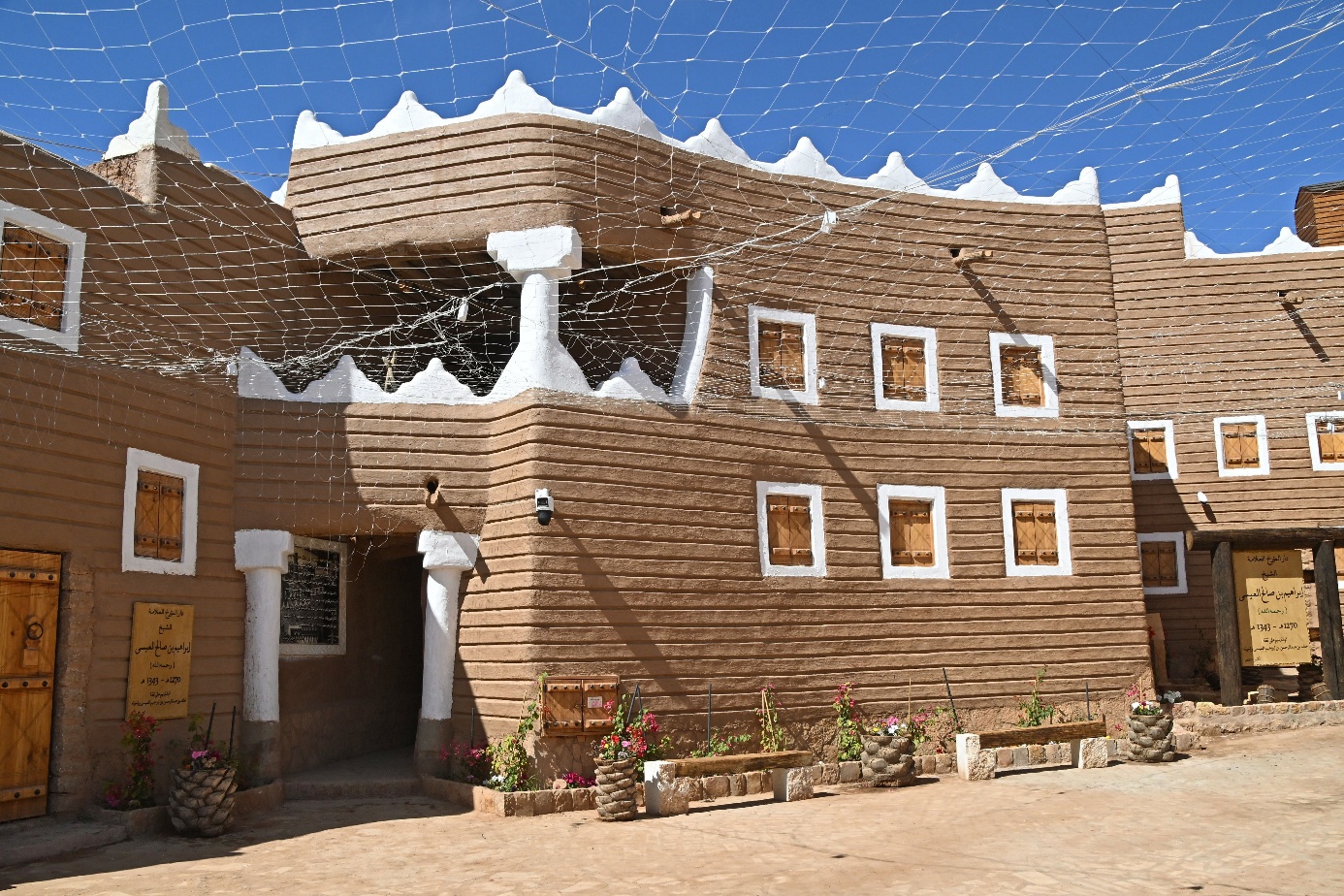
Home of Sheikh Ibrahim bin Saleh Aleisa
More importantly, Ushaiger is the birthplace of the Al ash-Sheikh family. To this day, it remains the most powerful religious family in Saudi Arabia. They are descended from Muhammad ibn Abd al-Wahhab, the founder of Wahhabism. Under his influence, this strictly orthodox variant of Islam became the state religion of the kingdom.
The insignificant-looking Ushaiger grew into the most important religious and intellectual centre of Central Arabia
As early as the sixteenth and seventeenth centuries, the insignificant-looking Ushaiger grew into the most important religious and intellectual centre of Central Arabia. Islamic scholars flocked here from all directions to study in Ushaiger. The theological foundations that would later form the basis of Wahhabism were cultivated and taught here for generations by local religious scholars.
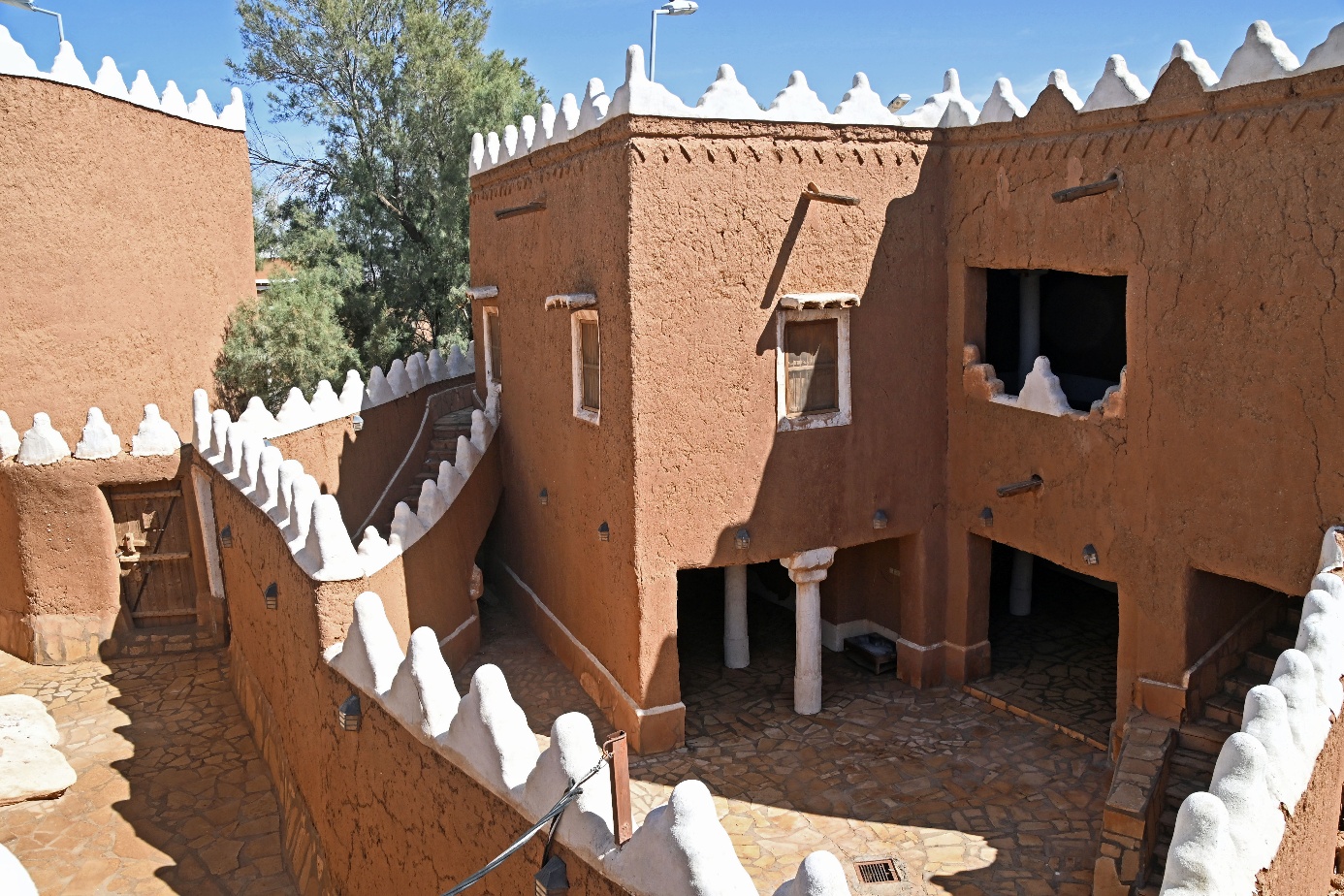
Ushaiger offers a good impression of the traditional environment in which Wahhabism was able to grow and flourish
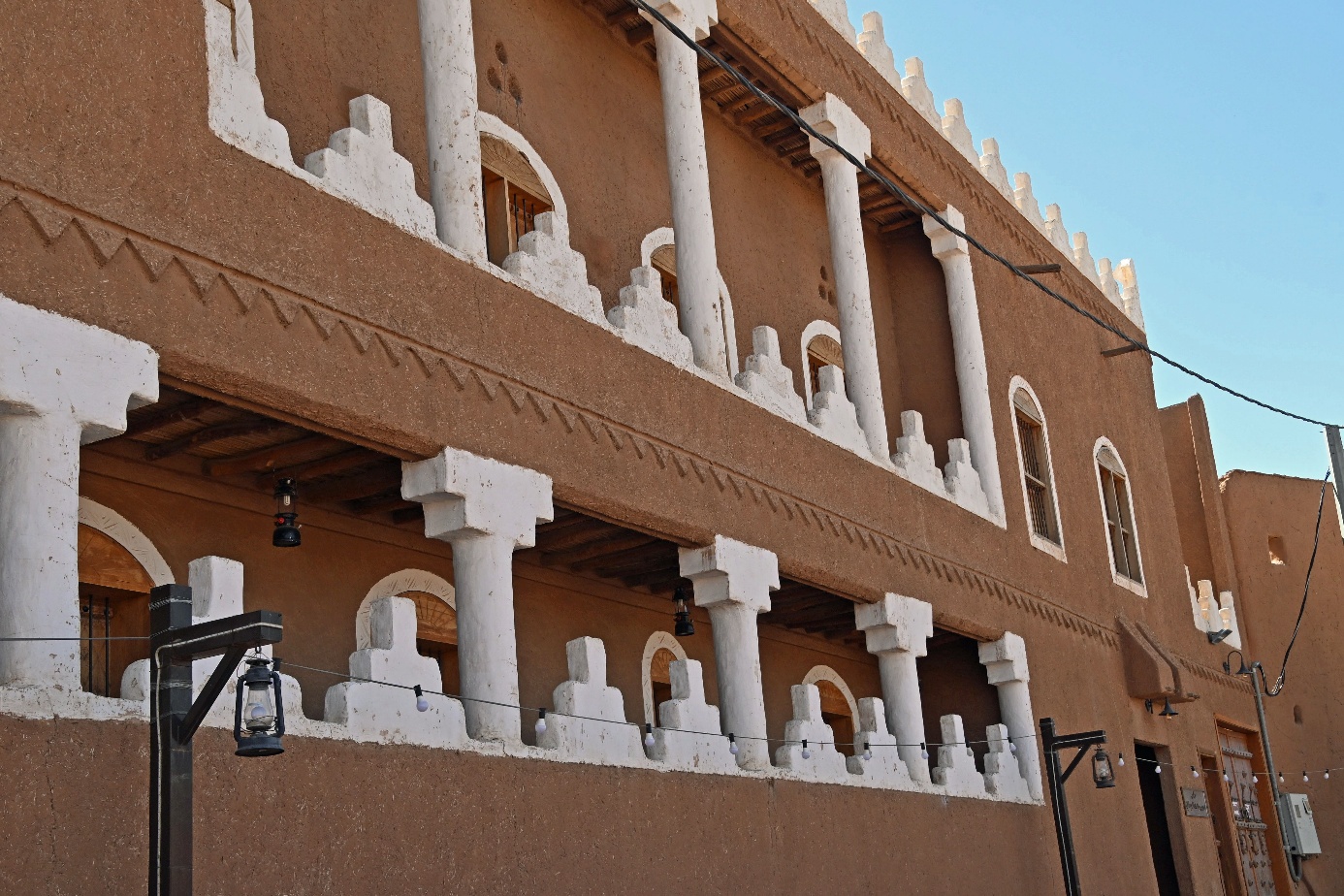
Nowadays, Ushaiger is best known among tourists for its Heritage Village, an open-air museum of traditional adobe houses, most of which have been preserved but are no longer inhabited. About a decade ago, the Saudi government launched a large-scale restoration programme. Although it is still far from complete, you can already get a good impression of the traditional environment in which Wahhabism was able to grow and flourish.
It was therefore seen as an unprecedented provocation when, in July 2017, a video clip appeared on Snapchat showing a young Saudi woman without a headscarf, wearing a miniskirt and a crop top
It was therefore seen as an unprecedented provocation when, in July 2017, a video clip appeared on Snapchat showing a young Saudi woman without a headscarf, wearing a miniskirt and a crop top. And, to make matters worse, she was filmed among the mud-brick walls of ancient Ushaiger, the birthplace of Wahhabism – adding insult to injury.
Khulood, the woman in question, was summoned to the police to explain herself. Her defence amounted to saying that she had not posted the video herself, that she had always been accompanied by a mahram, a male relative, as required by law, and that no third parties had been involved in making the clip. In the end, Khulood was released without charge. Did the international outcry play a role in this exceptional act of clemency? Or was it connected to the visit by the Trump family two months earlier, when Melania and Ivanka were allowed to appear in public without headscarves?
|
|
Ceiling |
We resolve not to provoke anyone with our clothing – at least, not deliberately – and set off to explore the old town. A broad earthen wall with massive towers and gates made of tamarisk enclosed the town. Inside were around 400 houses, more than a hundred of which have since been restored. The fact that this modest village once had no fewer than 25 mosques does not surprise us, given its history. Furthermore – and this is not insignificant – there were 80 freshwater wells.
The restored part of Ushaiger proves to be a magnificent showcase for traditional Najd architecture
|
|
|
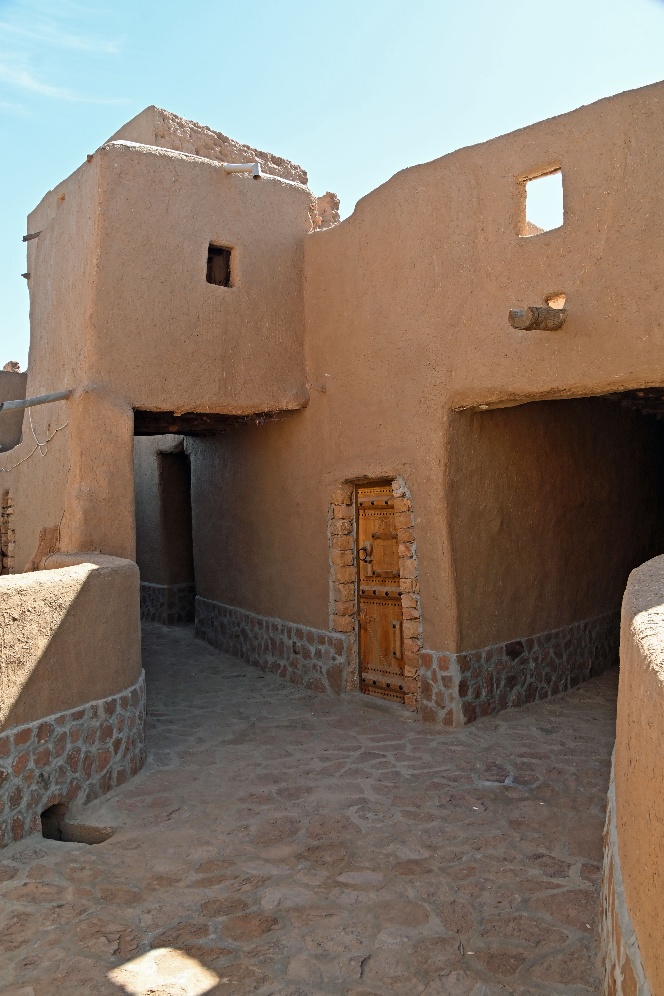
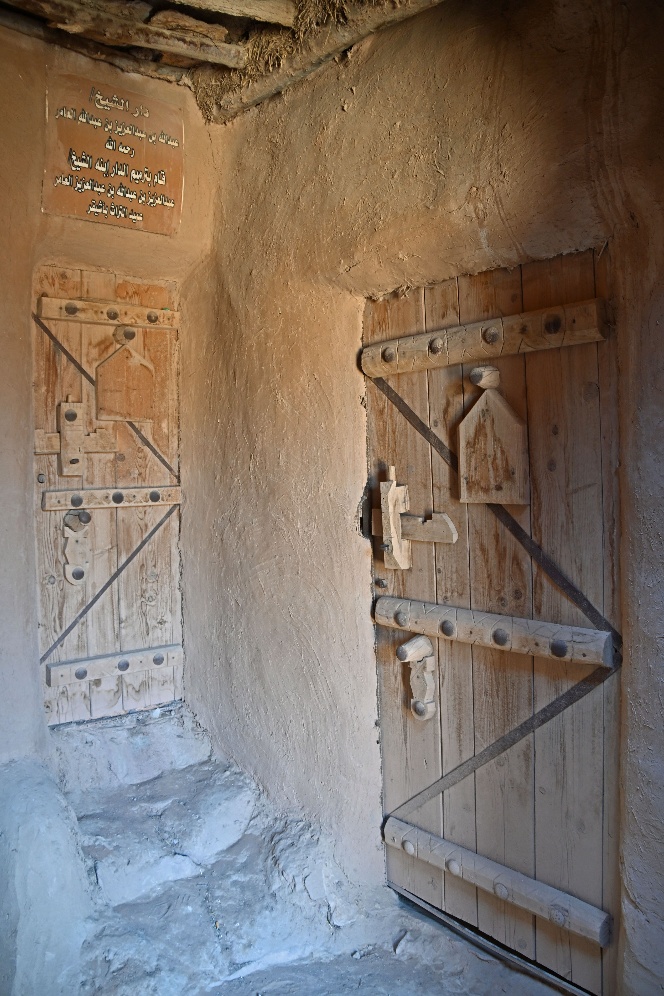
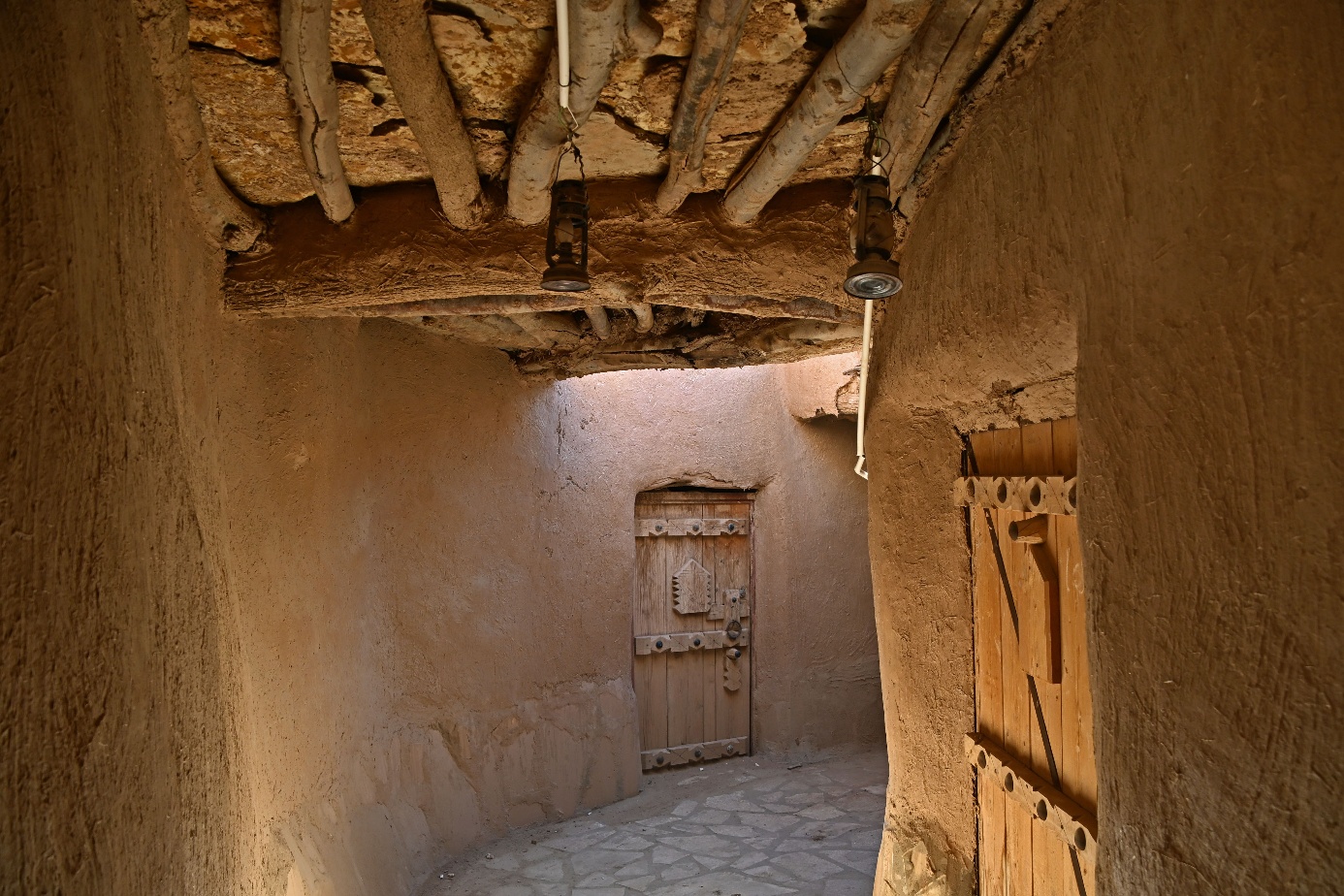
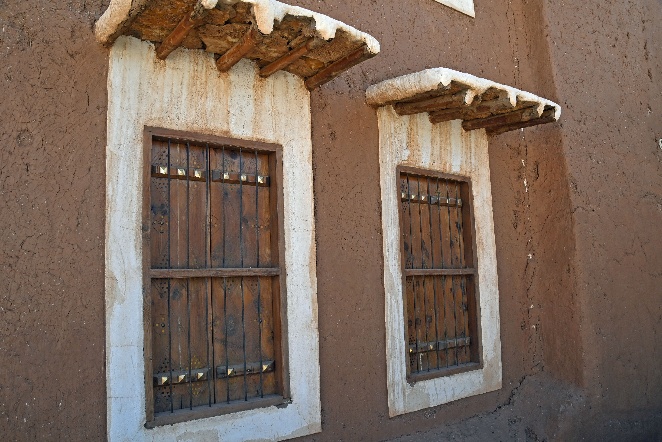
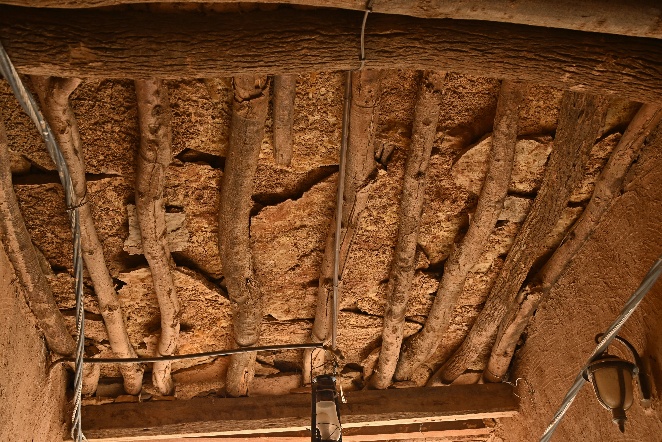
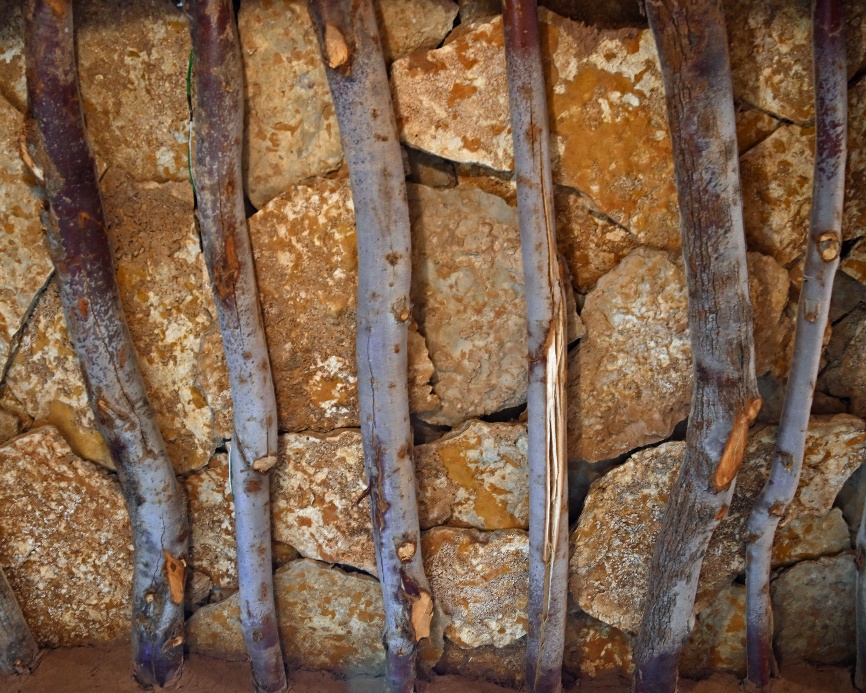
The restored part of Ushaiger proves to be a magnificent showcase for traditional Najd architecture. The buildings are made exclusively of mud bricks, usually resting on a foundation of about five courses of limestone and other local stone. Tamarisk and palm trunks were used for the roofs, while palm leaves and a layer of clay provided the covering. Sometimes the ceiling is supported by wooden posts as well.
Through the tarma, the lady of the house could verify the identity of a visitor standing at the door without being seen herself
|
|
House with cantilevered tarma above the doorway |
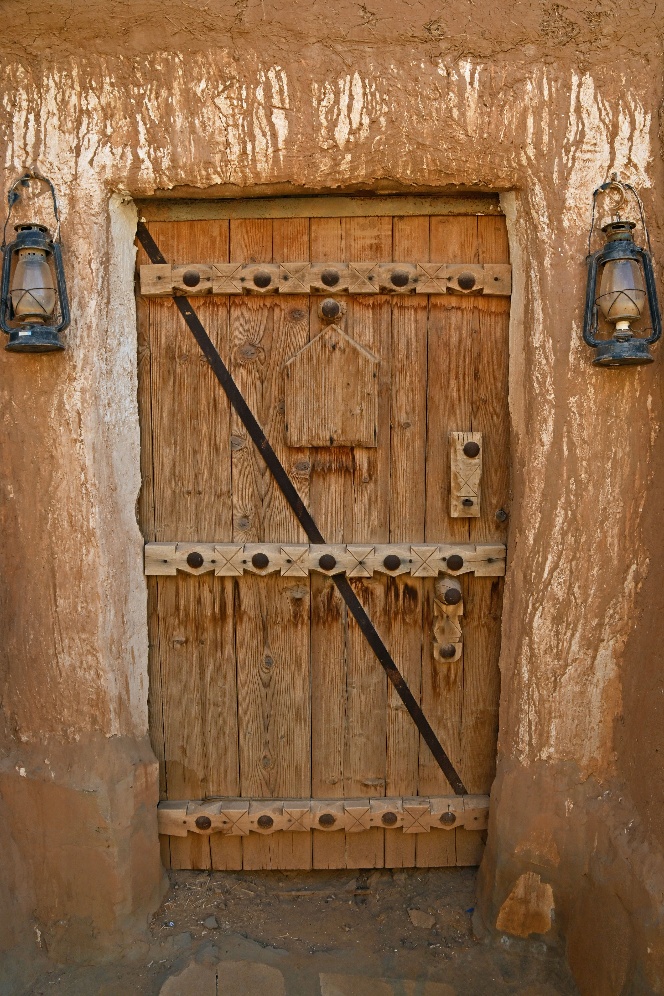
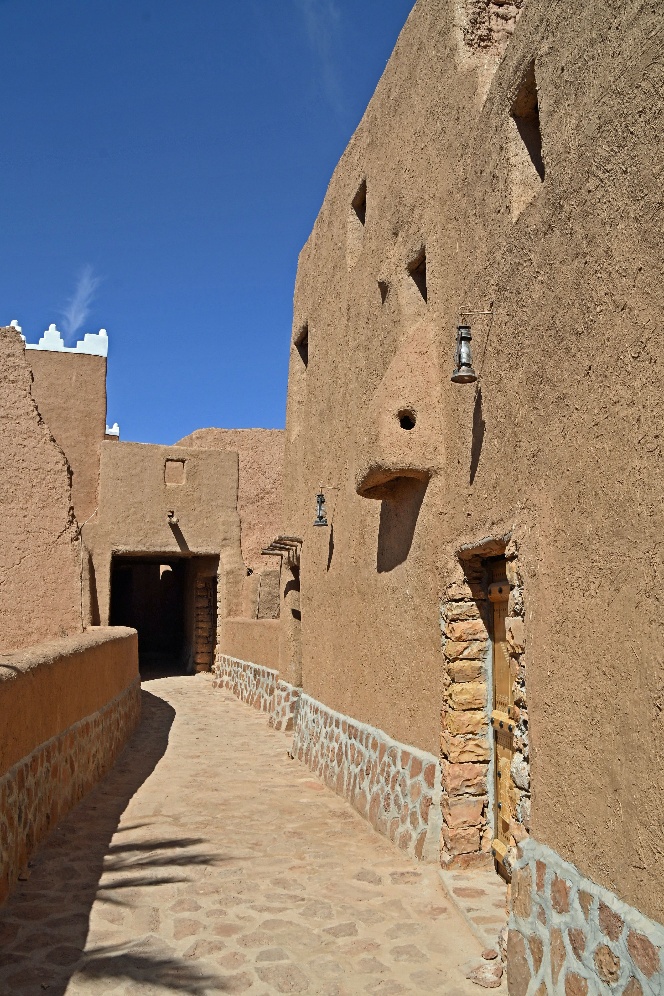
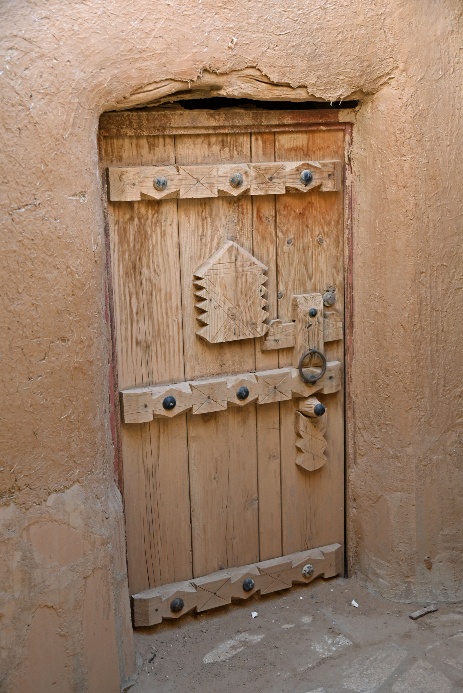
The ochre-brown façades gleam in the sun, topped by the white triangular battlements so characteristic of this style. Here and there, we notice a tarma above the doorway, a cantilevered peephole on the façade that allowed the lady of the house to check the identity of a visitor standing at the door without being seen herself – more specifically, whether the visitor was a man or a woman. Wooden doors, meticulously crafted and sometimes even painted, give each historic house its own identity. No wonder that several houses bear a sign displaying the name of their proud owners.
One of the first gems is the home of Ibrahim bin Saleh Aleisa, one of the most prominent historians of Najd. Born in 1854 and died in 1925, he was already highly respected during his lifetime, as evidenced by the title of sheikh that he was entitled to bear. This title was reserved for men – but also for some women – who had earned a reputation as leaders, both in spiritual and worldly affairs. The restoration of his home was financed by his descendants.
The alleyways are often covered, with occasional openings allowing in light and air, creating a somewhat milder microclimate
|
|
|
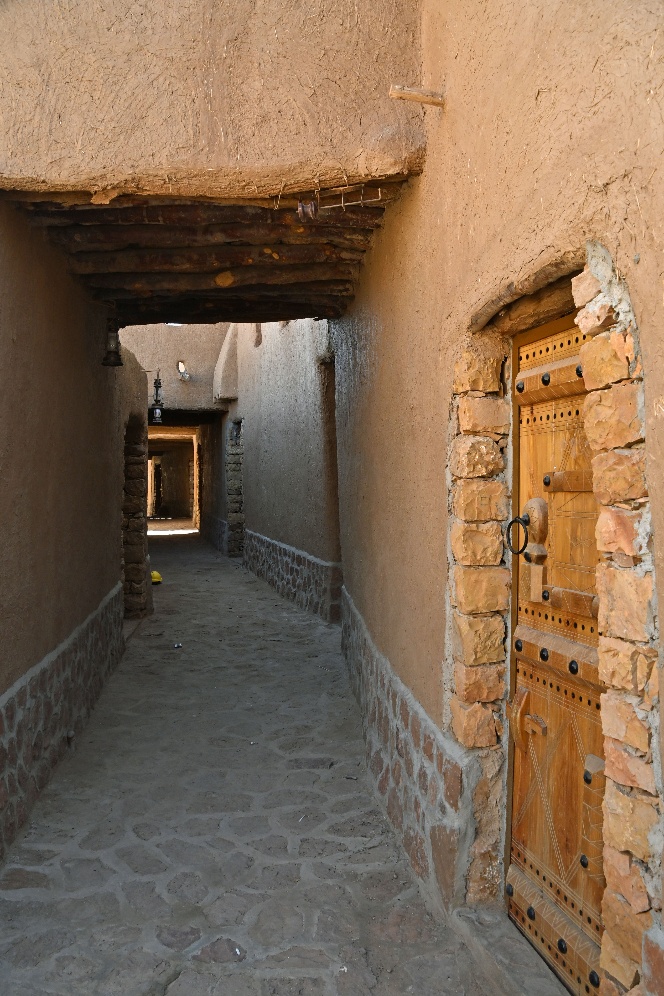
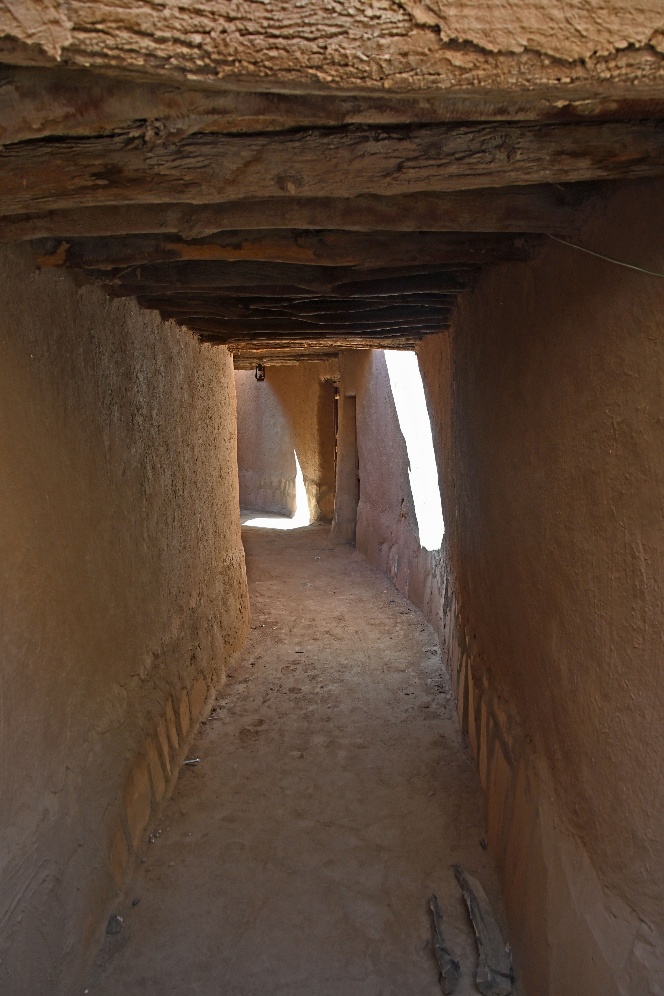
We wander on through alleyways that are often covered, with occasional openings allowing in light and air, creating a somewhat milder microclimate. We cannot help but think of the old town of AlUla, although old Ushaiger feels less clinical.
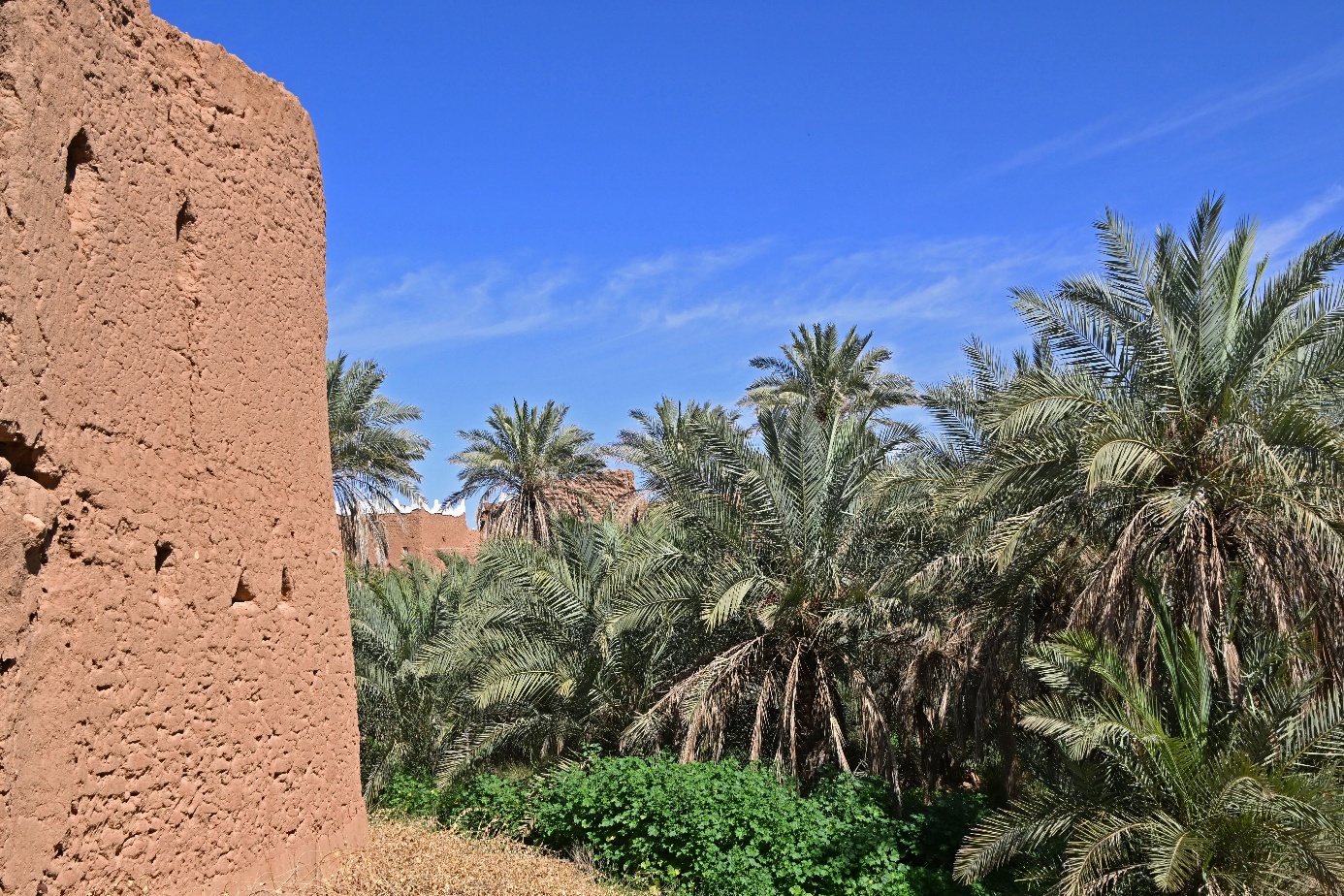
Perhaps this also has something to do with the fact that the oasis town’s orchards were incorporated into the restoration project. You can still wander among the palm trees here. We look out over an area filled with palms, where individual plots were once enclosed by low sandstone walls.
Date-palm gardens and wells were the lifeblood of this historic oasis
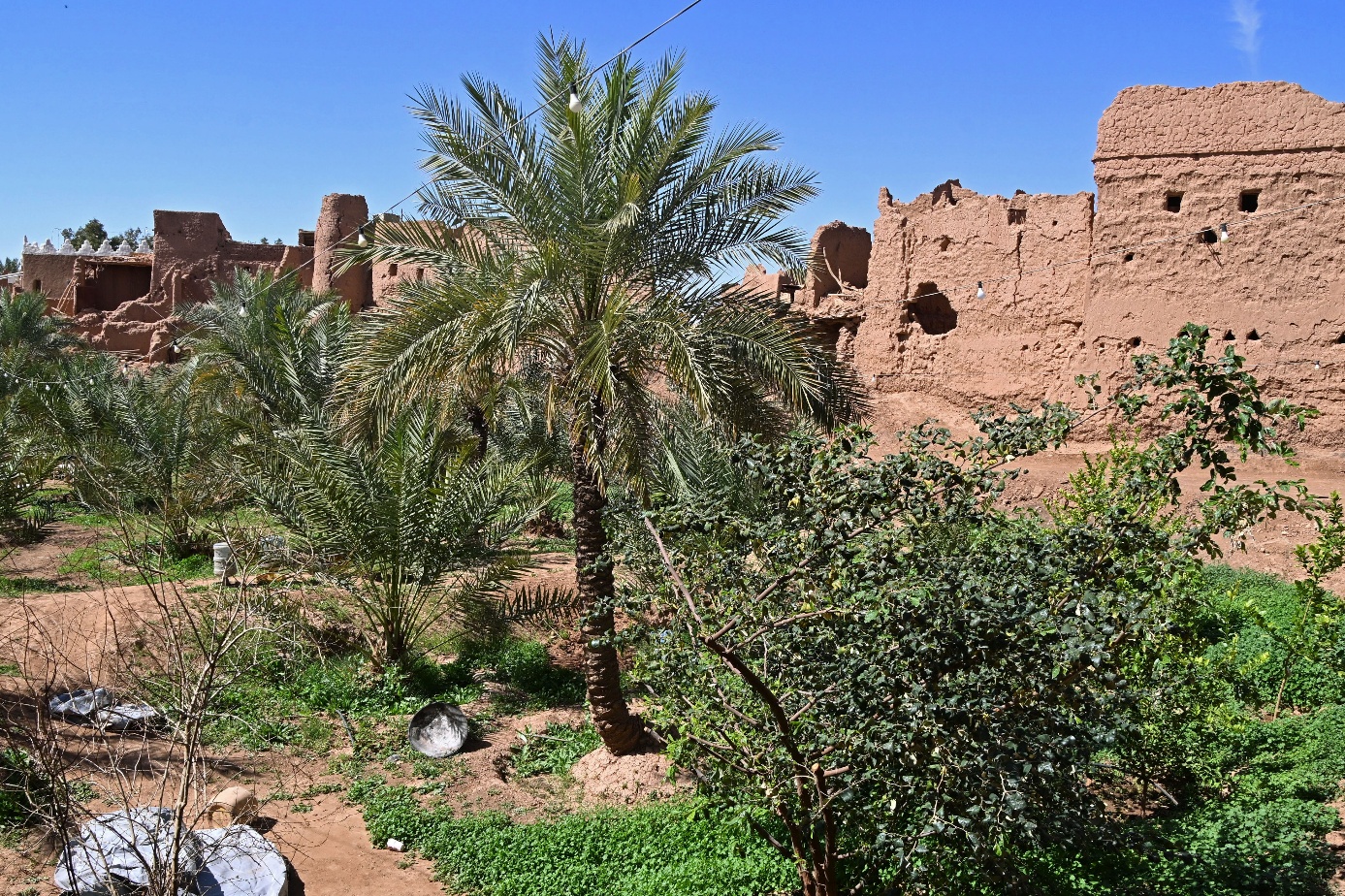
In fact, date-palm gardens and wells were the lifeblood of this historic oasis. For centuries, the lush green belt of palms surrounding the mud-brick town has been sustained by an advanced network of interconnected wells. The people of Ushaiger were masters of water management. In this way, they succeeded in transforming an otherwise arid landscape into a little agricultural paradise.
Ruins of the ancient town |
|
Well (left), small mosque (right) |
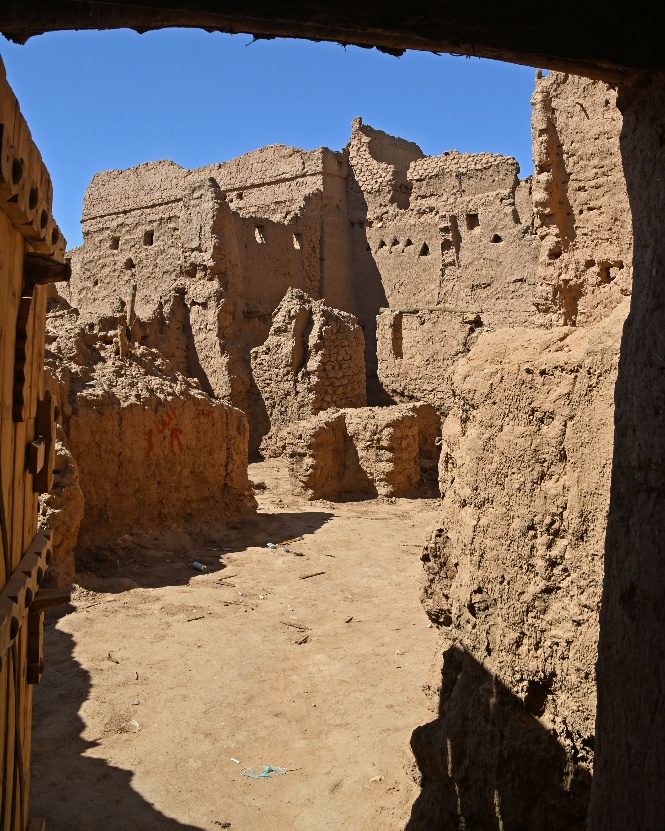
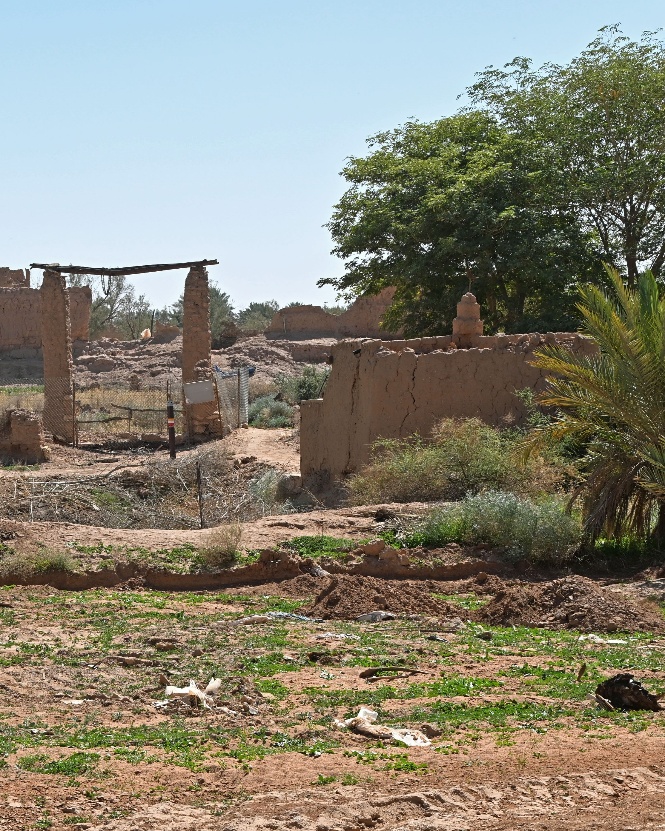
Above one of the wells, we can still see the precarious framework from which a bucket once hung to draw up water. Beside it stands an amorphous mass of adobe bricks in which we are supposed to recognise a small mosque; in the background, we can see the crumbling remains of the town wall. A complete mess, really. There is no other way to describe the neighbourhoods that have yet to be restored. It makes you appreciate the enormous effort that has already gone into this place – and the immense amount of work that still lies ahead.
The elegant semicircular façade of Dar al Mishraq opens onto the square through a white portico
Dar al Mishraq |
|
|
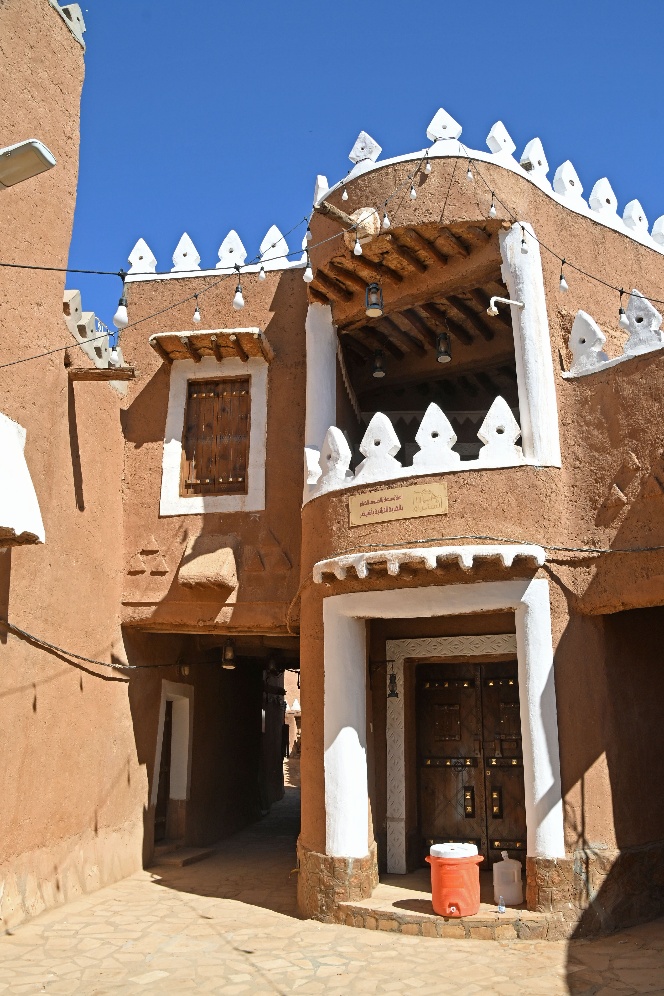
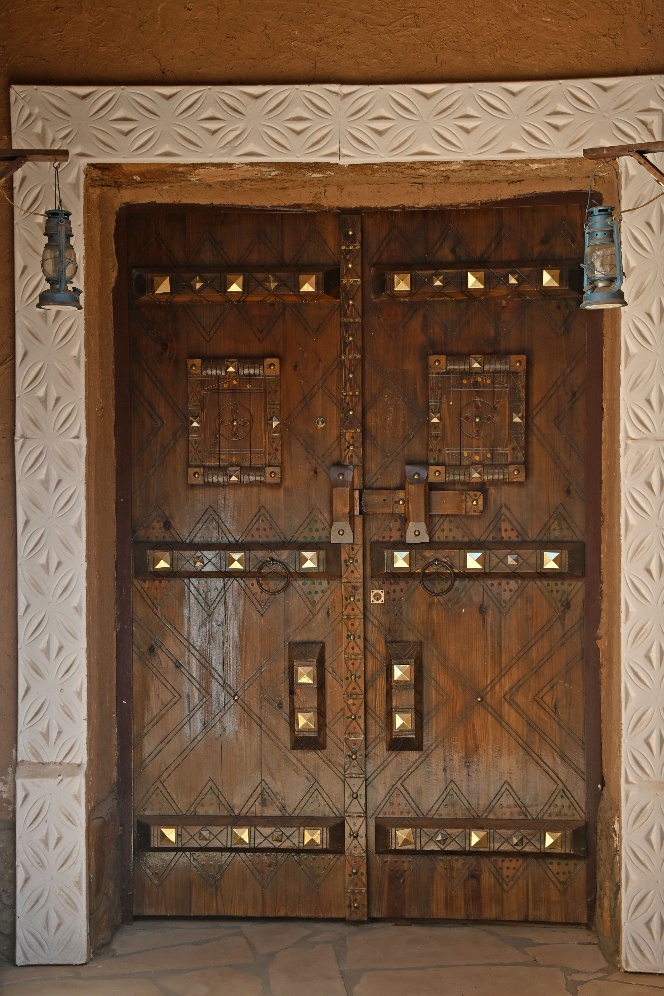
Without a doubt, one of the finest houses is Dar al Mishraq, an imposing residence on a small square in the centre of the town. Its elegant semicircular façade opens onto the square through a white portico. White plasterwork surrounds the impressive wooden door, while the open balcony on the first floor is finished in a similar fashion. On both levels, we recognise the familiar triangular crenellations.
The ‘first primary school’ bears witness to the efforts being made at the time to introduce formal government education to the region
‘First primary school’ |
|
|
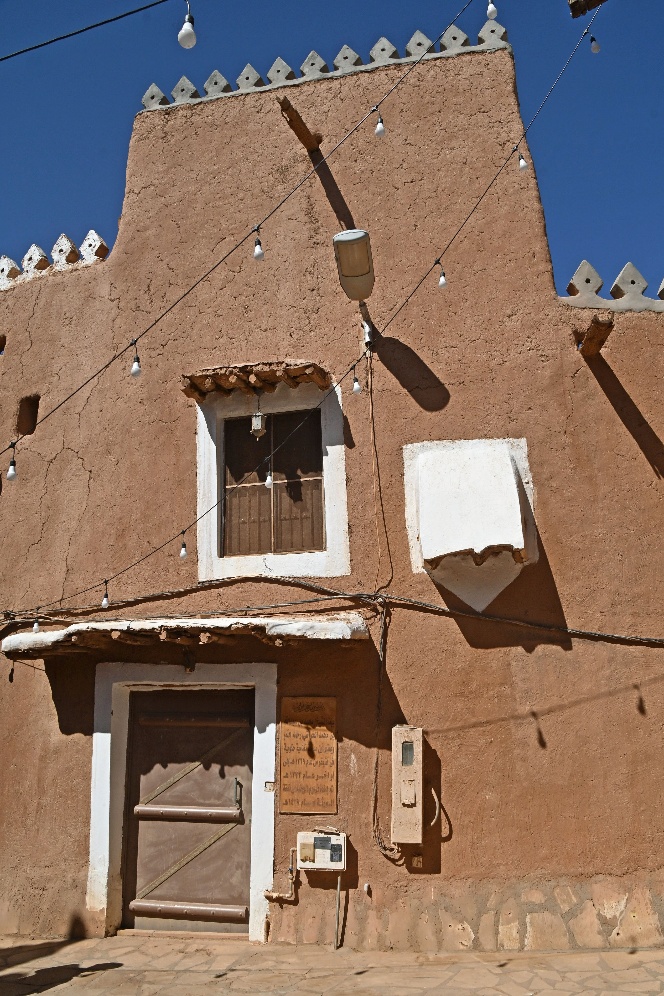
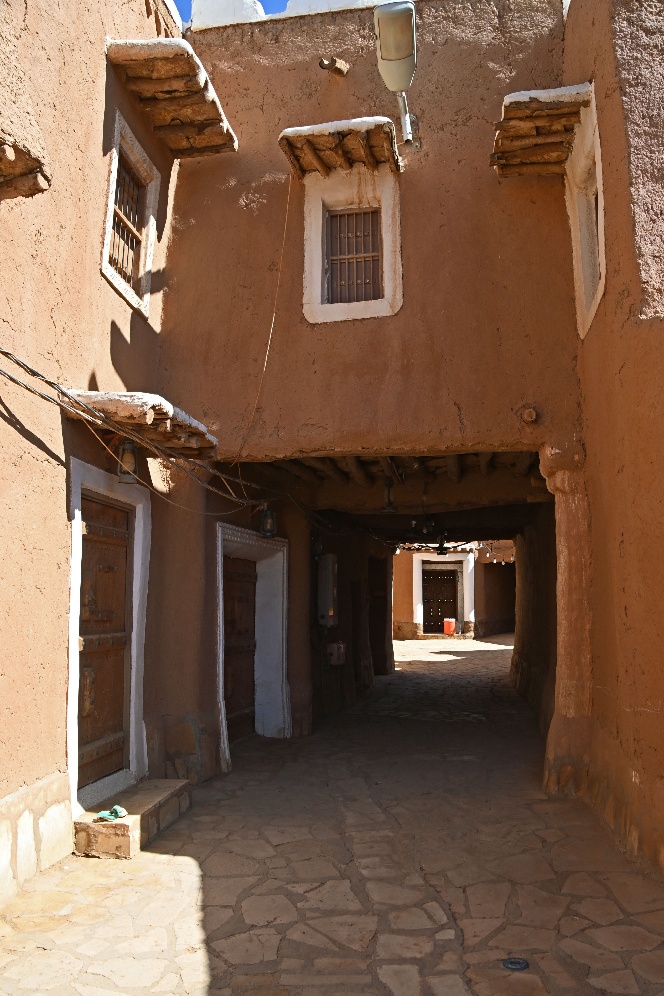
Just a few metres away stands a building that is referred to here as the first primary school. Although it is less elaborately finished than Dar al Mishraq, that does not make it any less important. Dating from 1950, it bears witness to the efforts being made at the time to introduce formal government education to the region. That bridged the gap between traditional life in Najd and modern scientific pursuits – so we read – and thus paid tribute to the importance of knowledge in the history of Ushaiger. That may well be so, but we cannot escape the observation that, historically speaking, this so-called modern scientific knowledge in Ushaiger was in fact consistently confined to religious matters.
In its austere simplicity, the Al Mufailaqiya Mosque reflects the puritanical character of Wahhabism
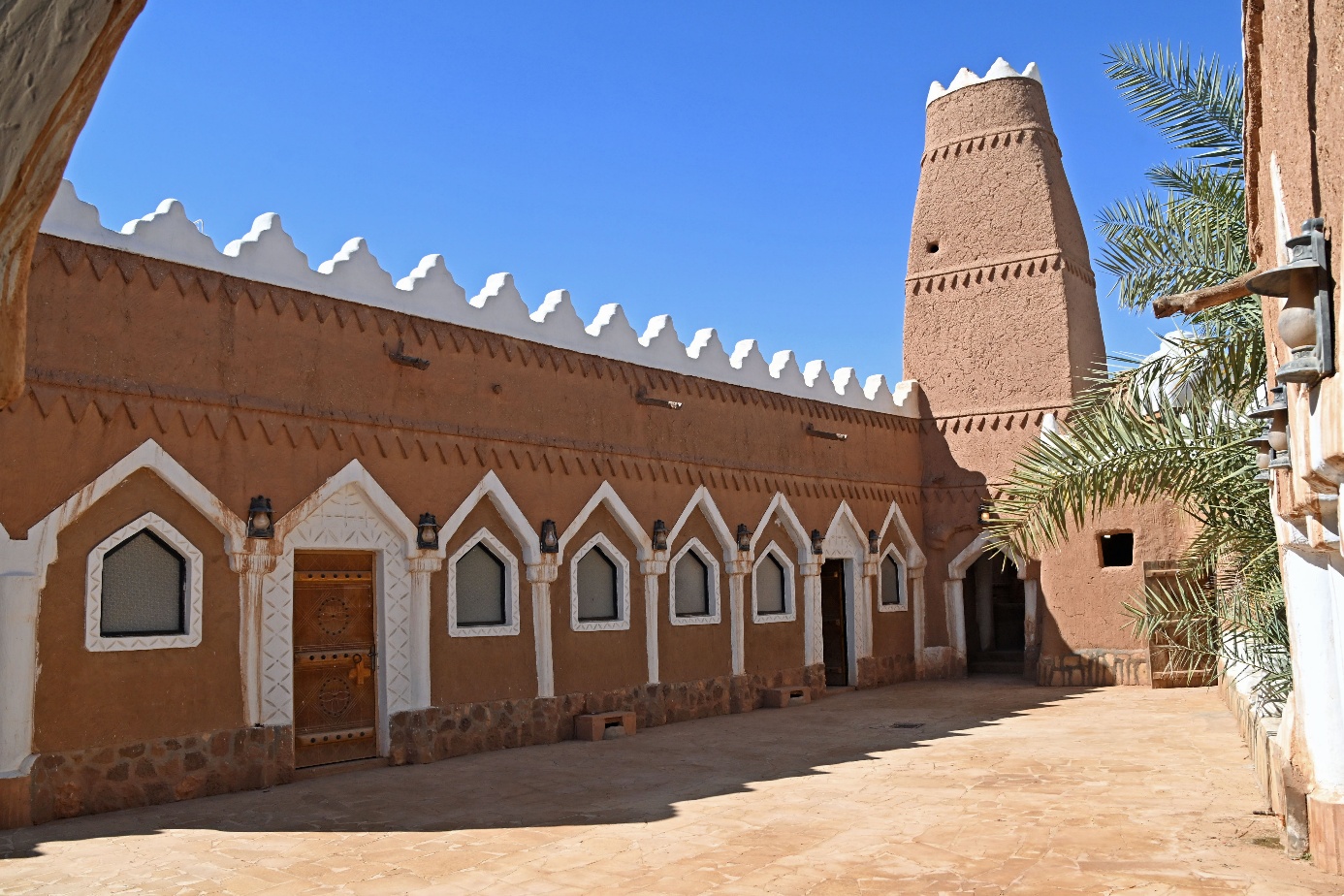
Al Mufailaqiya Mosque
The Al Mufailaqiya Mosque has also been restored. It is an elegant building which, in its austere simplicity, reflects the puritanical character of Wahhabism. You will search in vain for lavish ornamentation here, as such embellishments could only distract the faithful from their focus on prayer.
Wahhabis adhere to a very strict, literal interpretation of the Qur’an and the Sunna, the rules based on the life of the Prophet. They vigorously reject any deviation from this strict doctrine, such as Shiism, Sufism or liberal Sunni Islam. The separation of men and women, dress codes, dietary rules, prayer regulations and economic prescriptions are strictly observed. Any form of glorification of individuals, including taking photographs of people, is forbidden. Even celebrating a birthday or participating in democratic institutions is regarded as un-Islamic.
Even celebrating a birthday or participating in democratic institutions is regarded as un-Islamic
Wahhabis therefore prefer to call themselves Salafis, a term referring to the forebears. The term Wahhabism, after all, refers to Muhammad ibn Abd al-Wahhab, the founder of the movement. And that smacks of a cult of personality, something the Prophet himself wanted absolutely nothing to do with.
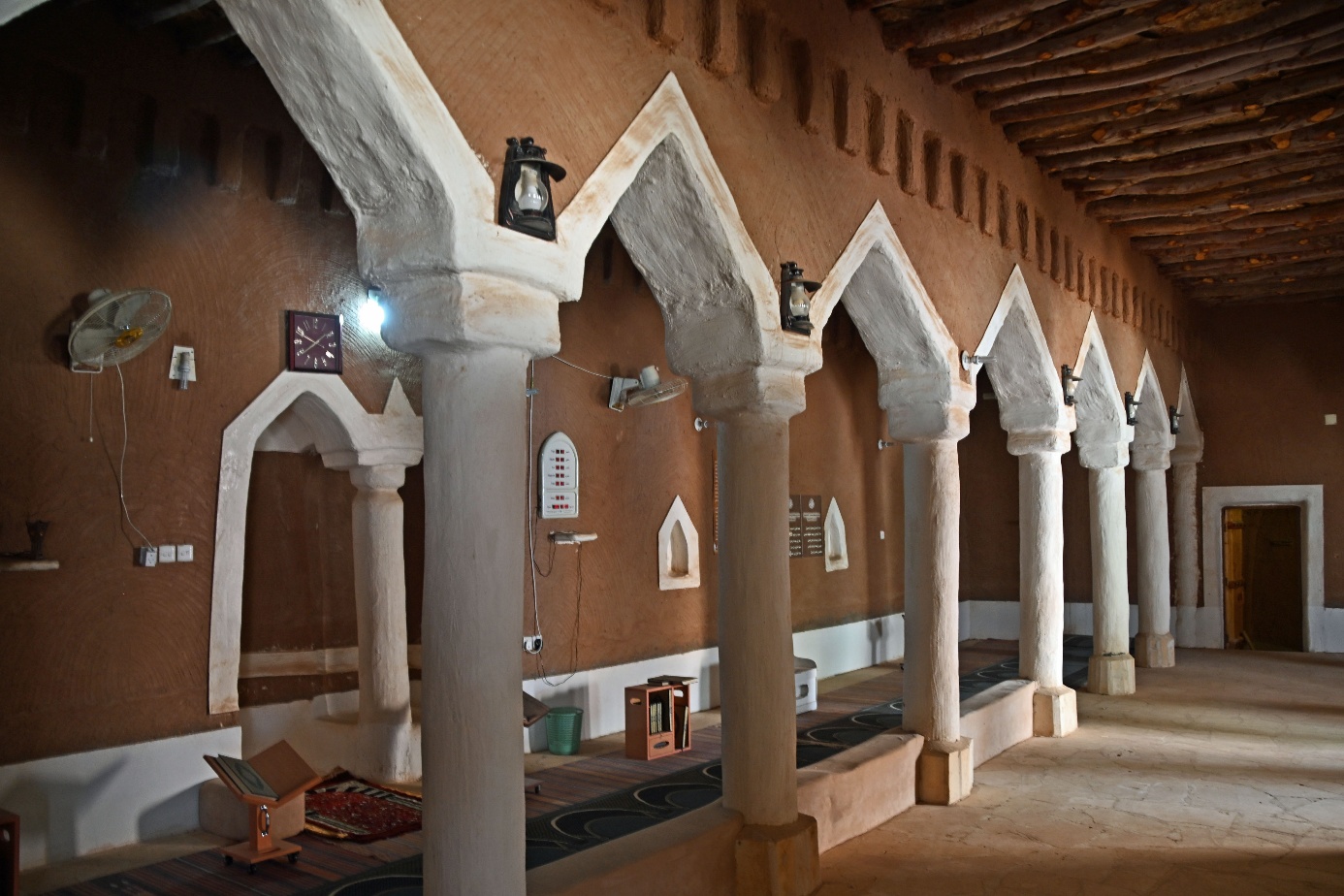
Ground-floor prayer hall
Naturally, the typical Najdi architecture is also prominent in the mosque – ochre-brown mud-brick walls, a roof made of tamarisk wood and palm leaves, triangular elements in the windows and on the façades, and white crenellations standing out sharply against the blue sky. You will never see a dome on mosques of this kind.
The minaret is particularly striking. Not a cylindrical structure pointing skywards like a pencil, but a broad, squat tower, four storeys high, topped by a platform edged with white crenellations.
We recognise the same elements in the misbah, the mosque’s ground-floor prayer hall, where the mihrab, the prayer niche, is decorated with plaster floral motifs. Spanning a large space is not possible with traditional structural elements; hence, two rows of pillars are required to support the roof.
The khalwa, the underground prayer hall, was used during the winter months
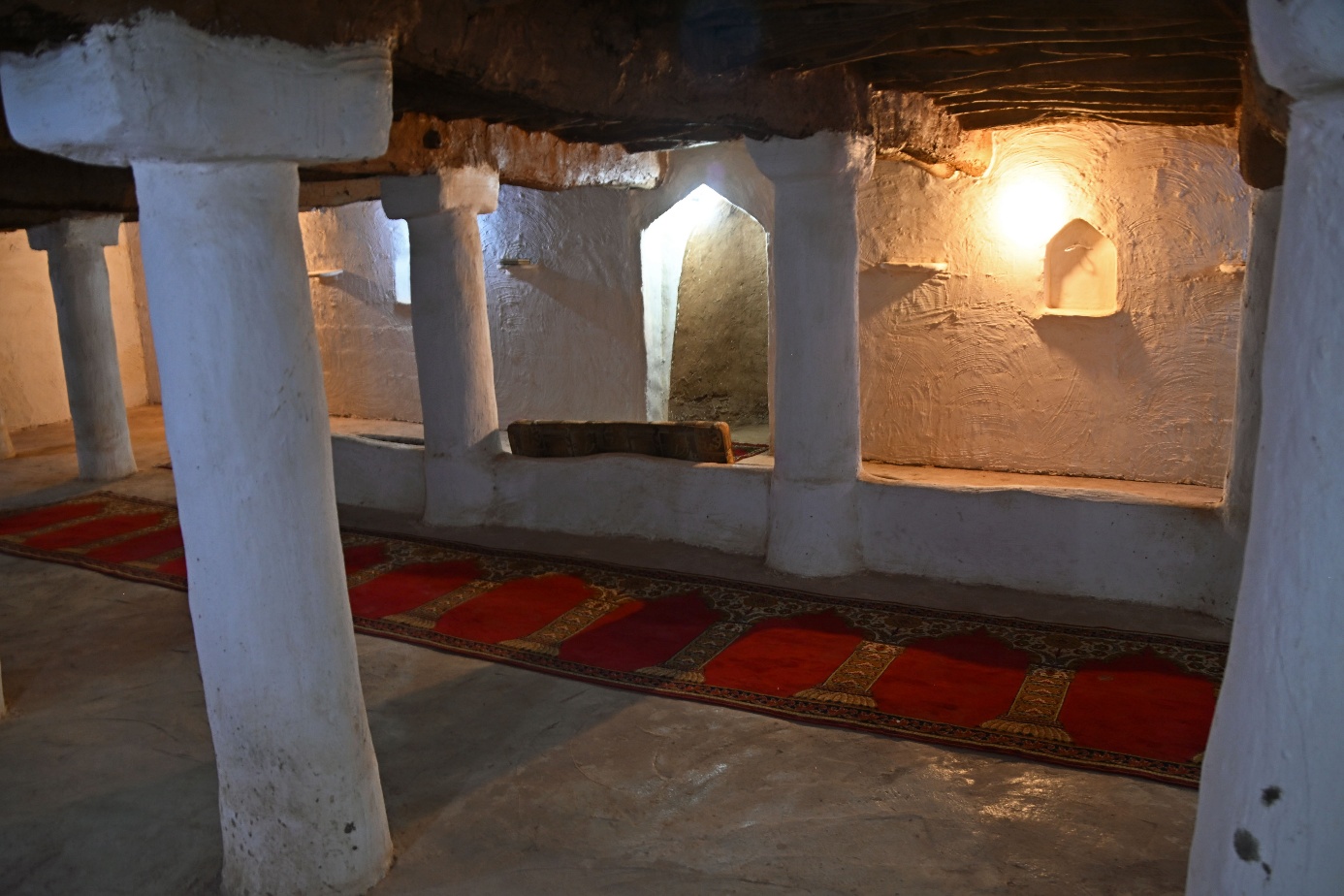
Khalwa (underground prayer hall)
The khalwa is new to us: a basement room that can also serve as a prayer hall. Apparently, it was used during the winter months. It is roughly the same size as the prayer hall above ground, with two rows of pillars providing support. The bare, whitewashed walls show no trace of decoration.
Madrasa
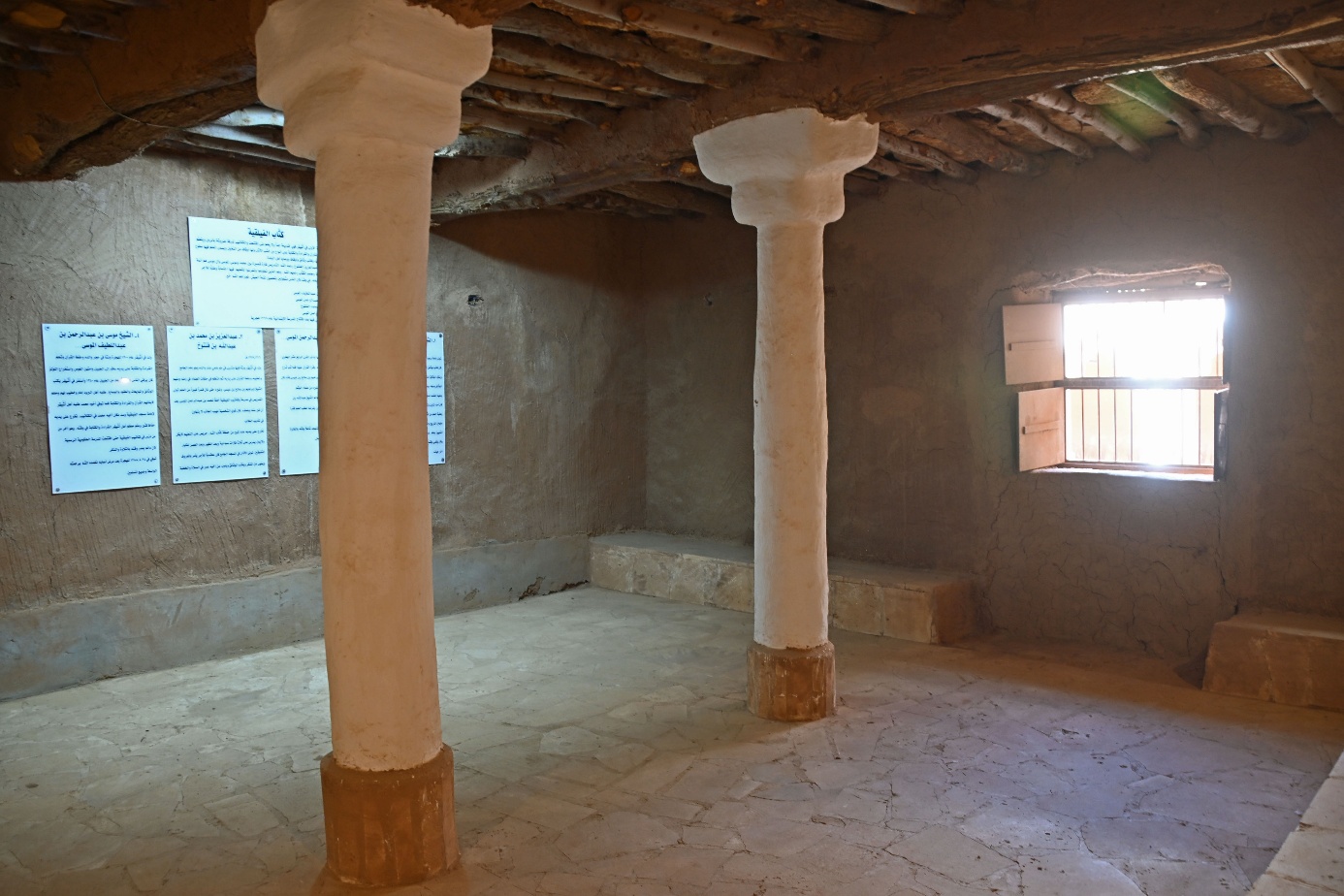
Immediately beside the mosque is a madrasa, a rather Spartan room with two white pillars and a U-shaped bench along the wall, where teaching took place. For generations, this mosque served as an important centre of education. But it also played a crucial role in the town’s social fabric, for mosques often provided support for the less fortunate.
Ceiling of the madrasa |
|
|
On our way to the bus, we are intercepted by Ibrahim. With some insistence, he invites us to visit his Hamal Al Salim Heritage Museum. We immediately blunder by failing to take off our shoes before shuffling across the carpets. It does not stop Ibrahim from calmly launching into his fascinating explanations, delivered in fluent English.
With some insistence, Ibrahim invites us to visit ‘his’ Hamal Al Salim Heritage Museum
Hamal Al Salim Heritage Museum |
|
Molds for making adobe bricks |
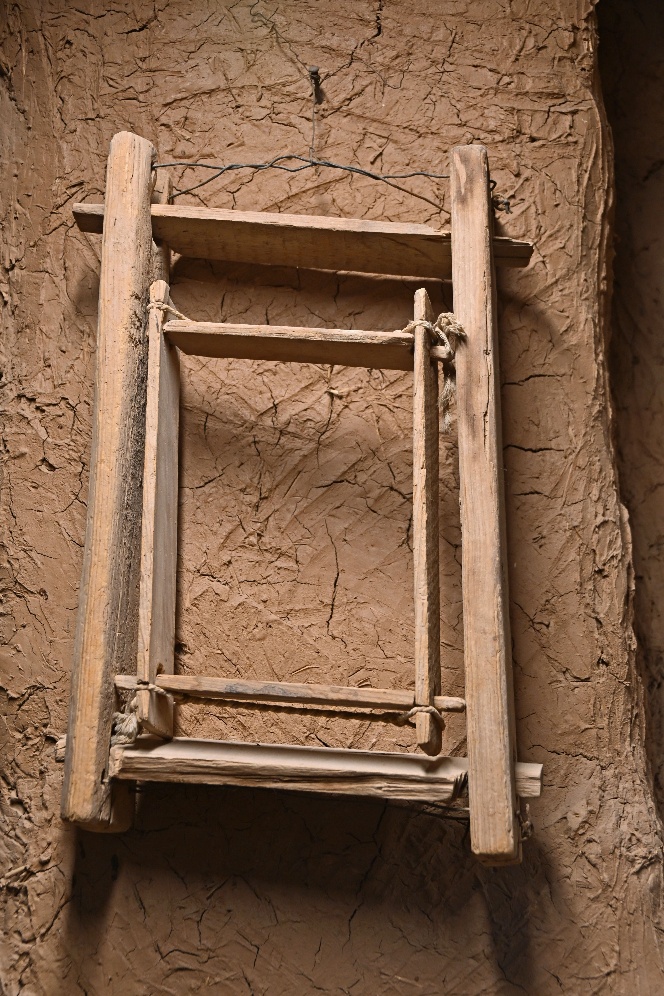
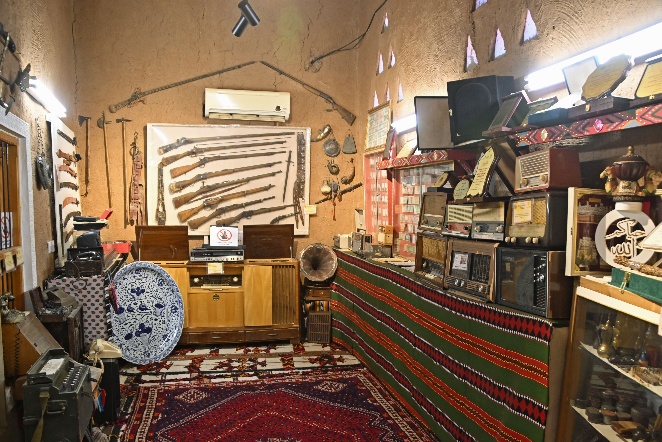
What has been brought together here, in a handful of relatively small rooms, is a curious and intriguing amalgamation. If we had to name the theme that inspired the curators when collecting these artefacts, there is really only one concept that qualifies – Anything goes. A cassette recorder sits next to a pumpkin gourd, a model of a 1948 Ford F1 pickup truck next to a traditional date press, a fossilised lizard next to a revolver.
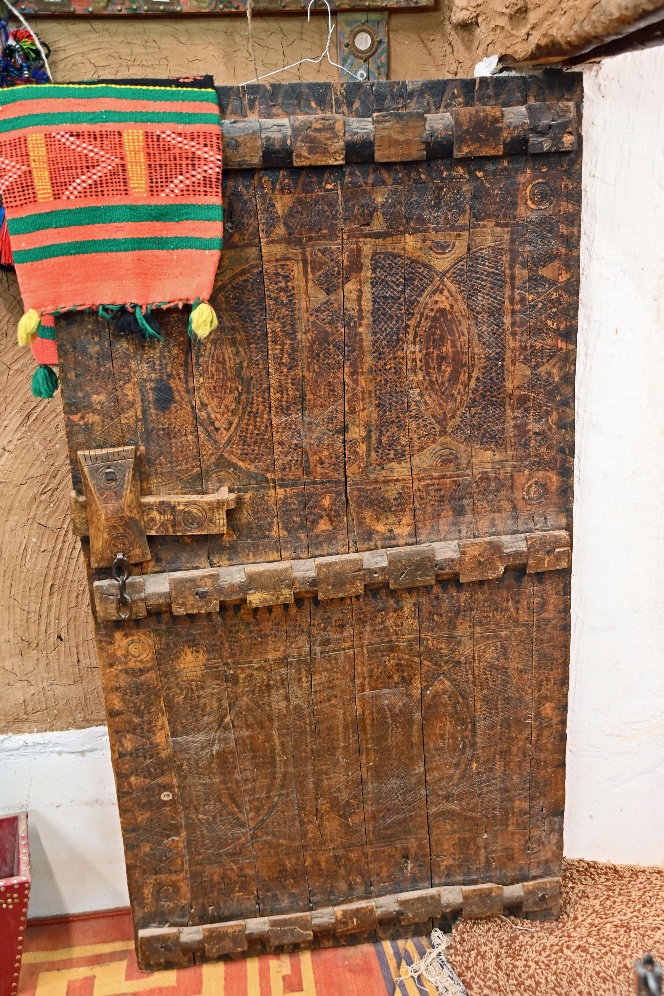
Hanging on the wall is an impressive arsenal of Ottoman weapons, alongside complete panels from richly painted, full-height doors and the harness used by horses to haul buckets of water from a well. Elsewhere, we find a sedan chair for a woman making the pilgrimage to Mecca, a jack for cars that have broken down, a camel-skin water container, a collection box for the poor and an antique telegraph machine. Old coins and hefty wooden door keys are available in abundance.
What has been brought together in the museum's relatively small rooms is a curious, intriguing amalgam
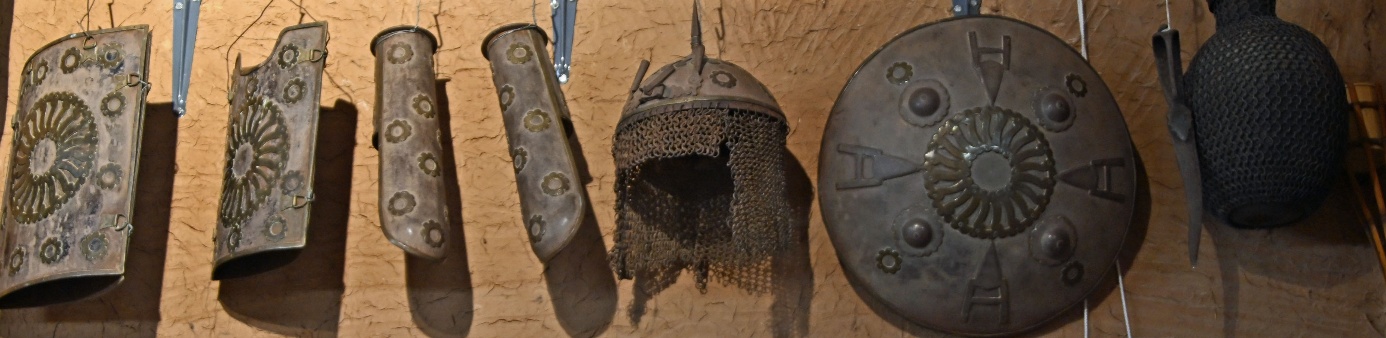
Ottoman weapons
|
|
|
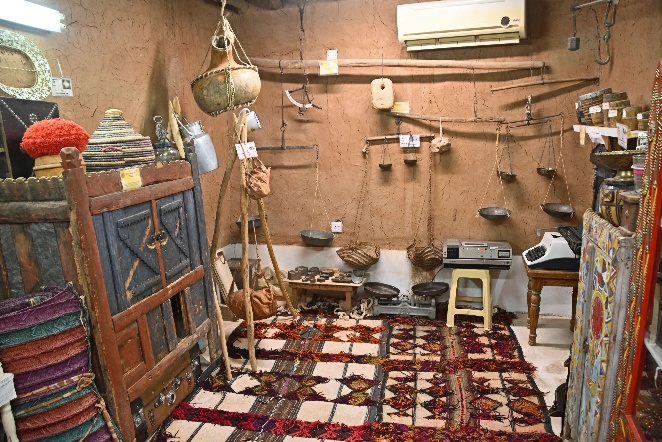
Ibrahim is particularly proud of an elaborate wooden cabinet. One of its little doors is not closed, but we cannot work out the trick for opening it. We are completely astonished by the antique abaya he shows us. The black fabric is designed to wrap the woman up completely; you cannot even see her eyes. There are just two small holes for the thumbs, allowing her at least to grasp something.
Najd is renowned not only for its distinctive architecture, but also for the exceptional hospitality of its inhabitants. Ibrahim is no exception
Najd is renowned not only for its distinctive architecture, but also for the exceptional hospitality of its inhabitants. Ibrahim is no exception. It is not long before we are sitting together, enjoying a small cup of qahwa, Arabic coffee. And the delicious dates, of course.
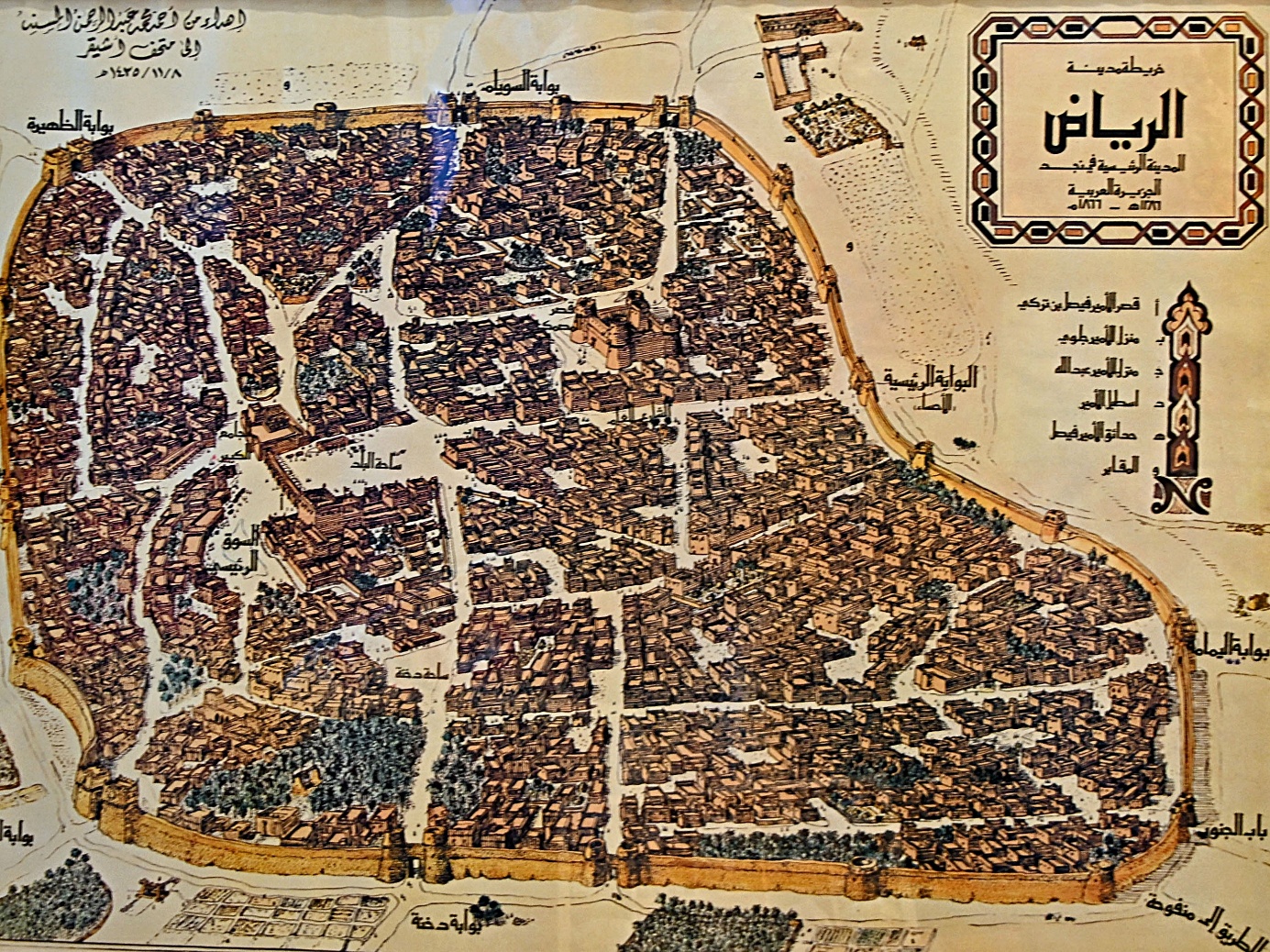
Riyadh anno 1866 (Hamal Al Salim Heritage Museum, Ushaiger)
One final drive of just over two hundred kilometres will now take us to Riyadh, the capital of the kingdom. Good lanes alternate with less good ones. Shortly after half past six, the spectacular skyline gradually comes into view through the window. Names such as McDonald’s, Burger King, Zara and Nike leave no room for doubt – just like everywhere else in the world, globalisation has firmly established itself here too.
Every now and then, we catch a glimpse of the Al Majdoul Tower, a skyscraper whose façades twist upwards in a slow spiral, like a gigantic strand of DNA
|
Riyadh anno 2026 – al Majdoul Tower |
|
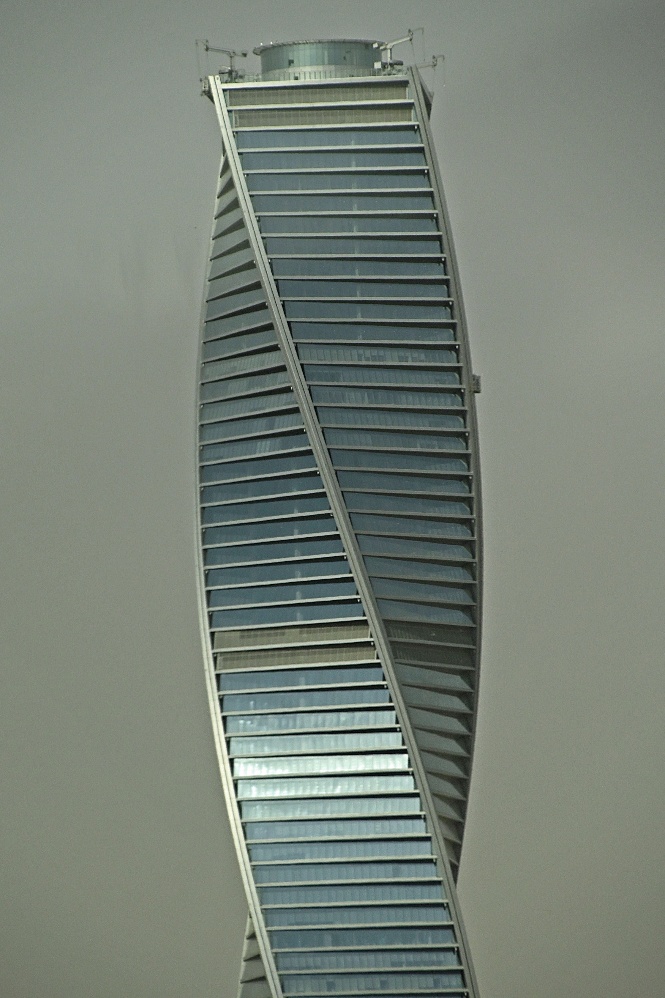
But of course, this city has much more in store. We will discover that over the next two days. Every now and then, we already catch a glimpse of it.
Take the Al Majdoul Tower, for instance: a fascinating blue-grey skyscraper whose façades twist upwards in a slow spiral, like a gigantic strand of DNA. Each floor is rotated by 2.5° in relation to the one below. Floor by floor, the rotation accumulates, until at the very top the building has turned through no less than 135° compared with the ground floor.
It takes nearly an hour to cross the city on the way to our hotel. Hardly surprising, given that the city of Riyadh covers an area of 1,973 km² (762 square miles) – 2.5 times the combined area of New York's five boroughs.
Jaak Palmans
© 2026 | Version 2026-10-07 14:00
Continue reading in (7/7)
Third time’s the charm
